Advertisement
Advertisement
May 2026
Sponsored by AngioDynamics, Inc.
Laser Atherectomy Versus Intravascular Lithotripsy for Calcified Femoropopliteal Disease
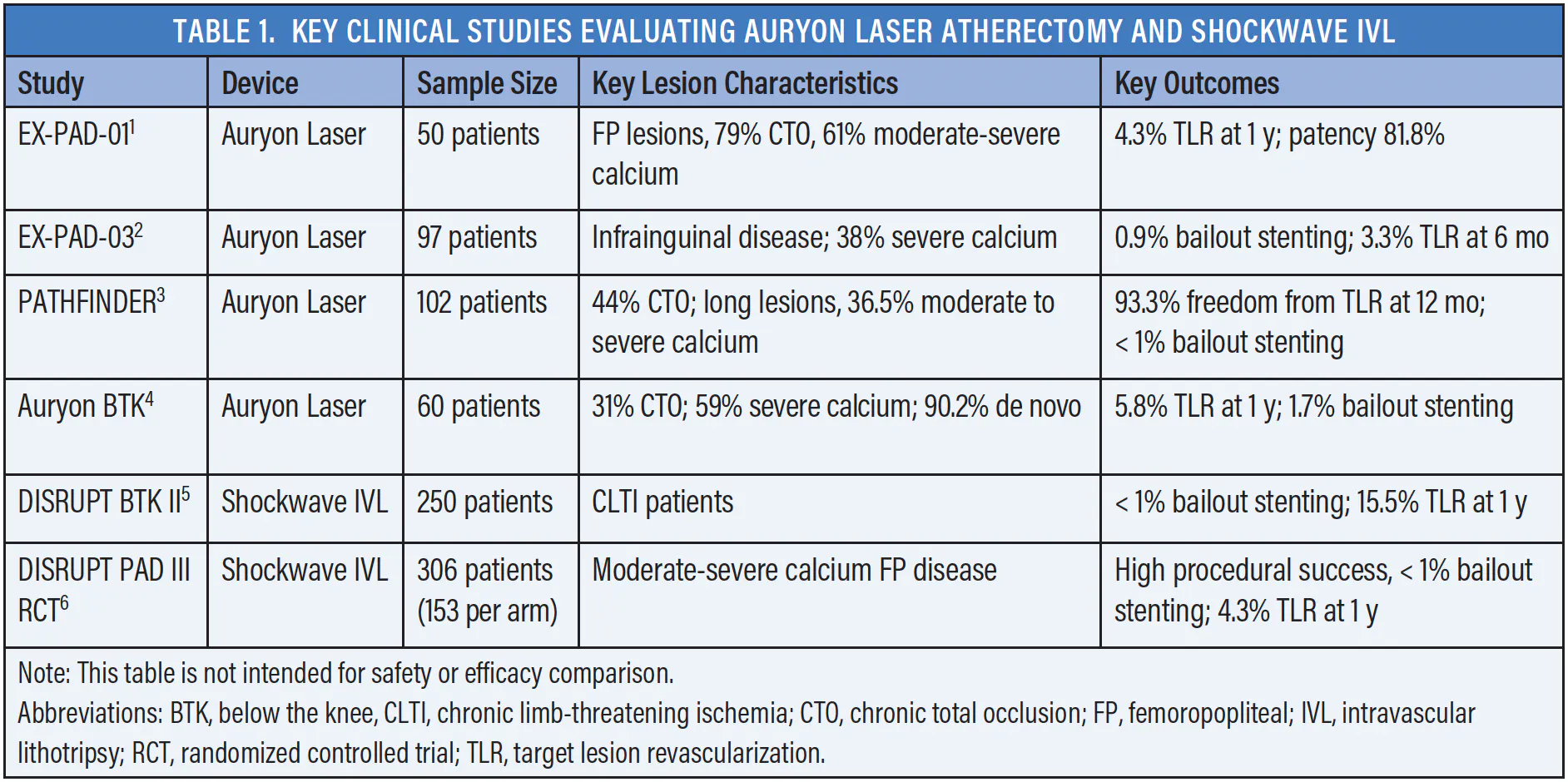
Calcified femoropopliteal arterial disease remains a major challenge in endovascular therapy. Vessel preparation technologies have emerged to improve outcomes prior to balloon angioplasty or drug-coated balloon therapy. Two commonly utilized approaches include laser atherectomy using the 355-nm Auryon Laser Atherectomy System (AngioDynamics, Inc.) and intravascular lithotripsy (IVL; Shockwave Medical). Laser atherectomy generates photomechanical forces and plasma formation that disrupt calcified plaque, whereas IVL produces pulsatile sonic pressure waves that fracture superficial and deep calcium. Clinical studies evaluating the Auryon system include the EX-PAD series and the PATHFINDER registry, while IVL has been evaluated in the DISRUPT PAD trials (Table 1).1-6 A comparative pilot analysis of calcified femoropopliteal lesions demonstrated greater immediate luminal expansion with IVL but greater luminal gain after adjunctive balloon angioplasty following laser atherectomy. Both modalities resulted in statistically similar residual narrowing at end of procedure and demonstrated excellent procedural safety. These technologies provide complementary mechanisms for vessel preparation in complex calcified peripheral artery disease (PAD).
Severe arterial calcification in femoropopliteal PAD is associated with procedural complications including recoil, dissection, and incomplete luminal expansion. Vessel preparation strategies have therefore become an essential component of modern endovascular therapy. Two technologies increasingly used for calcium modification include laser atherectomy and IVL. Each approach relies on different physical principles and produces distinct effects on calcified plaque.
MECHANISMS OF CALCIUM MODIFICATION
355-nm Laser Atherectomy (Auryon)
The Auryon Laser Atherectomy System utilizes ultraviolet photon energy at a wavelength of 355 nm, producing high-energy pulses with pulse durations of approximately 10 to 25 ns.7 The interaction of laser energy with blood and plaque produces cavitation bubbles, photomechanical shockwaves, and plasma formation that disrupt plaque and creates disruption of medial calcium, as shown by electron microscopy and pathologic evaluation of 355-nm laser-treated calcified cadaveric limbs.8 The Auryon laser appears to minimize damage to surrounding tissues, as demonstrated by intravascular ultrasound and the low need for bailout stenting.1-4,9,10
Intravascular Lithotripsy (Shockwave Medical)
IVL delivers pulsatile acoustic pressure waves through a balloon catheter inflated at low pressure. These sonic pulses fracture superficial and deep calcium while minimizing vessel trauma. The acoustic energy produces pressure waves equivalent to approximately 50 atm of dilating force. IVL also results in lower bailout stenting and dissections when compared to balloon angioplasty in patients with moderate to severe calcium.5,6
COMPARATIVE ANALYSIS OF THE AURYON SYSTEM AND SHOCKWAVE IVL
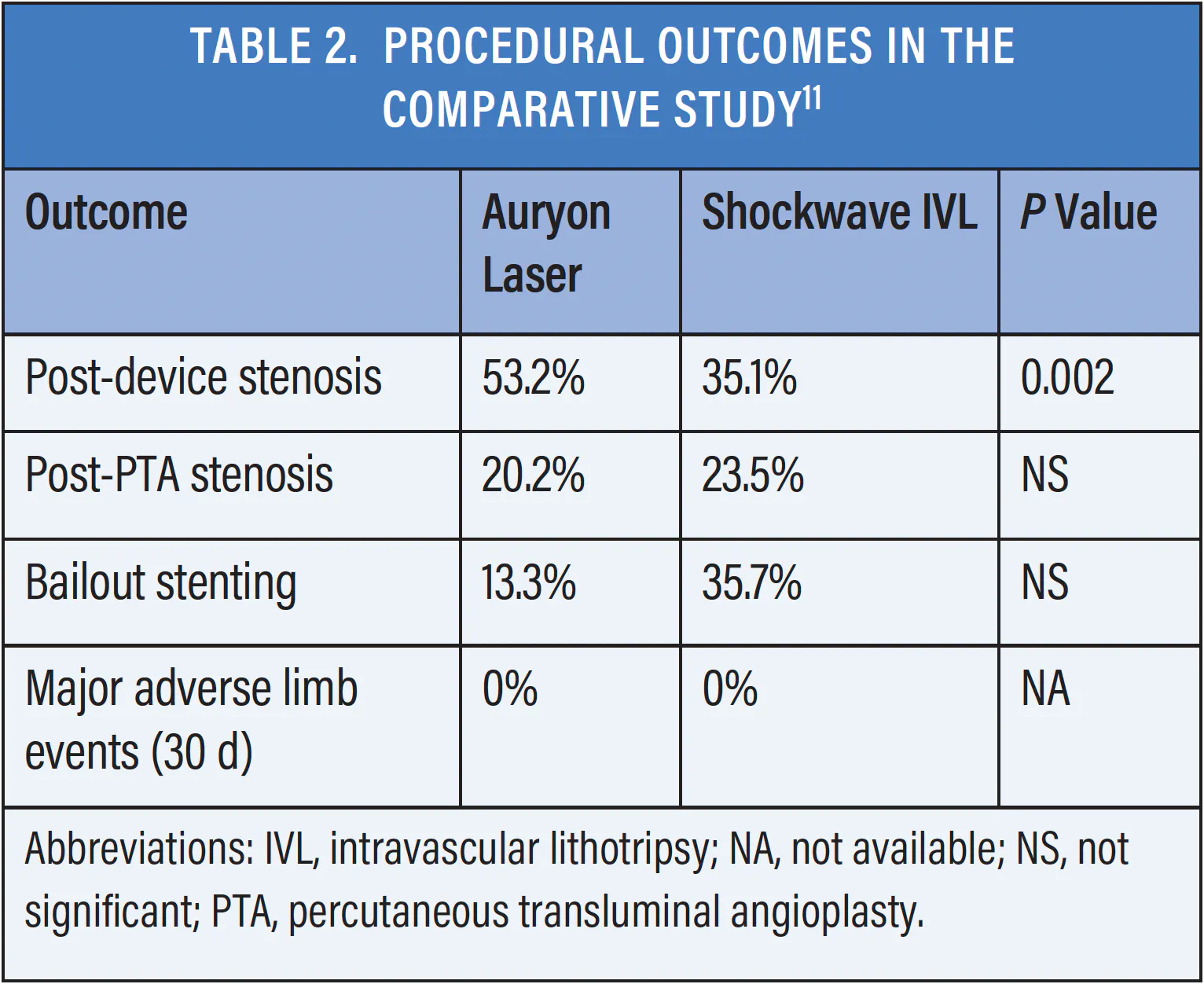
A retrospective pilot study of 30 patients evaluated the Auryon 355-nm laser (n = 15) and Shockwave IVL (n = 15) in calcified femoropopliteal lesions.11 Both devices were associated with excellent safety outcomes (Table 2). Shockwave IVL produced greater immediate luminal expansion after device deployment, while Auryon laser atherectomy demonstrated greater luminal gain after adjunctive balloon angioplasty. The final percent stenosis was similar in both devices. There were no major adverse limb events at 30 days for either device. Although not statistically significant, laser therapy demonstrated a numerically lower need for bailout stenting (13.3% vs 35.7%), consistent with a strategy of “leaving the least behind.” The bailout stent rate as defined by the protocol (type D dissection or > 30% residual narrowing) was driven by persistent residual narrowing of > 30% rather than severe type D dissections. This higher rate of stenting was likely due to the definition of bailout stenting (> 30% residual rather than > 50% residual narrowing) and operator preference.
CONCLUSION
Both the 355-nm Auryon laser and Shockwave IVL are effective vessel preparation strategies for calcified femoropopliteal disease. Both IVL and the 355-nm Auryon laser provide deep calcium fracture with similar final stenosis at end of procedure. These complementary technologies allow operators to tailor therapy according to lesion characteristics and procedural strategy. Although a statistically similar bailout stenting was seen between the Auryon laser and Shockwave IVL in calcified femoropopliteal disease, the numerically higher stent rate with Shockwave may warrant further evaluation in a randomized trial.
1. Kuczmik W, Oszkinis G, Kruszyna Ł, et al. Percutaneous photoacoustic debulking of infra-inguinal atherosclerotic disease- early European experience with a novel, solid-state, pulsed -wave, ultraviolet 355 nm laser. Lasers Med Sci. 2025;40:4. doi: 10.1007/s10103-024-04216-7
2. Shammas NW, Chandra P, Brodmann M, et al; EX-PAD-03 investigators. Acute and 30-day safety and effectiveness evaluation of Eximo Medical’s B-Laser™, a novel atherectomy device, in subjects affected with infrainguinal peripheral arterial disease: results of the EX-PAD-03 trial. Cardiovasc Revasc Med. 2020;21:86-92. doi: 10.1016/j.carrev.2018.11.022
3. Das TS, Shammas NW, Yoho JA, et al. Solid state, pulsed-wave 355 nm UV laser atherectomy debulking in the treatment of infrainguinal peripheral arterial disease: the PATHFINDER registry. Catheter Cardiovasc Interv. 2024;103:949-962. doi: 10.1002/ccd.31023
4. Shammas NW, Yates T, Sastry A, et al. Prospective, multi-center, single-arm study of the Auryon laser system for treatment of below-the-knee arteries in patients with chronic limb-threatening ischemia: 30-day results of the Auryon BTK. Am J Cardiol. 2024;219:1-8. doi: 10.1016/j.amjcard.2024.03.008
5. Chandra V, Lansky AJ, Sayfo S, et al. Thirty-day outcomes from the Disrupt PAD BTK II study of the Shockwave Intravascular Lithotripsy System for treatment of calcified below-the-knee peripheral arterial disease. J Vasc Surg. 2025;81:710-719.e2. doi: 10.1016/j.jvs.2024.11.003
6. Tepe, G, Brodmann, M, Werner M, et al. Intravascular lithotripsy for peripheral artery calcification: 30-day outcomes from the randomized Disrupt PAD III trial. J Am Coll Cardiol Interv. 2021;14:1352-1361. doi: 10.1016/j.jcin.2021.04.010
7. Herzog A, Bogdan S, Glikson M, et al. Selective tissue ablation using laser radiation at 355 nm in lead extraction by a hybrid catheter; a preliminary report. Lasers Surg Med. 2016;48:281-287. doi: 10.1002/lsm.22451
8. Rundback J, Kawai K, Sato Y, et al. Treatment effect of medial arterial calcification in below-knee after Auryon laser atherectomy using micro-CT and histologic evaluation. Cardiovasc Revasc Med. 2023;57:18-24. doi: 10.1016/j.carrev.2023.06.027
9. Shammas NW, Torey JT, Shammas WJ, et al. Intravascular ultrasound assessment and correlation with angiographic findings of arterial dissections following Auryon laser atherectomy and adjunctive balloon angioplasty: results of the iDissection Auryon laser study. J Endovasc Ther. 2022;29:23-31. doi: 10.1177/15266028211028200
10. Rundback J, Chandra P, Brodmann M, et al. Novel laser-based catheter for peripheral atherectomy: 6-month results from the Eximo Medical B-Laser™ IDE study. Catheter Cardiovasc Interv. 2019; 94:1010-1017. doi: 10.1002/ccd.28435
11. Shammas NW, Tannenbaum Y, Shammas WJ, et al. Shockwave lithoplasty versus 355-nm laser for vessel preparation in calcified femoropopliteal arterial disease: a single-center comparative study. Presented at: CRT 2026; March 8, 2026; Washington, DC.
AngioDynamics, the AngioDynamics logo, Auryon, the Auryon logo are trademarks and/or registered trademark of AngioDynamics, Inc., an affiliate or a subsidiary. © 2026 AngioDynamics, Inc.

Advertisement
Advertisement