Advertisement
Advertisement
The 2026 revision of the Current Procedural Terminology (CPT) codes for lower extremity revascularization introduces important changes that are intended to better align code selection with contemporary endovascular practice.1 In this article, I highlight several key updates and illustrate how I applied the revised codes to a case of chronic limb-threatening ischemia (CLTI) in the setting of multilevel occlusive peripheral artery disease (PAD).
OVERVIEW OF THE CHANGES
The 2026 lower extremity CPT restructure establishes a more clearly defined coding framework for lower extremity revascularization. The revised code set expands from 16 to 46 codes and classifies lesions as straightforward or complex based on occlusion status. The new code set also updates nonfacility (office-based lab) practice expense relative value units to incorporate the cost of drug-coated balloons (DCBs) for nearly all femoropopliteal procedures, so payment rates now reflect routine DCB use.
Code selection follows a stepwise hierarchy based on the highest-intensity intervention performed in a treated vessel (percutaneous transluminal angioplasty, stent placement, atherectomy, or combinations thereof) and on whether one or multiple vessels are treated within a given territory. For each territory, one primary code is reported, with add-on codes used when applicable to describe additional treated vessels. The 2026 framework specifies how vessels are defined within each territory, both how many distinct vessels exist in each territory and which arteries or segments belong to each vessel. These definitions govern whether multiple treated lesions are coded as one vessel or as separate vessels, warranting add-on codes.
These 2026 CPT code changes affect both physician and facility reporting alike, including physician practices, hospital outpatient departments, and ambulatory surgery centers. All providers will need to update charge capture tools, code references, and local policies, and also ensure that documentation workflows reliably collect the data elements required under the new definitions. In particular, accurate assignment of straightforward versus complex lesion codes depends on describing lesion type (stenosis vs occlusion), specific vessel and segment, percentage stenosis when relevant, and the therapeutic approach applied to each treated site. Procedure notes should explicitly name each vessel and location treated, summarize the diagnostic angiographic findings, and clearly link those findings to the interventions performed so that coding is both accurate and reproducible. The following case demonstrates these principles in a real-world intervention.
CASE EXAMPLE
Patient Presentation
A man in his late 60s with hypertension, diabetes mellitus, dyslipidemia, and history of hepatitis C who is a current smoker presented with a 6-month history of left fourth- and fifth-toe gangrene, consistent with Rutherford 6 CLTI and multilevel occlusive lower extremity PAD. Left lower extremity resting ankle-brachial indexes were 0.6 in the left dorsalis pedis and 0.3 in the left posterior tibial distributions. The patient underwent bilateral lower extremity angiography that confirmed a short total occlusion of the distal left superficial femoral artery (SFA) (Figure 1A) as well as total occlusions of the entire left tibioperoneal trunk (TPT) and origin-to-distal left peroneal arteries (Figure 1B). The left anterior tibial artery was patent. The dorsalis pedis artery was occluded. Distal outflow was further complicated by variant anatomy, including a congenitally absent posterior tibial artery and a plantar arch supplied by the dominant but occluded left peroneal artery. The goal of revascularization was to restore inline flow to the lateral plantar artery distribution.
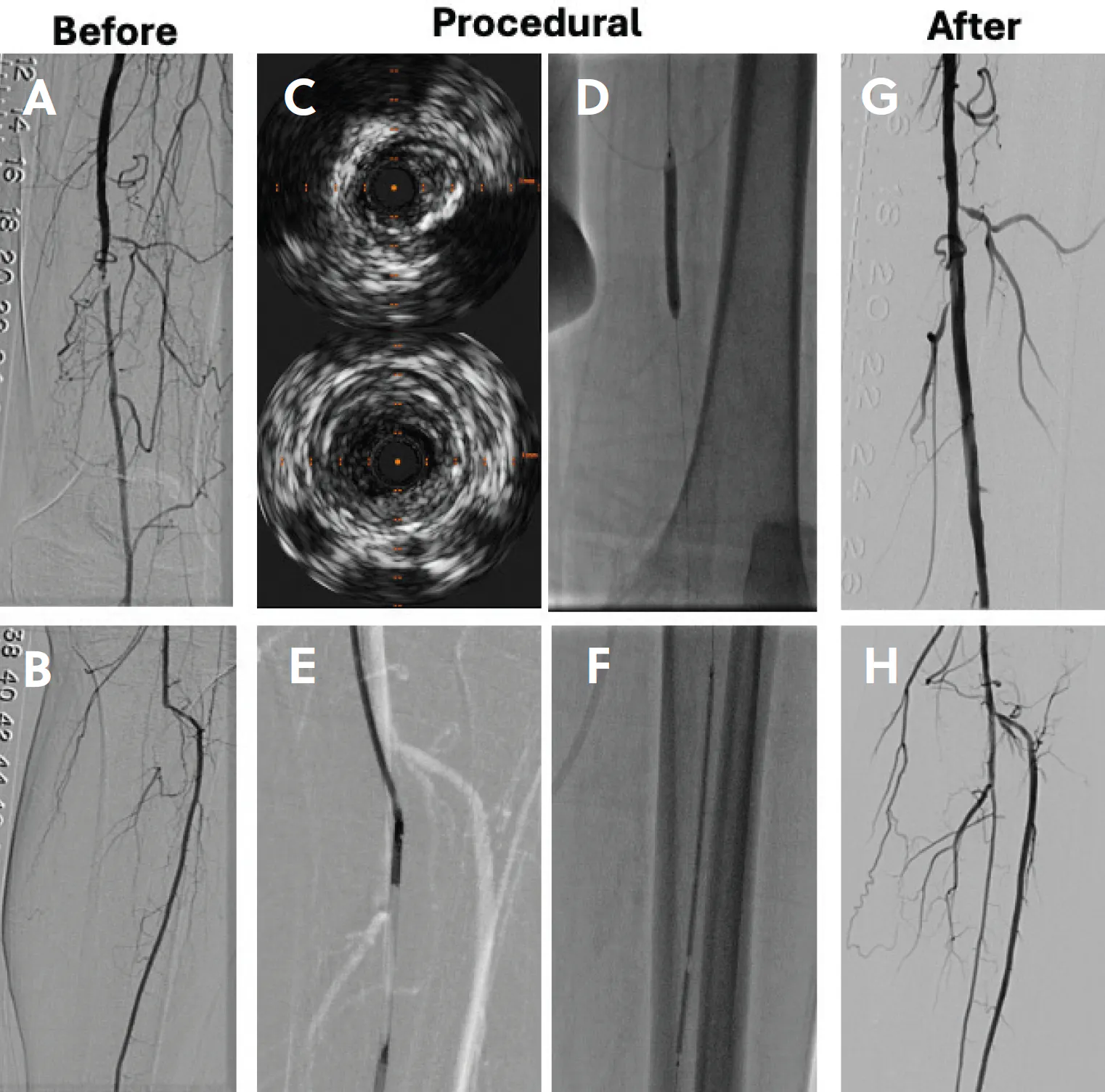
Figure 1. Pretreatment angiograms: Left SFA short total occlusion (A); left TPT, proximal-to-distal peroneal total occlusions and patent anterior tibial and atretic posterior tibial arteries (B). Procedural angiograms: IVUS images, with the bottom IVUS image showing the SFA occlusion (C); SFA occlusion treated with HawkOne™ directional atherectomy system (not shown) followed by IN.PACT™ Admiral™ drug-coated balloon (DCB) (D); TPT occlusion treated with HawkOne directional atherectomy system (E); TPT and peroneal artery treated with plain balloon angioplasty (F). Final angiograms: Left SFA (G); TPT and peroneal arteries (H).
Procedural Overview
After crossing all three occlusions with a guidewire and support catheter, intravascular ultrasound (IVUS) (Figure 1C) showed predominantly noncalcified lesions with reference vessel diameters of 5.5 mm in the SFA, 3.5 mm in the TPT, and approximately 2.2 mm in the peroneal artery. The SFA lesion was treated with the HawkOne™ directional atherectomy system (Medtronic), followed by DCB angioplasty (IN.PACT™ Admiral™ DCB, 5.0 X 40 mm; Medtronic) (Figure 1D); the TPT was treated with the HawkOne directional atherectomy system (Figure 1E) and plain balloon angioplasty; and the peroneal artery was treated with plain balloon angioplasty (Figure 1F).
Final angiography demonstrated marked improvements in perfusion, with all lesions treated to < 10% residual stenoses (Figure 1G and 1H). Two-vessel inline flow was restored, with widely patent medial and lateral plantar arteries in the foot.
Patient Outcome
Overall, this case illustrates successful multilevel endovascular revascularization for Rutherford class 6 CLTI in the presence of challenging anatomy, with restoration of inline flow to support prompt wound healing and limb preservation.
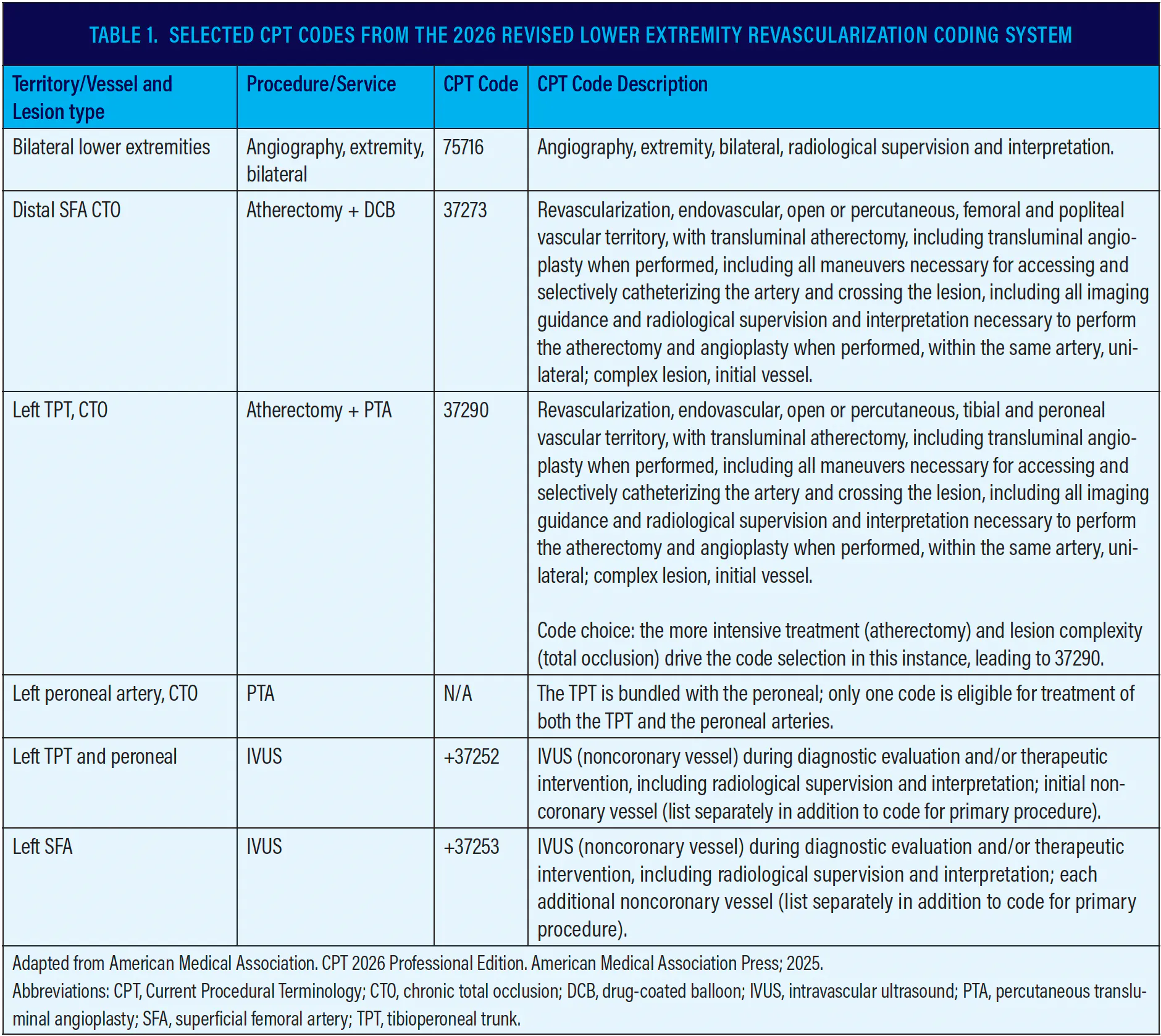
The CPT codes used for this case under the newly restructured lower extremity revascularization coding system are shown in Table 1.
CONCLUSION
Accurate coding depends on clear documentation of the treated vessel, lesion characteristics, and therapies performed, as incomplete or incorrect documentation increases the risk of downcoding, claim denial, or rework. The 2026 CPT update more closely aligns with contemporary practice through refined territory definitions, a structured procedural hierarchy, and lesion/disease severity.
1. American Medical Association. CPT 2026 Professional Edition. American Medical Association Press; 2025.

HawkOne™ directional atherectomy system
Reference Statement
Indications for Use: The HawkOne™ directional atherectomy system is intended for use in atherectomy of the peripheral vasculature. The HawkOne™ catheter is indicated for use in conjunction with the SpiderFX™ embolic protection device in the treatment of severely calcified lesions. The HawkOne™ catheter is NOT intended for use in the coronary, carotid, iliac, or renal vasculature.
Contraindications: Do not use in the coronary arteries, carotid artery, or in the iliac, or renal vasculature. Do not use for in-stent restenosis at the peripheral vascular site.
Potential Adverse Events: The potential complications include, but are not limited to the following: Amputation, aneurysm, arterial dissection, arterial perforation, arterial rupture, arterial spasm, arteriovenous fistula, bleeding complications, death, embolism or arterial thrombosis, emergency or non-emergency arterial bypass surgery, entry site complications, hypotension, infection, ischemia, restenosis of the treated segment, total occlusion of the peripheral artery, and vascular complications that could require surgical repair.
CAUTION: Federal (USA) law restricts this device to sale by or on the order of a physician.
Important information: Indications, contraindications, warnings and instructions for use can be found in the product labeling supplied with each device, at www.medtronic.com/manuals or contact a Medtronic representative.
IN.PACT™ Admiral™ Paclitaxel-coated PTA Catheter
Brief Statement (2026.04.16)
Indications for Use: The IN.PACT Admiral™ paclitaxel-coated PTA balloon catheter is indicated for percutaneous transluminal angioplasty, after appropriate vessel preparation, of de novo, restenotic, or in-stent restenotic lesions with lengths up to 360 mm in superficial femoral or popliteal arteries with reference vessel diameters of 4-7 mm.
Contraindications
- The IN.PACT Admiral™ DCB is contraindicated for use in:
- Coronary arteries, renal arteries, and supra-aortic/cerebrovascular arteries
- Patients who cannot receive recommended antiplatelet and/or anticoagulant therapy
- Patients judged to have a lesion that prevents complete inflation of an angioplasty balloon or proper placement of the delivery system
- Patients with known allergies or sensitivities to paclitaxel
- Women who are breastfeeding, pregnant, or are intending to become pregnant, or men intending to father children. It is unknown whether paclitaxel will be excreted in human milk and whether there is a potential for adverse reaction in nursing infants from paclitaxel exposure.
Warnings
- Do not use air or any gaseous medium to inflate the balloon. Use only the recommended inflation medium (equal parts contrast medium and saline solution).
- Do not move the guidewire during inflation of the IN.PACT Admiral™ DCB.
- Do not exceed the rated burst pressure (RBP). The RBP is 14 atm (1419 kPa) for all balloons except the 200 and 250 mm balloons. For the 200 and 250 mm balloons the RBP is 11 atm (1115kPa). The RBP is based on the results of in vitro testing. Use of pressures higher than RBP may result in a ruptured balloon with possible intimal damage and dissection.
- The safety and effectiveness of using multiple IN.PACT Admiral™ DCBs with a total drug dosage exceeding 34,854 μg of paclitaxel in a patient has not been clinically evaluated.
Precautions
- Assess risks and benefits before treating patients with a history of severe reaction to contrast agents.
- Administer appropriate drug therapy to the patient according to standard protocols for PTA before insertion of the dilatation catheter.
- Take precautions to prevent or reduce clotting when any catheter is used. Flush and rinse all products entering the vascular system with heparinized normal saline or a similar solution. For the IN.PACT Admiral™ DCB catheter, flush the guidewire lumen through the guidewire port with heparinized normal saline until the fluid exits the distal tip. Do not rinse or wipe the IN.PACT Admiral™ DCB catheter.
- Identify allergic reactions to contrast media and antiplatelet therapy before treatment and consider alternatives for appropriate management prior to the procedure.
- Handle the product with caution to avoid any damage to the balloon coating or folded balloon
- This product is not intended for the expansion or delivery of a stent.
- Do not expose the product to organic solvents such as alcohol.
- To reduce the potential for vessel damage, the inflated diameter of the balloon should approximately match the diameter of the vessel just distal to the lesion.
Potential Adverse Events: The potential adverse events associated with use of the device include but are not limited to: Abrupt vessel closure, access site pain, allergic reaction to contrast medium, antiplatelet therapy, or catheter system components (materials, drugs, and excipients), amputation/loss of limb, arrhythmias, arterial aneurysm, arterial thrombosis, arteriovenous (AV) fistula, death, dissection, embolization, fever, hematoma, hemorrhage, hypotension/hypertension, inflammation, ischemia or infarction of tissue/organ, local infection at access site, local or distal embolic events, perforation or rupture of the artery, pseudoaneurysm, renal insufficiency or failure, restenosis of the dilated artery, sepsis or systemic infection, shock, stroke, systemic embolization, vessel spasms or recoil, and vessel trauma which requires surgical repair.
Potential adverse events not captured above that may be unique to the paclitaxel drug coating include, but are not limited to: allergic/immunologic reaction, alopecia, anemia, gastrointestinal symptoms, hematologic dyscrasia (including leucopenia, neutropenia, thrombocytopenia), hepatic enzyme changes, histologic changes in vessel wall, including inflammation, cellular damage, or necrosis, myalgia/arthralgia, myelosuppression, and peripheral neuropathy. Refer to the Physician’s Desk Reference for more information on the potential adverse effects observed with paclitaxel.
CAUTION: Federal (USA) law restricts this device to sale by or on the order of a physician.
Important information: Indications, contraindications, warnings and instructions for use can be found in the product labeling supplied with each device, at www.medtronic.com/manuals or contact a Medtronic representative.
501971 ©2026 Medtronic. Medtronic, Medtronic logo are trademarks of Medtronic.
All other brands are trademarks of Medtronic. For global distribution. 05/2026
Advertisement
Advertisement