Advertisement
Advertisement
December 13, 2021
DISFORM Classification System Developed for Angioplasty-Induced Femoropopliteal Dissection
December 13, 2021—Based on a three-round, questionnaire-based process using the Delphi consensus methodology, Voûte et al describe the newly proposed DISFORM classification system for angioplasty-induced femoropopliteal dissection. The consensus study was published in JACC: Cardiovascular Interventions.
Key Findings
- Of a list of eight features, four were chosen by expert consensus for the model: diameter reduction ≥ 50%, length ≥ 2 cm, number of dissections (single vs multiple), and presence of spiral shape.
- Scaffolding was recommended if the diameter reduction was ≥ 50% (100% of panelists), the dissection had a spiral shape (73%-100%), had severe flow reduction (FLIPI grade 2 or 3; 93%-100%), or if there were multiple dissections and they were ≥ 2 cm (65%-100%).
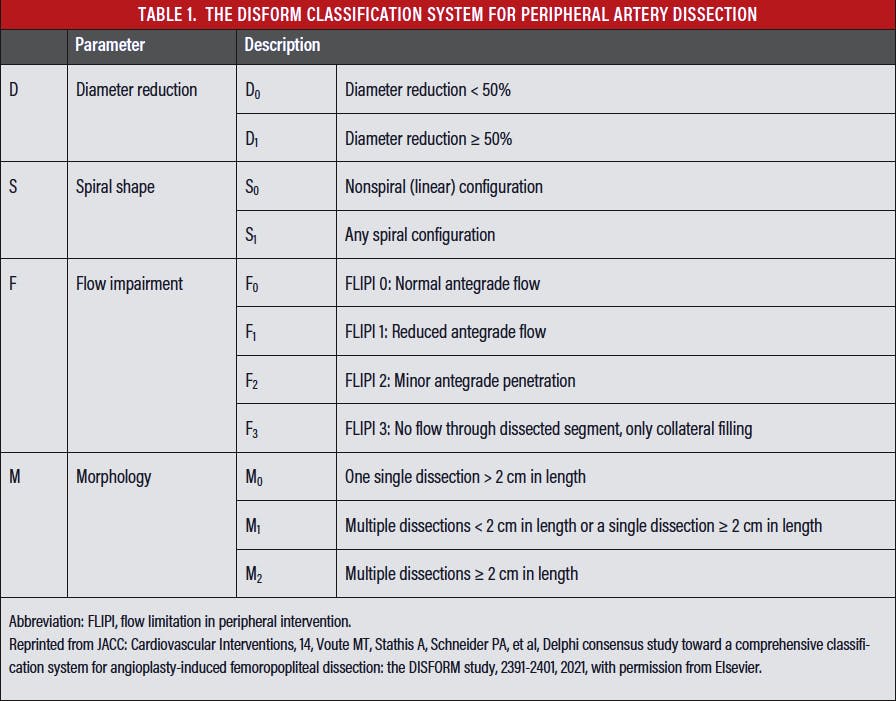
- The new classification system is named DISFORM (diameter reduction [D], spiral shape [S], flow impairment [F], morphology [M]), and with features noted as DXSXFXMX (Table 1).
The study aimed to achieve expert consensus in identifying clinical features of peripheral artery dissection and subsequently develop a comprehensive angiographic classification system.
Questionnaires were distributed via online software and/or email between April 2020 and January 2021. The panel consisted of equal proportions of vascular surgeons, interventional cardiologists, and interventional radiologists and a smaller sample of vascular medicine specialists from multiple regions.
In the first round, a committee (2 vascular surgeons, 2 cardiologists) listed potential features of angioplasty-induced dissection of the femoral and popliteal arteries that may predict adverse clinical outcomes, defined as acute target lesion failure within 24 hours or early restenosis at < 6 months.
In round 2, the Delphi panel was presented with those features listed in round 1 and asked to score them for their predictive value toward the adverse outcomes, with a score of 1 representing no predictive value and 9 the strongest predictive value. A mean score of ≥ 6 was deemed significant panel consensus, with at least 70% of scores within a 3-point bandwidth. The most predictive features and preferred methods for determining morphology and flow impairment were used in round 3.
In round 3, all possible combinations of factors determined in round 2 were presented as a graphical illustration and an angiographic image (when available). Panelists were asked a single question: “Would you treat this dissection with an additional scaffold (eg, tack or stent placement)? Possible answers were, “No, I would leave it,” “Yes, I would scaffold,” and “I believe this scenario does not exist in real life.” A consensus of > 80% was considered an absolute recommendation to use a scaffold, and > 50% to 80% was considered a moderate recommendation. Conversely, > 20% to 50% was considered a moderate recommendation not to use a scaffold, and ≤ 20% was consensus not to scaffold.
Each round had a 100% response rate. Eight features were chosen by the executive committee in round 1: (1) reduction in luminal diameter, (2) dissected artery length, (3) multiplicity of dissections, (4) contrast extravasation, (5) spiral shape, (6) double lumen lucency, (7) degree of flow, and (8) translesional pressure gradient. In addition, three methods of measuring flow impairment were suggested: (1) comparing flow through the dissected target artery to flow in the profunda femoris collateral vessels (same angiogram), (2) measuring the time for contrast filling and washout, and (3) using a flow grading system model modified from the thrombolysis in myocardial infarction (TIMI) flow grading system, which was redefined for the peripheral arteries as the flow limitation in peripheral intervention (FLIPI) grading system.
In round 2, the panel considered diameter reduction ≥ 50%, flow impairment, and spiral shape predictive of acute failure. For early restenosis, the same three factors plus length ≥ 2 cm, translesional pressure reduction, and multiple dissections were considered predictive. Most (53%) of the panel preferred the FLIPI method for assessing flow impairment, and there was consensus that real-time cine angiography was the best modality. For translesional pressure gradient, there was no consensus on what signified a pressure drop; thus, this was excluded from the classification system.
For round 3, of the eight features originally listed, diameter reduction ≥ 50%, length ≥ 2 cm, number of dissections, and spiral shape were chosen for the model. Scaffolding was recommended if the diameter reduction was ≥ 50% (100% of panelists), the dissection had a spiral shape (73%-100%), had severe flow reduction (FLIPI grade 2 or 3; 93%-100%), or if there were multiple dissections ≥ 2 cm (65%-100%).
The final classification system, termed DISFORM, incorporates the features identified in the consensus study (diameter reduction [D], spiral shape [S], flow impairment [F], morphology [M]) and is designed as a descriptive tool to facilitate discussion around treatment options and prognosis. Morphologic and pathophysiologic features are reported as DXSXFXMX (Table 1). Four DISFORM dissection types (I-IV) are then defined based on severity, which is intended as a tool for grading in clinical trials, noted the investigators.
ENDOVASCULAR TODAY ASKS…
Investigator Ramon Varcoe, MBBS, PhD, with Prince of Wales Hospital in Sydney, Australia, was asked to elaborate on why establishing a new classification system is important to everyday practice.
What were the everyday clinical needs that prompted the panel to embark in developing a new dissection classification system? What makes the DISFORM system distinct from previous dissection classifications?
It is generally accepted that dissection following peripheral angioplasty can lead to poor outcomes such as acute technical failure and early restenosis. Now that we have additional tools to treat dissection, it is important that we have a common language to describe them and an understanding of which may require scaffolding. DISFORM is a classification system designed specifically for peripheral arteries by experts in the field of peripheral intervention. This is important because coronary dissection classification systems include features that have little relevance to peripheral arteries. Other peripheral artery classification systems rely on intravascular ultrasound or translesional pressure wires, which are useful adjunctive methods but not universally available. DISFORM is a dedicated, pathophysiologic peripheral artery dissection classification system that can be used in any facility that uses angiography.
What are the next steps to validate the DISFORM classification system?
The next steps are to perform studies that validate the expert opinion that has led to DISFORM. These could take the form of a prospective observational study to follow the natural history of those dissection features thought to predict a bad outcome. An alternative might be to retrospectively review the experience of centers known to avoid scaffolding for dissection that have well-structured follow-up protocols. I would also like to see DISFORM extended to include other arteries beyond the femoral and popliteal segments, to those below the knee, and potentially the dialysis access circuit.
Advertisement
Advertisement
Find more Literature Highlights.
Browse additional literature summaries, key findings, and investigator commentaries across the vascular interventional field.
Read More