Advertisement
Advertisement
November 16, 2023
Surmodics’ SurVeil DCB Evaluated in 36-Month Data From TRANSCEND
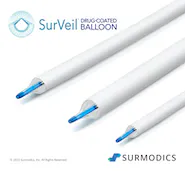 November 16, 2023—Surmodics, Inc. announced 36-month data from its TRANSCEND clinical trial. TRANSCEND is a prospective, multicenter, single-blind, randomized, controlled trial to assessing the safety and efficacy of the company’s SurVeil drug-coated balloon (DCB) versus the In.Pact Admiral DCB (Medtronic) for treatment of superficial femoral and proximal popliteal artery lesions.
The findings were presented by Peter A. Schneider, MD, at the 50th annual VEITHsymposium held November 14-18 in New York, New York.
According to the company, the trial enrolled 446 patients who were randomized to either the low-dose paclitaxel (2.0 µg/mm2) SurVeil DCB (n = 222) or the high-dose paclitaxel (3.5 µg/mm2) In.Pact Admiral DCB (n = 224) at 65 sites in the United States, Australia, Austria, Belgium, Czech Republic, Germany, Italy, Latvia, and New Zealand. Patient outcomes are being collected at 1, 6, 12, 24, 36, 48, and 60 months.
The trial’s primary efficacy endpoint is 12-month primary patency, defined as freedom from binary restenosis or clinically driven target lesion revascularization (CD-TLR). The trial’s primary safety endpoint is freedom from device- or procedure-related death within 30 days and above-ankle amputation or clinically driven target vessel revascularization within 12 months.
At 12 months, the primary patency and safety outcomes were comparable between the SurVeil DCB and In.Pact Admiral DCB (patency, 82.2% vs 85.9%; safety, 91.8% vs 89.9%). Noninferiority was tested using a multiple imputation approach at one-sided alpha 0.025.
The company advised that the 12-month primary endpoint data demonstrated that the SurVeil DCB is noninferior to the In.Pact Admiral DCB with regards to both safety and efficacy, while delivering a substantially lower drug dose of paclitaxel. The 12-month data were presented by Kenneth Rosenfield, MD, at LINC 2021, the Leipzig Interventional Course.
At 36 months, the SurVeil DCB demonstrated similar outcomes compared with the In.Pact Admiral DCB in the treatment of patients with symptomatic peripheral artery disease caused by stenosis of the femoral and/or popliteal arteries. These intermediate-term secondary outcomes included CD-TLR, major target limb amputation (TLA), thrombosis at the target lesion, and historical major adverse events (MAEs). A total of 352/363 (96.97%) patients completed 36-month follow-up.
The SurVeil DCB and In.Pact DCB were statistically comparable in CD-TLR (20.3% vs 19.5%; P = .897), major TLA (0.0% vs 0.5%; P = 1.00), thrombosis at the target lesion (0.6% vs 0.0%; P = .475), and historical MAEs (28.6% vs 28.5%; P = 1.00), stated the company.
“The TRANSCEND 36-month data continue to demonstrate safe and effective performance of the SurVeil DCB,” commented Dr. Schneider in Surmodics’ press release. “SurVeil DCB is a best-in-class, high-quality treatment option for our PAD patients utilizing a next-generation surface coating with a lower dose of paclitaxel compared to In. Pact Admiral DCB.”
The SurVeil DCB received CE Mark approval in the European Union in June 2020 and received FDA approval in the United States in June 2023.
In February 2018, Surmodics announced an agreement to provide Abbott with exclusive worldwide commercialization rights for the SurVeil DCB. With the recent regulatory approval of the device in the United States, Surmodics will retain responsibility for manufacturing commercial quantities of the product and will realize revenue from product sales to Abbott as well as a share of profits resulting from sales to third parties.
Advertisement
Advertisement
