Advertisement
Advertisement
November 2010
CHIEF MEDICAL EDITOR'S PAGE: When Thoracic Catastrophes Strike…
Thoracic specialists do not know when thoracic aortic catastrophes such as transections, dissections, traumatic injuries, penetrating ulcers, and aneurysm ruptures will arrive in their ORs—only that they will. Perhaps as much as any vascular pathology we encounter, the severity and nature of thoracic aortic pathologies vary significantly based on many factors, and it is entirely possible with any given patient that we will encounter a dilemma we have never seen before. The one common set of factors many of these cases share is that they are emergent, possibly deadly, and require immediate attention. Those that do not require immediate repair still demand that a course of action be promptly put in place and carried out expeditiously.
For this reason, it is incumbent upon us to be prepared for any aortic repair that may cross our thresholds. We must be well versed in current surgical and endovascular techniques and technologies, creative but safe applications of available devices, and efficient communication between departments and staff. Access to advanced imaging systems is also of paramount importance. This is a field that has recently begun to move very quickly, and studies are currently underway in many centers on multiple continents. Because of the multivariate nature of these catastrophes, we must learn from the experiences of others and seek to share our own, both in person and in print.
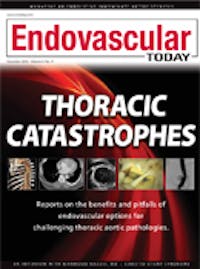
With this in mind, the sections of Vascular Surgery of the Yale University School of Medicine in New Haven, Connecticut, and the University Medical Center Utrecht in the Netherlands, which share a continued relationship, conducted a symposium on this topic in August 2010. We then collaborated with Endovascular Today to publish some of the presentations that comprised this symposium, which appear as the cover feature of this issue.
We begin with an overview of acute aortic syndromes, spanning the spectrum of penetrating aortic ulcers, intramural hematomas, and dissections. Next, we look at the effects of hypovolemia on aortic dimensions and their practical implications for endovascular repair of thoracic aortic rupture. Current trends in aortic imaging are also presented, with an eye toward how to determine the optimal modalities for each patient, including computed tomography options, magnetic resonance imaging, threedimensional reconstruction, and intravascular ultrasound.
Additionally, we describe the endovascular treatment of ruptured descending thoracic aneurysms and share an interesting look at a pair of explant images showing stent healing in a patient treated for acute descending thoracic aortic dissection and visceral ischemia. Finally, Dr. W. Anthony Lee shares insights into the Society for Vascular Surgery's recent issuance of guidelines pertaining to thoracic endovascular repair of traumatic thoracic aortic injury. Aside from our thoracic feature, we also have an article on the endovascular management of an embolizing innominate artery stenosis and another on exclusion of carotid stump syndrome. We conclude with a very interesting interview with Dr. Mahmood Razavi.
We hope you find the information presented in these articles to be helpful in your continued endeavors to stay current in the fast-moving field of thoracic aortic intervention.
Bart E. Muhs, MD, PhD
Guest Chief Medical Editor
Advertisement
Advertisement