Advertisement
Advertisement
January 2026
Sponsored by Penumbra, Inc.
Expert Perspectives: The Modern PE Landscape and Evolving Care With STORM-PE
With Timothy Fernandes, MD, MPH; Robert Lookstein, MD, MHCDL; Rachel P. Rosovsky, MD, MPH; Clay Wiske, MD; and Adam Reichard, MD



Pulmonary embolism (PE) has an elusive presentation. How has a modern clinical examination improved diagnosis and risk stratification in patients? Does the risk stratification look poised to evolve as well?
Dr. Lookstein: In 2026, we’re diagnosing PE faster and with greater precision. A modern workup pairs high-quality CT pulmonary angiography with a deliberate look at right ventricular (RV) function, most notably the right ventricular/left ventricular (RV/LV) ratio, plus pragmatic biomarkers and clinical scores. RV/LV is a critical indicator of right heart recovery or failure; it’s the physiologic readout of right heart strain and is tightly linked to early adverse outcomes. Small improvements in RV strain translate into meaningful prognostic shifts, making it a critical data point for patient care and clinical trials alike.
On stratification itself, I think we’re moving beyond the classic bins. The 2019 European Society of Cardiology (ESC) framework that split “intermediate” into intermediate-low and intermediate-high has served us well, but the conversation now includes a “catastrophic” subgroup within high risk (patients in cardiac arrest or peri-arrest) because they behave differently and demand different escalation strategies. This evolution is critical because it enables activation of tailored care pathways and ensures that patients receive the most appropriate intervention as quickly as possible.
Dr. Rosovsky: PE remains challenging to diagnose because its clinical presentation is notoriously nonspecific. Advances in diagnosis stem from the systematic integration of clinical assessment, validated prediction rules, biomarkers, and imaging (particularly evaluation of RV dysfunction) rather than reliance on symptoms alone. Collectively, these approaches have improved diagnostic accuracy and facilitate risk-based decision-making.
Risk stratification has evolved beyond traditional frameworks. Clinically important phenotypes are increasingly recognized within established subgroups. For example, normotensive shock patients are considered intermediate-high risk but exhibit impaired cardiac output and inadequate tissue perfusion despite preserved blood pressure; this “normotensive shock” phenotype is associated with a high risk of rapid deterioration. At the other extreme, patients presenting with refractory shock or cardiac arrest constitute a catastrophic high-risk group that may require mechanical circulatory support such as ECMO. Although these distinctions are not yet fully standardized in guidelines, they are becoming increasingly relevant in clinical practice.
There is also growing interest in markers of end-organ perfusion, such as serum lactate, to help identify patients at risk before overt hemodynamic collapse. Ultimately, risk stratification must remain dynamic: It informs not only prognosis but also therapeutic escalation, recognizing that patients may transition between risk categories over time. Although anticoagulation (AC) remains the cornerstone of treatment for all patients, the central clinical challenge lies in identifying who requires therapy beyond AC—and when—to improve both short- and long-term outcomes.
Dr. Fernandes: We have a lot of tools now, but it’s still incumbent on the treating clinician to consider a PE as a possibility. Sick and unstable patients presenting with obstructive shock should go to the CT scanner right away. Modern 64-slice CT scans have become very good, and we are not missing PE that is clinically evident on CT scans.
For future iterations of risk stratification, short-term prognosis is important, but we also need to think about long-term prognosis and risk stratify patients to consider both “will they survive the next 48 hours with PE?” and also “will they be functional at 6 months?”
I have the benefit of seeing these patients long term in clinic for follow-up, and it is still surprising that after a PE episode, upwards of 50% of patients will have worsening shortness of breath post-PE that does not return to baseline. And, if so, about 30% of patients show persistent perfusion defects on the ventilation-perfusion scan. What’s the risk of impairment from? Residual defects from PE if we left this clot alone? Can we identify patients who would be at risk for chronic complications of PE and functional impairment? Maybe that is what we need to be using to consider interventions.
What infrastructure-level changes are helping with the in-hospital care of acute PE?
Dr. Rosovsky: PE response teams (PERTs) have fundamentally transformed the in-hospital management of acute PE. Multiple studies have demonstrated that PERT implementation is associated with improvements in care delivery, including shorter time to diagnosis, decreased time to therapeutic AC, lower rates of inferior vena cava filters, and reduced ICU utilization. Some studies also show improved clinical outcomes—several pre- and postimplementation analyses have reported reductions in mortality, including one study demonstrating an approximate 5% decrease in mortality for each hour earlier that PE was diagnosed. The incorporation of the PERT concept into the 2019 ESC guidelines reflects its growing acceptance and perceived clinical impact.
The establishment of a PERT program should be accompanied by a commitment to ongoing performance evaluation and quality improvement. Systematic data collection, regular multidisciplinary review of outcomes, morbidity and mortality assessment, and continuing education are essential components of a high-functioning program. Without a structured way to assess process and outcomes, it is not possible to determine whether a PERT is meaningfully improving the quality of care delivered to patients with acute PE.
Importantly, there is no single optimal model for PERT implementation. Program structure should be tailored to the needs, resources, and clinical environment of each institution. However, successful PERTs are built on rapid multidisciplinary collaboration, clear activation pathways, timely access to advanced diagnostics and therapies, and structured postdischarge follow-up care, while remaining aligned with evolving guidelines, emerging therapies, and the latest research.
Dr. Fernandes: At UCSD Health, we have implemented an artificial intelligence software that has been instrumental in identifying patients and coordinating care. The pulmonologists and interventional radiologists are notified by Aidoc (Aidoc Medical) and then we discuss. The pulmonologist sees the patient, and we consult with our interventional radiology colleagues to determine which patients need an intervention and the timing of the intervention.
2025 had the first prospective randomized controlled trial (RCT) of an advanced therapy versus AC in over 10 years. What kind of signal is that for PE? How do results of STORM-PE give context to the modern body of evidence?
Dr. Lookstein: STORM-PE is foundational. The results of this trial are a signal for the medical community. PE patients randomized to Penumbra’s Computer Assisted Vacuum Thrombectomy (CAVT™)* plus AC achieved a markedly greater reduction in RV/LV ratio than those on AC alone, with significantly more achieving a > 0.2 reduction and normalization to ≤ 1.0 at 48 hours with a comparable safety profile. Furthermore, early right heart recovery aligned with improved clinical measures: lower heart rate, reduced oxygen requirement, and significantly greater 90-day functional capacity found in 6-minute walk assessment.1
Importantly, these findings land within a decade of single-arm and registry experiences but now provide level 1 evidence.
Dr. Rosovsky: We have been waiting for a trial like STORM-PE for more than a decade. This prospective study enrolled 100 patients from both United States and international centers, comparing CAVT plus AC to AC alone, the current standard of care. The trial’s findings meaningfully inform contemporary decision-making regarding advanced therapies for PE, particularly by addressing the long-standing question of how to identify patients most likely to benefit from intervention beyond AC.
STORM-PE enrolled patients with acute intermediate-high–risk PE, defined by symptom onset within 14 days, evidence of RV dysfunction on CT, and elevated cardiac biomarkers. The primary endpoint (RV/LV ratio) was intentionally selected as a validated surrogate associated with mortality and widely used in prior PE trials. The study demonstrated a significantly greater reduction in RV/LV ratio within 48 hours with CAVT compared with AC alone (29.7% vs 13.1%).
What distinguishes STORM-PE from prior studies is its deliberate focus on recovery beyond early physiologic improvement. Patient-centered functional outcomes were incorporated, including post-VTE functional scale and their predicted walking capacity (which adjusts for sex, age, and body surface area). Patients treated with CAVT achieved a substantially higher percentage of their predicted walking capacity at 90 days (94% vs 75%), reflecting more complete functional recovery.
Functional endpoints are critical because they capture outcomes that are most meaningful to patients. The inclusion of a patient representative on the steering committee underscores the study’s recognition that recovery from PE is multifaceted and extends beyond short-term survival. Taken together, the substantial improvement in RV function, early physiologic recovery, and superior functional outcomes provide a comprehensive assessment of the therapeutic benefit of CAVT in this patient population. These data can meaningfully inform shared decision-making when caring for patients with acute intermediate-high–risk PE.
Dr. Fernandes: It’s a really important time. For the last 25 years, we’ve been really focused on the right ventricle, RV/LV ratio, and improvement in function by 48 hours. The important thing STORM-PE did is to look at not only RV/LV ratio at 48 hours, which has been the gold standard for a long time, but also long-term improvements in functional mobility—which, if you ask a patient, is what they really care about.
Moving forward, I think all these trials will start looking at post-PE syndrome and the idea that patients still have residual functional problems and their VO2 max, their ability to exert themselves, is impaired. I think more evidence to support intervention to prevent these long-term complications will be provided by the next generation of clinical trials.
How could this influence the medical communities’ understanding of what to offer patients? How much do procedural factors play a role?
Dr. Lookstein: For the patient with acute intermediate-high–risk PE, clinicians now have STORM-PE to make the case for offering CAVT early alongside AC when the right heart is exhibiting pathophysiologic strain. When the therapy is executed efficiently, the safety profile is comparable to AC, and the potential upside is substantial.
Procedural factors matter immensely: I’ve said this before—the longer you keep a symptomatic patient on the table, the more opportunity there is for trouble. The Lightning Flash™ CAVT device (Penumbra, Inc.) lets us move decisively, and now we have high-quality evidence that it’s not just fast—it’s better for patients. In the trial, median device time was approximately 25 minutes, and median total procedure time was approximately 56 minutes, with 100% technical success and no device-related transfusions.
Minimizing time on the table isn’t just workflow, it’s safety.
Dr. Fernandes: The STORM-PE and STRIKE-PE data showed a very low risk of device-related complications. If you have a PE and have an option of getting it into the canister, it’s not going to make you sick anymore. You can leave the hospital and take your AC to prevent a second event. It makes patients better on the table. If we can make patients better and get them out of the hospital, that’s best for everyone.
Dr. Rosovsky: Across major medical society guidelines, there is limited specificity on the management of intermediate-high–risk PE beyond AC. Current recommendations emphasize close monitoring and consideration of rescue reperfusion therapy only if the patient clinically deteriorates.
In this context, the STORM-PE trial demonstrated that advanced therapy with CAVT can be safe, rapid, and effective. The study reported 100% technical success, with no device- or procedure-related transfusions, no access site complications, and no device-related mortality. Importantly, safety outcomes were comparable between the treatment arms through 90 days. A common concern with interventional therapy is that the potential clinical benefit may be offset by increased bleeding or procedural risk—yet STORM-PE did not identify any such safety signal.
Another important aspect of this trial was the focus on the patient-centered outcomes. Recovery from PE extends beyond the acute event, and systematic postdischarge follow-up is essential—not only to identify post-PE syndrome, but also to address the substantial psychologic and psychosocial consequences that patients may experience.
Guidelines are famously unchanged for several decades, despite innovations and adoption. What might be different now? European Society of Vascular Medicine (ESVM) recently updated guidelines along this fashion2; can we expect more to follow?
Dr. Lookstein: For years, advanced therapies outpaced the guideline process. ESVM’s recent update is an early sign of what’s to come. The 2025 guideline on interventional treatment for VTE formalized indications and emphasized procedures within experienced centers, signaling a broader acceptance of catheter-based strategies when patient selection is sound.
Ultimately, PE care has and continues to be an individualized approach, such that the provider must assess the patient in front of him/her and recommend the therapy that offers the best outcome possible. Guideline authors now have a foundation to align practice with what’s already happening in leading health care centers.
Dr. Fernandes: Patients not only did better acutely in STORM-PE; they did better over the long term. These types of data have been missing from this field for a long time, and these data were necessary to really move the guidelines.
Colleagues will ask, “The STORM-PE data are positive; does this mean that all the catheters are created equal? Can I pick a different [aspiration] catheter off the shelf?” You really must rise to that level of level 1 RCT data and meeting a meaningful endpoint; the results are device-specific. The complications of different devices are different, and the same goes for the treatment efficacy.
I would not say that you can take any catheter off the shelf because results from STORM-PE were positive. I would say these data support CAVT and it would end there. Hopefully, that’s what the guidelines also endorse.
What’s your forward-looking statement for 2026?
Dr. Rosovsky: We are in an exciting era for PE care, but continued progress depends on education, awareness, and prevention. Advances in diagnosis, risk stratification, and treatment are already improving outcomes, and several RCTs are expected over the next 1 to 2 years that will further clarify which patients benefit most from advanced therapies.
Critical questions remain, particularly for special populations such as pregnant patients, children, and patients with cancer. As evidence grows, we will better understand how to tailor device-based, pharmacologic, or combined therapies to the individual patient.
Raising awareness of risk factors and implementing effective prevention strategies are essential and often underappreciated components of improving outcomes. Initiatives such as World Thrombosis Day provide an important opportunity to highlight these issues and promote broader awareness.
Finally, PE can result in significant long-term physical and psychologic consequences that are often overlooked unless clinicians actively assess for them. Recognizing and addressing these impacts was a key motivation for incorporating patient-centered outcomes into the STORM-PE trial.
I think we are at a true inflection point in PE care—opening the door to more personalized treatment, improved recovery, and a broader, patient-focused approach to improving both short- and long-term outcomes.
Dr. Fernandes: When these mechanical thrombectomy (MT) devices first came out, there were bleeding complications and catheter-related injuries, and I think we were right to be circumspect in who was seen in the lab. Now, the device has gotten so quick and safe that, if I have an intermediate-risk PE, I’d call this alert for myself.
We’re moving beyond just treating patients to prevent their short-term mortality and decompensation. CAVT has become so safe and efficacious that we can use it not only to prevent that short-term mortality but also to treat patients to prevent long-term cardiopulmonary disabilities such as chronic thromboembolic disease.
I think that’s where we are moving. We already showed a functional improvement. Does being aggressive prevent these long-term complications of PE? I think in the next 5 years, we’ll have data showing that in addition to the functional improvements we already know.
Dr. Lookstein: Looking ahead, I expect three things:
- Risk stratification will get sharper—with formal recognition of a more complex and comprehensive classification spectrum. There will be a “catastrophic” subset inside high risk and more automated RV metrics embedded in radiology workflows to prompt earlier activation.
- Broader recognition and adoption of early MT. We now know that subsequent gains in functional capacity at 90 days are only realized with early interventional treatment such as CAVT. Restored function is meaningful to the patient and provider alike, so these advanced therapies should be considered when appropriate.
- Guidelines begin to catch up. ESVM’s step in 2025 is likely the first of several. As additional trials read out, I anticipate harmonized recommendations that endorse AC plus MT for well-defined phenotypes of intermediate-high–risk PE and require multidisciplinary decision-making at experienced centers.
If we keep focusing on rapid right heart recovery—paired with measured procedural efficiency—we’ll move this field from emerging to routine. That’s the future I want our patients to experience.
1. Lookstein RA, Konstantinides SV, Weinberg I, et al. Randomized controlled trial of mechanical thrombectomy with anticoagulation versus anticoagulation alone for acute intermediate-high risk pulmonary embolism: primary outcomes from the STORM-PE trial. Circulation. 2026;153:21-34. doi: 10.1161/CIRCULATIONAHA.125.077232
2. Schlager O, Campello E, Madaric J, et al. 2025 ESVM guidelines on interventional treatment of venous thromboembolism. Vasa. 2025;54:365-381. doi: 10.1024/0301-1526/a001211
Disclosures: Dr. Fernandes: Consultant to Penumbra and Inari Medical; Dr. Lookstein: Consultant to Boston Scientific, Penumbra, Medtronic, Imperative Vascular, Abbott Vascular, AIDOC, and Siemens Healthineers; Dr. Rosovsky: Consultant to Boston Scientific, Dova, Inari Medical, Inquis, Janssen, Penumbra, and Thrombolex.
Next Generation of CAVT™: Lightning Flash™ 3.0 in Practice
With Clay Wiske, MD, and Adam Reichard, MD
Pulmonary embolism (PE) is moving to the forefront of the venous thromboembolism (VTE) conversation, emerging as a time-critical disease state that demands both clinical urgency and technical reliability. As treatment volumes rise and procedural strategies continue to evolve, so has the expectation for thrombectomy tools. Today’s systems must deliver speed without sacrificing safety, and precision without adding complexity. With these priorities in mind, Penumbra’s latest launch of Lightning Flash™ 3.0 introduces the most advanced evolution of the Lightning Flash technology to date, designed for the rapid removal of pulmonary and venous thrombus.
From a speed perspective, Lightning Flash 3.0 shows a clear step forward with 1.3 times faster clot removal,* enabled by a nearly 40% increase in diameter for the aspiration tubing. The larger lumen tubing is engineered to reduce systematic friction caused by previously ingested thrombus, helping ensure full vacuum power is maintained at the catheter tip. An automated decompression feature further mitigates friction buildup within the tubing, minimizing thrombus-related obstructions during aspiration. Together, these design choices translate into efficient aspiration and allow for shorter procedure times.
This upgraded technology is designed to mitigate blood loss frontline, streamlining procedure workflow by eliminating the need for blood-return strategies. This improvement is attributed to enhanced algorithmic sensitivity and a notable architectural change: relocating the clot-detection computer from the top of the canister to just 18 inches behind the CAT16 catheter. By positioning the sensor closer to the point of thrombectomy, the system is better able to distinguish between thrombus and patent flow, helping preserve blood volume without compromising efficacy. From a safety standpoint, Lightning Flash 3.0 has demonstrated 60% fluid savings.*
Workflow simplicity rounds out the system with the updated user interface with the addition of a Flash console, providing clear, streamlined audiovisual feedback with an intuitive layout. Integrated air detection and straightforward operation reduce technologic complexity and enable clinicians to focus where it matters most—on the patient and the procedure.
Built with thrombectomy cases in mind, the Element™ sheath (Penumbra Inc) is the first laser-cut hypotube sheath on the market and is designed to be used with Penumbra’s 16-F platform. Available in lengths of 13, 33, 45, and 65 cm, the 17-F Element features a unique HemoLock Dual Valve system—combining a 360° rotating hemostatic valve with a removable cross-cut designed to help maintain hemostasis during access and clot removal.
Element and Lightning Flash 3.0 put Penumbra at the forefront of device innovation and underscore their commitment to thrombectomy solutions that prioritize speed, safety, and simplicity in the treatment of PE.
*Compared to Lightning Flash 2.0. Tests performed and data on file at Penumbra, Inc. Test performed using bovine blood and water. Bovine blood took 1.3x more time to be fully ingested in bench top testing of Lightning Flash 2.0 when compared to Lightning Flash 3.0, while 60% less water was removed with Lightning Flash 3.0 when compared to Lightning Flash 2.0. Bench test results may not be indicative of clinical performance.
CASE 1: NEXT-GENERATION LIGHTNING FLASH 3.0 CLEARS RIGHT-SIDED PE

PATIENT PRESENTATION
A woman in her early 70s with a relevant history of uterine carcinoma on immunotherapy with left iliac vein compression presented to the emergency department with shortness of breath and severe pain, swelling, discoloration, and numbness of the left leg. She was progressively hypoxic and hypotensive and was intubated and started on multiple pressors.
A CT scan demonstrated thrombus in the right pulmonary artery (PA) and extensive thrombus of the left lower extremity extending from the compressed left iliac vein inferiorly throughout the left lower extremity venous system. Her physical examination was consistent with phlegmasia with high-resistance signals in the left foot compared to palpable pulses in the right foot.
The patient’s family felt that it would be consistent with the patient’s wishes to proceed with intervention. We discussed interventions for both the PE and the acutely threatened left lower extremity.
Given the concern for massive PE, as well as an acutely threatened limb, an approach was taken that would provide the best probability of survival and thus the best probability of rapidly addressing the right PA thrombus. As a secondary goal, because the left leg was acutely threatened, an approach that would potentially facilitate left leg thrombectomy in a rapid fashion was favored.
INTERVENTION
Bilateral common femoral vein access was obtained. The right-sided access was primarily used to facilitate thrombectomy, and the left-sided access was obtained to provide a rail for up-and-over sheath and catheter advancement in anticipation of potential lower extremity thrombectomy. A 17-F, 65-cm Element sheath was advanced into the right PA, and a right-sided thrombus affecting multiple segmental branches was identified (Figure 1A). The 16-F Lightning Flash 3.0 catheter was advanced over a Rosen wire into the right PA, and aspiration was turned on; near-immediate evacuation of the target thrombus was achieved and confirmed by follow-up angiography (Figure 1B). Following successful pulmonary thrombectomy, a decrease in PA pressure was noted.
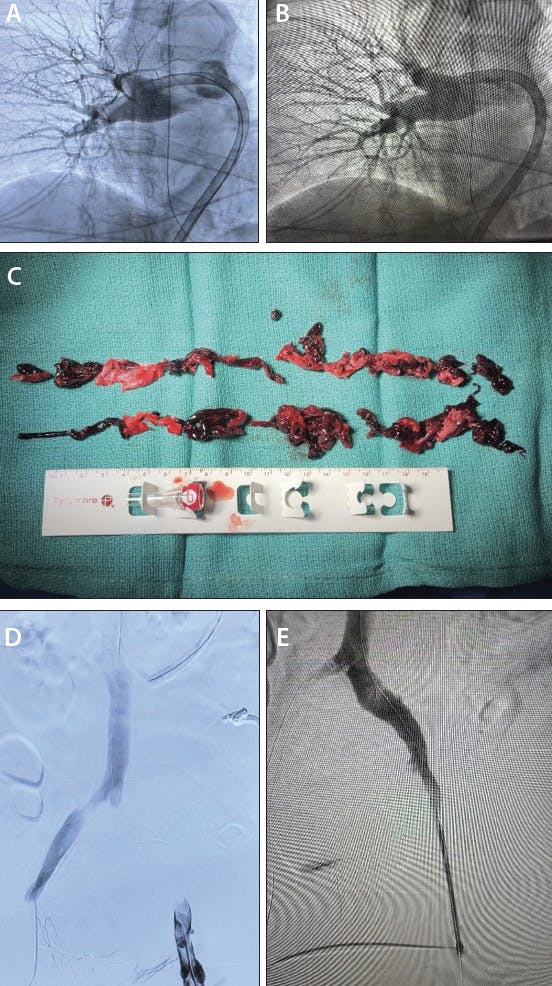
Figure 1. Angiogram showing right-sided pulmonary thrombus (A). Follow-up angiogram showing target pulmonary thrombus removed after thrombectomy (B). Left lower extremity venous thrombus extracted (C). Pre-thrombectomy angiogram (D). Post-thrombectomy angiogram (E).
The focus was shifted to the left leg. A 0.035-inch guidewire was snared for through-and-through up-and-over access. The same Lightning Flash 3.0 was reintroduced and advanced across the iliocaval confluence. Thrombectomy of the left iliac system was successful. The through-and-through wire was removed such that left vein thrombectomy could be performed as well. After three passes, a significant amount of thrombus was removed (Figure 1C). Final angiography demonstrated restored patency after placement of an Abre stent (Medtronic) (Figure 1D and 1E).
DISCUSSION
The upgraded Lightning Flash 3.0 clot detection algorithm was notable for enhancing sensitivity to blood and thrombus and enabled a single-session thrombectomy for pulmonary and venous thrombus with mitigated estimated blood loss and avoidance of tissue plasminogen activator. Additionally, the trackability of Penumbra’s comprehensive VTE platform facilitated efficient navigation through complex and variable patient anatomy.
CASE 2: BILATERAL PULMONARY THROMBUS BURDEN SUCCESSFULLY REMOVED WITH LIGHTNING FLASH 3.0

PATIENT PRESENTATION
A man in his late 60s presented to the hospital with a 1-week history of persistent shortness of breath. On presentation, the patient was tachycardic with a normal blood pressure. Labs were significant for elevated troponin levels. CT demonstrated right heart strain, with a RV/LV ratio of 1.4. Additionally, bilateral pulmonary thrombus was identified, including a large saddle component. Transthoracic echocardiography confirmed RV strain.
INTERVENTION
Initial access was obtained via the right common femoral vein using an 8-F sheath that was upsized to a 17-F Element sheath, and Lightning Flash 3.0 was advanced over a 0.035-inch wire into the right PA. With the Lightning Flash 3.0 aspiration catheter positioned, the 0.035-inch wire was removed and 10 mL of contrast was loaded into the catheter, followed by a 20-mL saline flush to deliver the contrast into the right PA vasculature. Angiography demonstrated an occlusion in the right upper lobar artery (Figure 1A).
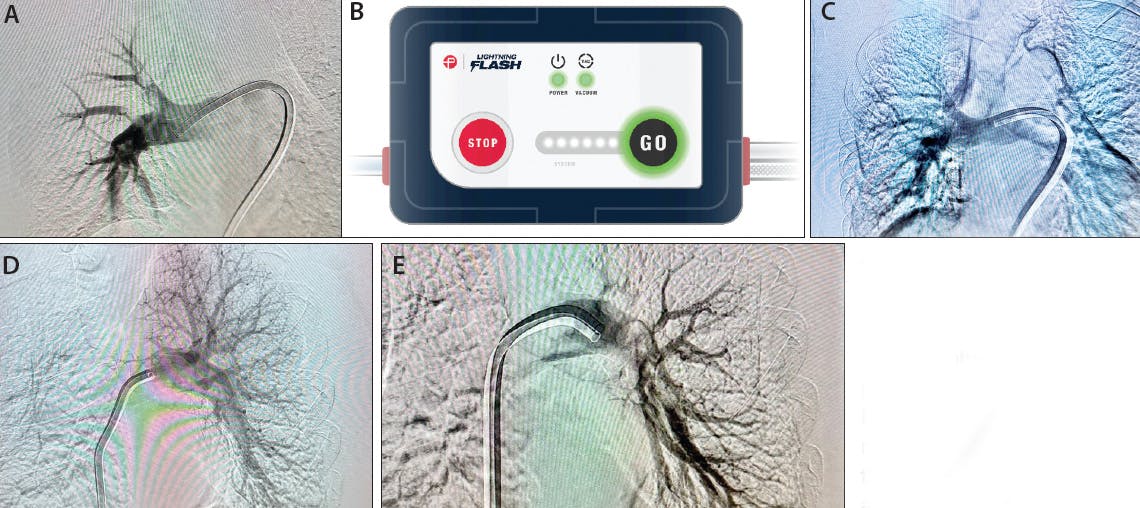
Figure 1. Pre-thrombectomy right pulmonary angiogram (A). Lightning Flash console (B). Post-thrombectomy right pulmonary angiogram (C). Pre-thrombectomy left pulmonary angiogram (D). Postthrombectomy left pulmonary angiogram (E).
The aspiration catheter was then torqued and positioned proximal to the occlusion, at which point aspiration was initiated. The Lightning Flash console (Figure 1B) illuminated yellow, and the valve cadence increased, indicating catheter engagement with thrombus. The Lightning Flash 3.0 catheter was retracted toward the right main PA. Upon retraction, a large thrombus burden was seen being evacuated through the system. Subsequently, the Lightning Flash system transitioned to sampling mode, indicating the target segment had been cleared. Repeat contrast injection via the Lightning Flash catheter confirmed resolution of thrombus (Figure 1C).
Attention was directed to the left main PA, which contained the majority of the thrombus burden. With the wire in place, the double-bend HTORQ tip configuration of the Lightning Flash 3.0 catheter facilitated seamless access into the left main PA for pre-thrombectomy imaging, revealing extensive thrombus (Figure 1D). Aspiration was initiated, and the target thrombus was successfully removed in three passes (Figure 1E).
DISCUSSION
In total, cumulative aspiration time was 6 minutes, and the interval from initial imaging to device removal and access site closure was 25 minutes. Estimated blood loss (EBL) for this bilateral PE intervention was 100 mL.
The enhanced aspiration power of Lightning Flash 3.0 was evident, as demonstrated by the rapid aspiration time and the successful removal of this large thrombus burden, allowing the patient to be taken off the table as soon as possible. The improved accuracy of the clot detection algorithm incorporated into the Lightning Flash 3.0 software was apparent and enabled minimization of EBL.
Disclaimer: The opinions and clinical experiences presented herein are for informational purposes only. The results may not be predictive of all patients. Individual results may vary depending on a variety of patient-specific attributes.
Advertisement
Advertisement