Advertisement
Advertisement
February 2011
Chief Medical Editor's Page: DVT and VTE: A Broad Spectrum of Challenges
Endovascular therapy for deep venous thrombosis (DVT) and its complications remains an area of great interest and great opportunity but with a lack of understanding by many of the physicians who treat these patients on the front line. Venous disease has long been of secondary interest to vascular therapists, but I sense a definite change occurring in our midst. Clearly, there is much to offer in improving patient care and outcomes.
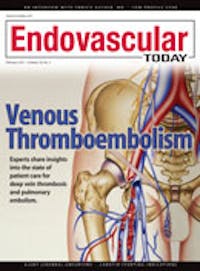
We open our feature with an article by Mahmood K. Razavi, MD, who discusses the present state of DVT intervention. Dr. Razavi describes the roles of catheter-based treatments for acute DVT, including multiside-hole infusion catheters, percutaneous mechanical thrombectomy catheters, and lyticassisted devices. Next, Antonios P. Gasparis, MD, RVT, FACS, and Nicos Labropoulos, PhD, DIC, RVT, present the indications and techniques for managing venous outflow obstruction.
After these two overviews, our feature switches gears to a series of interviews on the current state of care in DVT and venous thromboembolism (VTE). My colleague and partner, James F. Benenati, MD, addresses the SIR's position on the very important topic of IVC filter use, commenting on recent issues regarding placement and retrieval.
Next, Michael R. Jaff, DO, looks at how the quality and efficiency of DVT patient care can be improved, and Suresh Vedantham, MD, continues this discussion with a thoughtful perspective on the CHEST guidelines, with particular focus toward their impact on DVT standards of care. Tod C. Engelhardt, MD, FACS, then provides an early look at ultrasound-assisted thrombolytic intervention for acute massive and submassive pulmonary embolism, a potential new role for catheterdirected therapy.
Outside of our DVT and VTE feature, we also have two Challenging Cases articles, the first of which is by Brant W. Ullery, MD, and Edward Y. Woo, MD, who discuss difficult access in EVAR patients and describe a case in which they use a low-profile AAA device to endovascularly repair a patient with poor access. Next, Demetrius K. Lopes, MD, and Andrew K. Johnson, MD, MS, detail their use of a double-wire technique in stenting a giant cerebral aneurysm.
Endovascular Today also provides a detailed summary of the FDA Advisory Panel recommendations for Abbott Vascular's RX Acculink CAS indications, which took place in January 2011. Finally, in our closing interview, Enrico Ascher, MD, discusses the goals of the International Society for Vascular Surgery and shares his insight on vascular fellowship programs and multidisciplinary collaboration.
As you can see, there is quite a bit to discuss in the world of endovascular therapy in 2011, from the multifaceted challenges of VTE to exciting new advances in aneurysm repair and carotid intervention. We hope you find this issue of Endovascular Today to be a timely and stimulating encapsulation of many of the trends we are seeing across the spectrum of vascular intervention.
Barry T. Katzen, MD
Chief Medical Editor
Advertisement
Advertisement