Advertisement
Advertisement
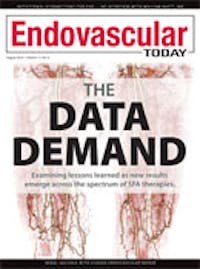
The superficial femoral (SFA) and proximal popliteal arteries remain among the most challenging vascular regions to treat. Achieving and sustaining long-term favorable outcomes is elusive in many patients despite a rapidly expanding arsenal of devices tailored specifically to this anatomy. Some of these technologies became available for use without definitive clinical data, and some were approved for nonvascular indications. Thankfully, after many years of off-label device use and clinical decisions based upon flawed or limited data, industry has been responding to the community's call for more and better studies. This issue of Endovascular Today examines the currently available evidence, citing important lessons learned as each new study adds to the body of knowledge regarding femoropopliteal intervention.
Ehrin J. Armstrong, MD, and I open our SFA discussion with an update on the current data regarding stenting technology for use in the SFA. We review recent trials and registries for self-expanding bare-metal stents, drug-eluting stents, and covered stent grafts; the data are promising thus far, but gaps in information still exist, particularly for long lesions and the critical limb ischemia population.
With in-stent restenosis rates in the SFA still higher than we'd prefer them to be, the addition of a drug therapy without the need for a permanent implant is appealing. Drug-coated/eluting balloons are an exciting technology with numerous potential applications. This technology is available in many markets but is still under investigation in the US. Thomas Zeller, MD, provides an overview of the trial results to date for drug-coated balloon technology in the femoropopliteal vascular bed. Maxwell E. Afari, MD, and Juan F. Granada, MD, FACC, continue the discussion on drug-coated balloons with a close look at the specific pharmacokinetic mechanics of this therapy.
The long-awaited FDA approval of a drug-eluting stent for use in the SFA could have a profound impact on our clinical practice. For our “One Question…” feature, Gary M. Ansel, MD; Bruce H. Gray, DO; John H. Rundback, MD; and Evan Lipsitz, MD, discuss the clinical and cost factors that will guide when and how they might incorporate this highly anticipated technology.
Atherectomy expert Lawrence A. Garcia, MD, reminds us that no matter how many tools we might have in our toolbox, data on long-term patency must drive our decision making for lower limb disease. He provides an overview of current and future atherectomy devices but notes that the need for direct comparison trials among different devices is tantamount to answering the question of which therapy to use and when.
To close our SFA feature, we shift our focus from data to the patient. When it comes to the SFA, all the data in the world might not help a patient who won't help himself. Eanas Yassa, MD, and Joseph V. Lombardi, MD, thoughtfully ask the important question as to whether more restraint is needed in providing SFA revascularization. They discuss challenges in managing patients with femoropopliteal disease and intermittent claudication and advocate a measured approach to treating this difficult patient population.
In our Techniques section, Rupal Bandi, MD, and Yun Robert Sheu, MD, MS, detail staged endovascular management for a renal artery aneurysm associated with a complex renal AVF and tortuous venous aneurysm. Dorian J. deFreitas, MD, and Joseph J. Ricotta II, MD, MS, explain why rotational atherectomy is their modality of choice for peripheral vascular disease.
In closing, TASC author William Hiatt, MD, shares a glimpse of what we can look forward to in TASC III and discusses lifestyle modification and medical management of the PAD patient.
This is an exciting, timely issue of Endovascular Today, and we hope that the data and discussion provided herein will help guide decision making in your practice.
Advertisement
Advertisement