Advertisement
Advertisement
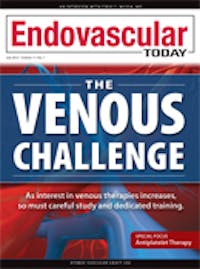
Venous therapies continue to be an area of significant growth and great opportunity, but many questions have arisen, leading to controversy and debate.
In this issue, we cover the hotly debated topic of chronic cerebrospinal venous insufficiency treatment in patients with multiple sclerosis. To present two important, and somewhat conflicting, viewpoints, Gary Siskin, MD, explains his perspective as an interventionist while Jack Burks, MD, and Patricia K. Coyle, MD, represent the neurologists' point of view.
Next, Mark J. Garcia, MD, FSIR, provides an updated look at the endovascular treatments for chronic deep vein thrombosis.
Are venous therapies being overutilized, inappropriately used, and overlooked from a quality and outcome point of view? What types of education, technical skill, and accreditation should a vein specialist achieve to qualify as such? Steve Elias, MD, FACS, FACPh, and Jose I. Almeida, MD, FACS, RPVI, RVT, discuss the need for in-depth knowledge and dedicated training.
Michael A. Vasquez, MD, FACS, RVT, explains that outcome reporting and disease stratification can be useful but only as long as the instruments used to measure them provide meaningful, valid, and practical data.
Next, the American Venous Registry shares a preview of the upcoming data on inferior vena cava filters and what you can do to help strengthen this research. In our One Question feature, we ask several leading physicians about the protocols they use to determine proper placement and retrieval of inferior vena cava filters in their practices.
In addition to our feature on venous interventions, we have a focus on pharmacology in endovascular interventions. Stephen L. Chastain, MD, and Marcus D. Stanbro, DO, FSVM, begin with a look at their current usage of antiplatelet therapy options for treating peripheral artery disease. Bruce H. Gray, DO, MSVM, FSCAI, continues the conversation with a case-based discussion, in which he explains his rationale for choosing specific antiplatelet therapies for several different cases. Karthikeshwar Kasirajan, MD, concludes this topic by touching on the potential importance of genome-based drug dosing and the affect that generic clopidogrel will have on patient care.
We then have a review by Brant W. Ullery, MD; Ben M. Jackson, MD; Joseph Bavaria, MD; and Edward Y. Woo, MD, of heparin-bonded hybrid vascular grafts with a series of interesting and illustrative case reports.
Finally, we close this issue with an interview with vascular surgeon Firas F. Mussa, MD, MS, FACS, in which he discusses ways to overcome challenging peripheral interventions and endovascular aortic repairs.
I hope you will again find this issue to be of clinical importance and of value in providing you with timely information to improve your knowledge and practice.
Advertisement
Advertisement