Advertisement
Advertisement
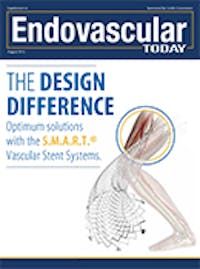
August 2013 Supplement
Sponsored by CORDIS CORPORATION
The Evolution of Stent Design
A look at S.M.A.R.T.® Vascular Stent design specifics for a new generation of durable performance.
The Cordis S.M.A.R.T.® Vascular Stent System (Cordis Corporation, Bridgewater, NJ) optimizes performance and outcomes through its unique design and associated characteristics. In general, a self-expanding stent's performance is determined by its geometrical pattern in conjunction with stent material (nitinol) parameters. Specifically, the construction of the circumferential rings comprising the stent struts, as well as the manner in which the bridges connect the longitudinally adjacent struts, fundamentally govern stent performance. The S.M.A.R.T.® Vascular Stent features 36 struts for each circumferential ring, with six alternating bridges connecting each ring to the next (Figure 1); through the 36-strut, six-bridge design, the stent's longitudinal stability, scaffolding, and resistance to radial force are maximized.
STENT DESIGN CHARACTERISTICS
The stent's response to a uniform radial force, the scaffolding it offers to the arterial wall as well as the stent expansion range, heavily depends on strut length, the axial spacing of strut rings along the length of the stent, and the number of struts within a given ring. For instance, if the number of struts were decreased across a ring while maintaining strut length, the radial stiffness of the stent would increase—however, this would result in a wider strut angle at the deployed state, thereby compromising scaffolding, as well as directly impacting stent expansion capability.
On the other hand, a stent with a greater number of struts may result in a more acute angle between the struts at the deployed state and could increase scaffolding while trading off radial stiffness. This decrease in radial stiffness may in turn be compensated by shortening the length of the struts, thereby stiffening the radial response. The short struts and 36-strut pattern inherent in the S.M.A.R.T.® Vascular Stent offer a balance of strut length and number of struts to maximize the aforementioned stent performance attributes.
Another important characteristic is the alignment of strut rings to the rings immediately (longitudinally) adjacent to it. The S.M.A.R.T.® Vascular Stent utilizes a peak-to-valley design (Figure 2), in which the peak of one strut is aligned with the valley in the next ring of struts, but with a slight circumferential offset to that alignment. This offset peak-to-valley design allows for each ring of struts to actually sit just slightly inside the adjacent ring. This has an impact on several performance characteristics:
(1) The number of strut rings per unit stent length plays an important role in the radial stiffness of the device. The peak-to-valley design allows for strut rings to be densely packed along the stent length, resulting in an increased number of strut rings per unit length and thus more resistance to radial loading.
(2) With peak-to-peak designs, a sharp arterial bend would cause struts at the outside of the bend to lift up or “fish scale” while also causing strut “collisions” along the inner radius of the bend. The peak-to-valley configuration in the S.M.A.R.T.® Vascular Stent helps to mitigate both fish-scaling and strut collisions at tight arterial bends, resulting in a smooth vessel lumen and enhanced stent contourability.
(3) Stent scaffolding is further improved with the offset peak-to-valley configuration in conjunction with the earlier-mentioned short stent struts. This configuration results in a smaller cell size (Table 1), thereby helping to mitigate plaque prolapse while continuing to provide high and consistent radial stiffness.
The six bridges per ring that connect those struts to the next ring are also designed to maximize performance characteristics. A reduced number of bridges compromise stent longitudinal stability and may lead to potential stent elongation during deployment. Stent elongation implies stent stretching during deployment, meaning that a device optimized to match the length of a lesion may end up stretching past that lesion and providing less structural support than is necessary. This in turn may affect placement accuracy, as well as radial performance (due to increased strut spacing). On the other hand, an increased number of bridge connections could make a stent too stiff, especially in tortuous anatomies in which sharp arterial bends are present.
The bridge geometry and the number of bridge connections are also crucial with regard to the propensity of stent fracture and subsequent fracture propagation. In stents with fewer bridges—for example, three to four bridges per ring—a fracture of a single bridge (type I fracture) can lead to complete transverse fractures (type III–V fractures) due to a decreased axial load-carrying capability of the remaining bridges. The six-bridge design of the S.M.A.R.T.® Vascular Stent helps prevent this fracture propagation, as is evident from the STROLL (S.M.A.R.T.® Vascular Stent Systems in the Treatment of Obstructive Superficial Femoral Artery Disease) clinical study. Specifically, the STROLL study determined a low (2%) fracture rate at 12 months, with no additional fractures at 24 months. Additionally, all fractures observed were type I fractures. The results from this clinical study are described in detail by William A. Gray, MD, in this supplement.
STENT PERFORMANCE METRICS
The various design characteristics of the S.M.A.R.T.® Vascular Stent, as previously discussed, have a profound impact on performance. From a vessel patency standpoint, a small gain in the poststented vessel radius can dramatically increase the flow rate of blood. For example, a 1-mm gain in radius from 4 to 5 mm, or a 25% radius gain, translates to a 56% increase in the cross-sectional area and eventual flow rate. A 2-mm gain in vessel radius would yield a huge (125%) increase in resulting flow rate. Maximizing the vessel radius gain in turn relates to three key stent performance metrics—specifically, stent radial force, longitudinal stability, and scaffolding.
Radial Force
The excellent resistance to radial force demonstrated by the S.M.A.R.T.® Vascular Stent due to its short struts and offset peak-to-valley design support significant longterm luminal gain. Bench tests have shown the S.M.A.R.T.® Vascular Stent to be superior in radial stiffness (resistance to radial force) compared to the majority of competitive stent designs, as evidenced by the results presented in Figure 3.
Longitudinal Stability
Stent longitudinal stability refers to the ability of the stent to resist stretching during deployment. Longitudinal stability was measured for various stent platforms by performing a tensile test along the stent axis and measuring the force required to stretch the stent by 50% (Figure 4). A lower force response would imply decreased longitudinal stability, indicating that the stent is more stretchable and thus more prone to deployment problems, resulting in reduced scaffolding and radial force.
The test results indicate that the longitudinal stability of the S.M.A.R.T.® Vascular Stent far exceeds competitive stent platforms (Figure 5). In fact, it demonstrates up to 349% greater longitudinal stability than competitive stents, as reflected in the chart.
Scaffolding
The effect of the close-packed stent struts and offset peak-to-valley design on stent scaffolding was previously described. The resulting small cell size and uniform coverage inherent in the S.M.A.R.T.® Vascular Stent is evident from the comparison presented in Figure 6.
The fatigue resistance of the S.M.A.R.T.® Vascular Stent has been characterized via rigorous chronic bench top tests and computational (FEA) models utilizing loading conditions relevant for the proximal, mid, and distal SFA, as well as the proximal popliteal artery. The cyclic loads incorporated for these studies include (1) radial pulsatile loading, (2) axial compression, (3) arterial bend, (4) arterial twist, (5) stent crush, (6) combined axial compression and bend, and (7) combined axial compression and twist. These chronic durability studies and low STROLL fracture rates at 12 and 24 months corroborate the structural fatigue robustness of the S.M.A.R.T.® Vascular Stent.
These excellent stent performance results will be further substantiated with clinical outcomes from the STROLL clinical study within this supplement.
CONCLUSION AND FUTURE STUDY
The next-generation, self-expanding stent platform from Cordis Corporation—the S.M.A.R.T.® Flex Vascular Stent—is currently under clinical investigation in the United States. The S.M.A.R.T.® Flex Vascular Stent is an evolution of S.M.A.R.T.® Stent technology, building on the radial strength, longitudinal stability, and scaffolding attributes of the S.M.A.R.T.® Stent design while adding fully connected helical struts to accommodate torsional, compressive, and bending loads and enabling reconstrainability during stent deployment.
Ramesh Marrey, PhD, is an Engineering Fellow at Cordis Corporation. He may be reached at rmarrey@its.jnj.com.
Advertisement
Advertisement