Advertisement
Advertisement
March 2013
The Challenge of Change—Is Innovation Slipping Away?
Endovascular intervention has had a dramatic impact on patients with vascular disease. This impact has been driven by many hardworking groups of people: The pioneering physicians who courageously sought better and safer options for patients than those traditionally offered by open vascular surgery. The modern interventionists who aim to reduce hospital length of stay and recovery times while adding years of quality to lives of patients. The nurses, technologists, and operations managers who coordinate complex care paradigms across matrixed hospital systems in order to streamline workflow and provide better patient outcomes. The government regulators and reimbursement specialists who have dedicated their lives to protecting the welfare of patients, and whose jobs are too often scorned or taken for granted due to lack of appreciation for their unique challenges. The industry innovators who design, improve, and provide a continuous stream of new technologies, again with the goal of making the lives of our patients better.
Changes in health care systems around the world, including the Affordable Care Act in the United States, aim to develop a more efficient, highly effective, value-based (versus volume-based) system. Combined with a prolonged and profound global economic downturn, the cost of care is increasingly and appropriately under scrutiny, with everyone from hospital administrators to legislators each trying to preserve great care while preventing bankruptcy for all. At the same time, investment dollars are increasingly tough to come by, as speculators seek markets with lower entry thresholds and more certain future returns. Oddly, smart phone applications offer greater opportunities for investors today as opposed to technology that will promote longevity for themselves and their children's children. Innovation is at a major crossroads in the United States, and there is no telling what will happen next.
It may not always be apparent, but every member of the vascular community has the same goal—to provide the best patient care possible. Our paths to achieve this may differ, but our objective is the same. With this in mind, it remains critically important that we seek multiple perspectives on how to promote innovation in the face of significant forces that threaten its momentum.
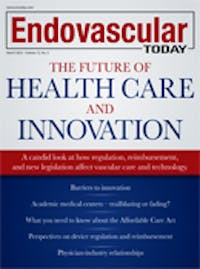
In this unique issue of Endovascular Today, our goal is to provide a variety of perspectives from experts throughout the field. We have forgone the publication's usual approach of focusing on the latest developments in a particular segment of vascular therapy to instead focus on the overwhelming forces affecting the entire field. In some cases, we invited experts to author articles on key topics. In others, we opted for an interview format targeting responses to today's most pressing questions.
We have asked physicians, leaders of academic medical centers, entrepreneurs, advisors, industry representatives, and members of the US regulatory and reimbursement agencies to provide their perspectives, each sharing the benefits of their knowledge and their years of work in various aspects of the field. Too often, we focus solely on our own motivations and frustrations, at best hearing only those of our closest colleagues. To understand the unprecedented changes facing all of us, continue to improve care and outcomes despite seemingly disastrous cost pressures, and to maintain the forward trajectory of innovation, we must listen to each other and work together.
I hope you find this issue informative and stimulating, and Endovascular Today welcomes your perspectives as we strive to continue this discussion in future issues as change inevitably marches on.
Advertisement
Advertisement