Advertisement
Advertisement
March 2013
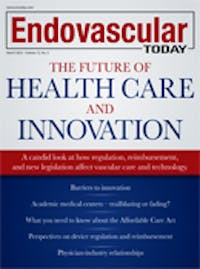
Measuring Value in Today's Health Care Climate
Michael R. Jaff, DO, interviews Gary Gottlieb, MD, CEO of Partners HealthCare, to discuss the impact of the Affordable Care Act, changes in reimbursement, and how they affect academic medical centers and physicians.
Dr. Jaff: What is your overall perspective regarding how health care in the United States has changed over the last 5 years? Are you excited about what's coming?
Dr. Gottlieb: Over the last 5 years, there has been an increasing focus on the cost of health care relative to public health outcomes. It's been a mixed discussion, because it is a comparison of apples and oranges. We've built an exceptional illness care system, and the measures that we are being evaluated against are largely those in health care systems that have had a public health focus. It's clear that there is substantial pressure to move rapidly toward improvement of public health and reduced spending on complex care. This creates a challenge to the infrastructure of the current health care system.
In the last 5 years, America has also experienced some of the most difficult economic conditions of the last three or four generations. As a result, the effects of the rate of growth in health care costs on an otherwise shrinking economy have been more obvious. Even with the recovery, which has been weak despite the current stock market performance, the notion that health care expenditures are crowding out the ability of the economy to invest in other areas has become increasingly evident.
The health care economy depends significantly on the public sector. State and federal governments are direct payers for health care, the federal government is a direct investor in science and training, and the private sector has substantial tax shielding in payment for employee premiums. In each of those areas, the effect of health care spending on other sectors or expenditures becomes important. In the public sector, every one of us lives in a town or city that has reduced spending on capital, on education, or on basic services because retiree health benefits or current employee health benefits have grown much more rapidly than the tax base.
Similarly, the ability of private businesses to pay good wages and invest in capital in an uncertain economy is dampened by the need for employers to pay insurance premiums that are growing at a much faster pace than their revenues.
Together, all of this has created pressure to determine how we move to a public health system that has better health outcomes, how we promote the idea of value—that is, getting something that's tangibly great for what we're paying for and how we can pay less for it. This transformation will occur in the context of greatly constricted resources caused by a massive federal deficit, which will have a sustained effect on federal, state, and local spending. This will be compounded by modest long-term private sector economic growth.
In 2006, Massachusetts led the nation in declaring that health care is a right and not a privilege. This was affirmed nationally in 2009 by the Affordable Care Act.
At the same time, the Affordable Care Act and 2012 payment reform in Massachusetts embraced the idea of moving away from fee-for-service medicine and what were perceived as perverse incentives thought to encourage increased volume of care toward models in which providers receive fixed or global payments for taking responsibility for the care of people over time. As we learned in the early 1990s, this model carries the risk of encouraging providers to create barriers to care or to provide less care than might be necessary. We are trying to embrace a new approach that promotes health and wellness while nurturing the miraculous advances that have been made in the diagnosis and treatment of people with acute and chronic illnesses. It is clear that the United States has driven the world's most important advances in diagnostics and therapeutics—many of which wouldn't exist without its market. It has been a luxury for much of the rest of the industrialized world to be able to adopt those breakthroughs when somebody else is paying for them while making major local investments in prevention and delivery of care.
The challenge for us as a country—the challenge for us at Partners—is to make certain we embrace the great good that has been created and to continue to lead in advancing much of the translation of exceptional science into remarkable care. At the same time, we must embrace the realization that the growth of expenditures will slow remarkably, and we must ensure that we demonstrate the value of the excellent care that we provide and the enormous benefit we create for those we serve.
Dr. Jaff: Do you view these next 5 to 10 years as the most challenging in Massachusetts General Hospital's (MGH) history, and are you excited or nervous about this?
Dr. Gottlieb: I'm excited, but I don't see them as the most challenging in MGH's history. As Drs. Peter Slavin and David Torchiana, MGH's leaders, remind us, in these 200 years and counting, MGH has lived through wars, famine, pestilence, and infectious diseases for which there appeared to be no answer. It has seen its physicians and its patients sent far away and lost, and families destroyed. MGH and all of the Partners institutions are filled with enormous talent, with the leverage and substantial assets to be able to face the current challenge. This challenge is one around continued evolution, leadership, and innovative solution. I'm excited because I'm surrounded by extraordinary people who have the ability to think through how to create solutions that will make us better than we have ever been.
Dr. Jaff: There's been a trend in the United States for hospitals to consolidate into larger health care systems, and at the same time, private practice groups to be acquired by hospitals. What do you think have been the drivers to those types of evolutions in the marketplace?
Dr. Gottlieb: I think the changes in payment structure are the drivers. There is a belief that some scale is necessary to get the right care at the right place. Feefor- service medicine has driven excellent transactions but has made the coordination among those transactions the burden of individual physicians and their offices.
Individual physicians, practicing alone or in small groups, may not have the ability to continue to translate the great science they're learning into better care for their patients because coordinating these transactions is completely absorbing their time and attention. There is also concern that different mechanisms of payment will put tremendous pressure on specialists. Specialists in cardiovascular medicine need to have a clear stake in every aspect of care delivery so that they can help design the right system going forward. The approach that we tried in the “managed-cost” environment of the 1990s polarized primary care doctors, specialists, and institutions. Capitating primary care physicians created tremendous stress between them and their colleagues, friends, teachers, students, and the institutions that they all loved. This time, we need to ensure that we don't create similar financial incentives that could isolate one important group of us from the rest of the system.
Cardiovascular specialists, for example, desire the best possible patient-centered care based on the evidence that they have helped to develop. Some consolidation offers greater security and the potential opportunity for them to acquire resources to make scalable investments in their practices that may be necessary in a new payment environment. These include IT, care coordination, and novel diagnostic tools.
Dr. Jaff: Partners has models of employed physicians and private practitioners. Do you think there is an opportunity to cultivate both of those models going forward?
Dr. Gottlieb: I think there is. In the long run, more physicians will be closer to institutions, and over time, more will want to benefit from the infrastructure that a system can provide and the type of investments that could be made in their practices. I think that there will always be private practice in medicine, but it will be easier for many doctors to work in groups so that they can share knowledge and resources and have access to capital when necessary. This will enable them to position themselves to provide the best care to their patients and remain financially stable, using their services and teaming up with other providers—hospitals and systems like ours—even if they're affiliated, rather than part of them.
Dr. Jaff: There have been some who suggest that large private practice groups are more nimble and more able to adjust to a changing marketplace than a large academic medical center. Perhaps the academic medical center is going to be relegated to only treating rare or impossible-to-cure illnesses and allow the straightforward management of patients to be left to private practitioners or large private groups. As you run a system with very large and well-respected academic medical centers, how do you react to that sentiment?
Dr. Gottlieb: My guess is that numerous solutions will prevail. It will depend on the local environments, which have driven the way health care has been delivered for most of the last century. There is substantial value that groups of providers can provide to the marketplace.
A continuum of care driven by the knowledge that emanates from academic medical centers but works on getting the right care in the right place guided by the wisdom of physicians will be one excellent approach. However, academic medical centers are not widely distributed or numerous enough nationally to be the core of system redesign everywhere. Additionally, essential physicians and other resources are distributed unevenly, so flexible and innovative solutions will be necessary to meet unique geographic demands. For example, many rural settings do not have enough cardiovascular specialists to meet the needs of the local population, and some regions have more physicians than would be demanded by the epidemiology of disability and disease.
A system like Partners has the unique opportunity to embrace a multifaceted mission that can only be fulfilled from the strength of academic medical centers. We are able to translate science and train exceptional young people.
We are committed to sustained investment in communities that don't have the necessary resources to independently provide innovative and humane solutions to the health and social needs of their residents. But, yes, as you suggest, we need to be more nimble so that we can shorten the latency between innovation and implementation.
Dr. Jaff: You mentioned that Massachusetts' state health care reform has become fairly aggressive. How do you strategize in a system as large as the one you're running in the face of those types of groundbreaking policy changes?
Dr. Gottlieb: The principles that are in Chapter 224, the most recent piece of health care reform legislation focused on health care costs, were not distant from the underpinnings of the strategy that we began to implement about 3 years ago.
It was evident that we would be facing a constriction in public and private sector resources and that the mechanisms of payment we would face would have a higher degree of price sensitivity from referring physicians and from patients.
We started to move strategically to make certain that, first, our unit costs were within reason; second, that we could focus on total medical expense in a way that was thoughtful across the system; and third, that we could use the spectrum of care that we have to figure out how we can compete on total medical expense without being as worried about transactional prices. The notion of population health management, and the effective management of episodes of specialty care and the kind of coordination that has been led by cardiovascular specialists and others, is important to those outcomes.
In addition, we have begun the work that will be necessary to show that we can deliver the outcomes that patients want from the care that they receive. If we can demonstrate that, while effectively coordinating what has been fragmented care, then we will create real value.
Dr. Jaff: Much of what has happened in the cardiovascular world has been led by iterative innovations in therapy and diagnostics. Massachusetts has been a vanguard of addressing relationships among physicians, manufacturers, and industry, and I believe Partners HealthCare has been a leader in transparency of relationships. How do you foster this tremendous opportunity for innovation, which has been part of the foundation at Partners, and make sure that everybody who needs to is disclosing relationships that are healthy and productive?
Dr. Gottlieb: You're asking a terrific question. Clearly, academia and our partners in industry need to develop a shared vision of productive partnership and transparency. Both academic medicine and the pharmaceutical and device industries are organized in highly matrixed organizations. In that context, we have periodically confused education, research, and marketing activities, challenging our ability to explain our relationships to the public. Together, we must be clear in distinguishing among these functions and emphasize our shared interest in improved tools and interventions that create better patient care.
We must determine how best to ensure integrity and public trust in our transactions and joint ventures. At the same time, we need to reevaluate where we may have become too restrictive in our relationships and how that might stifle exciting investment and innovation. The most immediate imperative is to jointly invest in science to create a more robust pipeline of diagnostics and therapeutics that can be translated into improvements in the human condition.
Dr. Jaff: You're running one of the most important health care systems in the nation, so as you reflect on your experiences so far, what is the mark that you would like to leave on Partners?
Dr. Gottlieb: Like the other leaders around our system, I would like to continue to facilitate the great works of people who are more talented and more innovative than I could ever dream to be. The most important piece is that the institutions of the Partners HealthCare System—our academic medical centers, our wonderful community hospitals, and other resources—are able to achieve their missions and thrive.
That mission is one that's precious, and it's consistent among those institutions: to bring the best and the brightest to care for the sickest and neediest populations. We strive to inform science with the care that we provide, and to have the care that we provide informed by science and translated into even better care; we train the most exceptional young people to lead, and we invest in the communities where we live and in communities around the world to make certain that there is equity in health care.
If those magnificent institutions thrive with that mission, that would be the imprimatur I would hope to leave.
Advertisement
Advertisement