Advertisement
Advertisement
March 2013
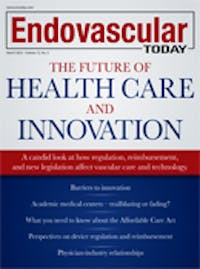
The Future of Physician-Industry Collaboration
AdvaMed's Code of Ethics seeks to provide physicians and industry with the room to collaborate while assuring the public of the transparency and integrity of that relationship.
The relationship between industry and health care providers is one of constant change and continuing microscopic evaluation by the federal government and, soon, the American public with the implementation of the Physician Payment Sunshine Act. This act will require pharmaceutical and medical device companies to report payments to physicians and teaching hospitals of > $10.
For as long as medical devices and pharmaceuticals have been manufactured, there has been a need for interaction between the manufacturing companies and the health care provider who utilizes the drug or device. The most common model that comes under scrutiny is the relationship between the sales representative and the physician. However, as physicians have evolved beyond customers to become speakers, consultants, and inventors, the dynamic and scrutiny has heightened dramatically. This scrutiny has forced companies and health care providers to carefully evaluate their relationships and understand the safe parameters and the ramifications for exceeding those boundaries.
Many medical device and pharmaceutical companies have developed compliance programs to ensure that their employees and their customers understand the government restrictions in regard to relationship conduct. Conceptually, these programs were derived from the United States Sentencing Commission, which created programs for law-breaking companies to reduce their criminal sentences. In May 2003, the Office of the Inspector General (OIG), Department of Health and Human Services provided industry with comprehensive parameters for establishing compliance programs, which should now exist at the core of every industry compliance program.1 The first OIG element zeros in to address specific areas of fraud and abuse, such as sales and marketing practices. Providing anything of value to health care professionals with the intent to reward or induce product purchases is strictly prohibited under the federal Anti-Kickback Statute and is punishable by a fine of not more than $25,000, 5 years imprisonment, or both. Physicians who solicit remuneration from industry with the same improper purpose will also face criminal liability that could include exclusion from federal health care programs.1
Considering that there remains a necessity to conduct business, provide training, and request consulting services from those who are utilizing devices and prescribing drugs, how does industry work compliantly with health care providers? The clear objective of the OIG guidance is to prevent industry from competing over physician relationships and must instead compete solely on the quality, capability, and price of their products. In a world where there are varying dimensions of superiority of one device or drug over another, in many cases, there is no “best” product. The reality of off-label use of drugs and devices exists. However, industry's responsibility is to educate on the indicated use of their product specific to the instructions for use for their devices. Health care provider consultation is mandatory to successfully develop and bring a product to market, as both parties must fully understand compliance constraints and develop relationships based on integrity and compliant behavior.
ADVAMED CODE
For medical device companies in particular, the AdvaMed Code is a guidance document that should be the pinnacle of every company's compliance program. The code became effective on January 1, 2004, and has more than 1,100 medical device industry members, which represents 90% of a $71 billion industry. The code is voluntary and self-regulating, and its main objective is to encourage ethical interactions between AdvaMed members and health care providers, as well as recognizing important differences of the medical technology industry.1
Five major areas of the code that are of specific relevance to the medical device industry and physician relationships are training and education, continuing medical education (CME), entertainment, consulting agreements, and gifts. The AdvaMed Code permits for compliant interaction in these areas by allowing controlled interface specific to the relevant need of the health care provider and the manufacturer.
Training and Education
Under the AdvaMed Code, industry training and
education is limited to “safe and effective use of medical
technologies directly concerning use of companies'
medical technologies.”2 This code also allows for staff
training that is necessary for allied health professionals
who are engaged in a medical procedure in which the
device may be used. However, the code does specifically
prohibit incidental refreshments for “guests” and prohibits
industry from paying for a meal when a training
participant brings their significant other or a nonclinical
person to a device training program. Reasonable travel
expenses are also permissible for physicians to attend a
particular training event. However, this is only allowable
if the training on a particular device cannot be conducted
effectively within the health care provider's hospital
or a local establishment. If a physician can be trained on
a simulator brought into their institution, they do not
need to travel to a location outside of their facility to
receive the training.
Support of CME
The code allows medical device companies to support
educational conferences that are ACCME (Accreditation
Council for Continuing Medical Education) accredited.
There are very specific guidelines with regard to industry
support of these types of educational venues, and
the AdvaMed Code is very much in alignment with the
OIG Compliance Program Guidance for Pharmaceutical
Manufacturers, the FDA Guidance for Industry, and the
ACCME Standards for Commercial Support. The crux of all of these documents is that industry may support
these meetings void of any input in regard to content,
faculty, or audience. There must be a clear delineation
between commercial support and the content of an
accredited program. The CME provider has sole responsibility
for applying industry grant funds to honorarium,
faculty travel, venue, catering, etc.
In order for the educational integrity of these meetings to remain intact, there must be a complete separation of commercial support and education. In most cases, there are opportunities for industry to exhibit during the medical education program, which is the only area where promotion of products may take place. This resolves the potential conflict for industry and allows for compliant support of advancing knowledge in disease states while providing a commercial venue outside of the accredited activity for promoting FDAapproved devices.
Entertainment
Entertainment is likely the most scrutinized area in
regard to the relationship between health care providers
and industry. Historically, there have been documented
extravagant engagements in the health care industry
that have resulted in complete prohibition of all entertainment
activities. One particular component of the
AdvaMed Code that is crucial to acknowledge is that
self-pay by the industry associate is completely prohibited.
In many cases, industry compliance programs
clearly state that any associate self-paying for customer
entertainment will result in termination. At times, industry
associates have been put in uncomfortable positions
by their customers and have self-paid in order to circumvent
the policy, but it must be understood that self-pay
is viewed and treated as if the company were funding the
entertainment.
Consulting Agreements
The role of the physician consultant continues to
evolve and with that evolution comes heightened scrutiny.
Compliance programs following the AdvaMed Code
are required to ensure the following:
- There is a legitimate business need for bona fide services
- There is a written agreement in place before any services are conducted
- The consultant selection is based strictly on qualification/ expertise specific to the consulting need, not sales numbers
- All services and expenses must be clearly documented
- Sales personnel involvement is strictly prohibited in the consultant selection process.
Gifts
Many industry-physician interactions occur on a
regular basis. For individuals in industry who have been
in their respective roles for many years, relationships
beyond business can result. Personal events such as
childbirths, birthdays, and marriages become common
knowledge, which in turn, potentially results in the desire
to provide gifts. The AdvaMed code strictly prohibits
industry from providing gifts to recognize life events.
It also prohibits raffle items, cookies, and food baskets.
As with entertainment, the AdvaMed Code prohibits
self-pay by industry associates. Prohibition of gifts and
entertainment allows for the device selection process to
always be made in the best interest of the patient and
prevents any perceived inducement to purchase one
company's products over another.
CONCLUSION
The relationship between industry and health care providers remains one of necessity. There are varying degrees of these relationships, depending on multiple factors. In order to maintain these relationships compliantly, we must all work together to change historical practices and comply with government-enforced regulations. Most recently, $311,000,000 in fines were levied against several orthopedic companies after a multiyear criminal investigation.1 Fines and investigations drain company resources and result in significant distraction from bringing devices to market. In a time of health care crisis, we cannot afford for this to continue. Holding each other accountable to best compliance practices is mandatory to protect health care providers and the future innovation of medical devices.
By no means are these relationship challenges between health care providers and industry insurmountable, as the common goal for both industry and health care providers has not changed: providing the best possible medical treatment for the patient.
Tammy Leitsinger is Global Director, Cordis Cardiac & Vascular Institute, Cordis Corporation (a Johnson & Johnson Company) in New Brunswick, New Jersey. Mrs. Leitsinger may be reached at (513) 934-9934; tleitsi1@its.jnj.com.
- Levin AJD. The physics of health care compliance in the medical device sector. Compliance Today. 2008;10:61-68.
- The Advanced Medical Technology Association. Code of ethics on interactions with health care professionals. http://www.biomet.com/fileLibrary/corporate/codeOfEthics.pdf. Effective July 1, 2009. Accessed July 2012.
Advertisement
Advertisement