Advertisement
Advertisement
November 2013
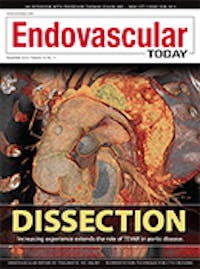
Advances in Treating Thoracic Aortic Dissection
The treatment paradigm for aortic dissection has changed considerably over the past few years. The benefits of endovascular surgery have revolutionized the care of patients with acute complicated type B dissection, and further advances are being made on a regular basis. However, aortic dissection still poses considerable challenges to the treating physician in terms of diagnosis, indications for intervention, long-term durability, and the application of endovascular techniques to challenging vascular territories.
Connective tissue disorders, which were among the exclusion criteria for early stent graft trials, pose a serious challenge for the treatment of aortic disease. James H. Black, III, MD, FACS, addresses CTO pathogenesis and procedural considerations to shed some light on this patient group.
Recently, further information has become available that may refine the indications for treatment in uncomplicated type B dissection, and a new classification system to aid reporting has been proposed, which Dr. Dake explains in his article on the mnemonic-based DISSECT system.
Professor Thompson discusses the 5-year outcomes of the INSTEAD trial with Principal Investigator Christoph A. Nienaber, MD, focusing on the study’s original design and goals, lessons learned from long-term follow-up, and the implications these findings may have on clinical practice.
Nimesh D. Desai, MD, PhD, and Joseph E. Bavaria, MD, shed light on the decision making for treating complicated aortic dissection, review treatment modalities, and provide results from their institution’s experience.
Kevin Mani, MD, PhD, FEBVS, and Anders Wanhainen, MD, PhD, explore the short- and long-term results of TEVAR in the treatment of chronic dissection and the impact of disease extent on the therapy’s success.
Nicola Mangialardi, MD; Eugenia Serrao, MD; Sonia Ronchey, MD, PhD; Holta Kasemi, MD; and Matteo Orrico, MD, look at the nuances of treating type A dissections. Both surgical and endovascular therapy remain challenging, but with the proper considerations, favorable results are possible.
In an interview with Endovascular Today, the FDA’s Dorothy B. Abel discusses the process of expanding approval for a thoracic endograft to the treatment of dissection in the descending thoracic aorta and the development of its postapproval study.
Outside of our TEVAR coverage, Haroon L. Chughtai, MD, FACC; James Torey, PA-C; Hiroshi Yamasaki, MD, FACC; and Thomas P. Davis, MD, FACC, explain the concept of a “reorientation” technique for crossing difficult chronic total occlusions, which utilizes intravascular ultrasound to remain in the true lumen of the vessel.
Gabriele Piffaretti, MD, PhD; Gianpaolo Carrafiello, MD; Filippo Piacentino, MD; and Patrizio Castelli, MD, FACS, review surgical and endovascular repair of traumatic IVC lesions. Although techniques have improved, current literature addressing this injury is sparse.
Looking forward to the year ahead, Katharine Krol, MD, FSIR, FACR, shares an overview of some of the revised CPT codes that go into effect on January 1, including those used to report vascular stenting, embolization, and fenestrated endovascular aneurysm repair.
Finally, we wrap up the issue with an interview with Professor Thomas Zeller, MD. He shares his insights on patient selection and various utilities for renal denervation, current data for drug-eluting balloons in lower-limb lesions, and other recent trials.
We hope you find this edition of Endovascular Today to be a practical summary of the most up-to-date data and topics of discussion in this important area of endovascular medicine.
Matt M. Thompson, MD, FRCS
Michael D. Dake, MD
Advertisement
Advertisement