Advertisement
Advertisement
United States August 2014 Supplement
Sponsored by Bard Peripheral Vascular, Inc.
Using IVUS to Guide Intraluminal Crossing of CTOs
An inside look at the anatomic advantages of central lumen crossing.
By James Torey, PA-C, and Tom Davis, MD
Chronic total occlusions (CTOs) of the lower extremities may be seen in up to 40% of patients with symptomatic peripheral artery disease.1 Various methods for performing endovascular peripheral interventions have been developed for this subgroup of lesions, including subintimal angioplasty and intraluminal mechanisms such as blunt catheter dissections, laser light, and vibrational energy. Subintimal angioplasty, also known as PIER (percutaneous intentional extraluminal recanalization), was first described by Bolia et al in a case in which an inadvertent subintimal channel of a totally occluded femoral artery was dilated and subsequently found to maintain its patency for 32 months.2
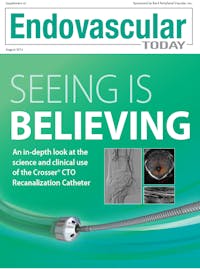
Alternatively, intraluminal devices have been designed to facilitate crossing of the CTO within the existing lumen. The Crosser® Catheter is a central lumen CTO crossing catheter with a tip that transmits high-frequency vibrations at 20,000 cycles per second at a forward depth of 20 μm that is delivered directly to the occlusion (Figure 1). The PATRIOT (Peripheral Approach to Recanalization in Occluded Totals) trial showed an 84% recanalization success rate of guidewire-resistant CTOs with the Crosser® Catheter, with no evidence of device-related clinical perforations; in addition, it displayed an exceptionally rapid lesion crossing time.3
While no direct comparison has been made of subintimal versus intraluminal crossing, at our institution intraluminal techniques are our primary approach, with PIER utilized as a bailout option. Understanding the importance of remaining as intraluminal as possible during crossing lies with understanding the anatomic effect of subintimal crossing. By deflecting into the media or the adventitial space, several anatomic distortions become inherent as a cost. As described in this article, intravascular ultrasound (IVUS) is a powerful tool to visualize these potential costs.
CENTRAL LUMEN CROSSING OF CTOs LOWERS DISSECTIVE EFFECTS
The process of deflecting into the subintimal space is a dissective process, as both the proximal and distal references experience tears into the medial plane that potentially compromise not only the anatomic integrity of the vessel but also impair or isolate the new lumen from the collateral circulation within this segment of the vessel. By utilizing central lumen crossing devices such as the Crosser® Catheter, these effects are potentially minimized.
By IVUS, we commonly see flow-limiting dissections and intramural or extravascular hematomas as a result of the PIER approach (Figure 2A). The hematoma is typically confined to a reference segment, but in the case of the superficial femoral artery (SFA), there are no significant side branches to limit its extension. Thus, the hematoma can travel and compress the entire length of the vessel, including the proximal or distal reference segment.
The characteristics of a hematoma are easily identifiable by IVUS: the base of the hematoma should be flush against the edge of the lumen (if intramural) or the edge of the adventitia (if extravascular) and extend outward in a “D” shape (Figure 2B). This will appear as a characteristic flattening effect on the inner edge. Intramural hematomas will maintain the size of the external elastic membrane in comparison to the segments of the vessel immediately proximal and distal to the hematoma. An extravascular hematoma will show compression of the external elastic membrane, with the hematoma initially growing to the size of the lost lumen it compressed and further growth only limited by the flow going into the hematoma and the space it occupies (Figure 2C).
A key attribute to assess in a hematoma is whether the hematoma communicates with luminal flow; in the case of an extravascular hematoma, this would constitute a form of perforation and would be considered high risk for subsequent pseudoaneurysm formation. High-flow hematomas (by grayscale IVUS) should appear black, and low-flow hematomas should be more solid in appearance, to the extent that it may be interpreted as a soft plaque on initial inspection.
CENTRAL LUMEN CROSSING AND COLLATERAL COMMUNICATION
Collateral loss is another potential drawback to subintimal crossings. Lipsitz et al reported in a study of 29 patients treated with subintimal angioplasty that 47% of the collaterals distal to and 26% of the collaterals proximal to subintimally treated CTOs of the lower extremity were lost after angioplasty.4 It should be noted that this study found that the collateral loss was not clinically significant because the reocclusions were not typically presenting as a threatened limb. It is postulated that new collaterals can be formed in the new subintimal channel, and this may provide protection if the treated segment reoccludes.
The study, however, employed angiography to assess whether the collateral was preserved. Using IVUS, we see considerably more patent collaterals and more collateral loss than can be appreciated by angiography. We can also easily establish whether the collaterals connect to the subintimal lumen or the true lumen, which is now isolated from systemic flow, despite their angiographic appearance of being intact. In a crossing utilizing a central lumen crossing device, such as the Crosser® Catheter, it is common to see multiple collaterals communicate with the lumen that the catheter creates within the intraluminal space.
By using IVUS, we can accurately document collateral preservation and also isolate collateral compromise, which may guide strategies to debulk the site in order to re-establish flow in the compromised collateral.
CROSSER® CATHETER DESIGNED TO AUGMENT CHANCE OF INTRALUMINAL CROSSING
Axial orientation is a primary focus of our IVUS runs, documenting not only which plane the crossing takes but also attempting to optimize the crossing to make it as intraluminal as possible. In our experience, utilizing the Crosser® Catheter enhances our ability to achieve purely intraluminal crossings versus a standard guidewire approach with a significantly lessened risk of deflection into the medial or adventitial planes.
The appearance of an intraluminal crossing is fairly distinct; the IVUS catheter is seen medial to the border of the internal elastic lamina with the medial stripe seen clearly lateral to the catheter (Figure 3A). The position of the catheter can be purely eccentric or central within the vessel, as this bears little impact on the overall quality of the crossing. The emphasis is on the catheter being in the former lumen of the vessel, no matter its position. The appearance of the overall vessel shape should be round and consistent with the reference segment external elastic membrane cross-sectional area.
It should be noted that within a total occlusion, the plaque is often seen as echolucent and fragmented or web-like in appearance. With the ChromaFlo™ (Volcano Corporation) option on, it is also not uncommon to see extensive microchannels of flow within the total occlusion that have multiple communications with collaterals.
Diffuse calcific changes that can be noted within the occlusion appear as bright plaques, which obliterate all imaging behind the lesion and are often the nidus for deflection into the medial plane. Despite this, in several of our cases, the Crosser® Catheter maintained an intraluminal orientation through a 360° wall of intralesion calcification.
In comparison to an intraluminal crossing, a medial deflection of the IVUS catheter has a distinct appearance. When devices enter the space within the media, both the lateral and medial edges of the crossing will displace, creating a tear that resembles a “sickle-shaped” lumen (Figure 3B). By the TAPE method (tears, axial [vs nonaxial], preservation [collaterals], and extension [treatment lesion length]), this orientation would be graded as an A1 orientation and is the standard orientation for an optimal PIER crossing.5 Reentry devices and wiring techniques work well within this space and are relatively straightforward and timely procedures.
A deeper deflection into the adventitial space or periadventitial area has a distinct appearance resembling a “snowman” or “figure 8” appearance (a small circle riding on top of a larger circle). The IVUS catheter rides in the smaller circle that is free of disease while the truly diseased vessel is seen adjacent to the lumen the IVUS catheter rides in. By the TAPE method, this orientation would be graded as A2 and is an undesired orientation for a PIER crossing. The distance between the false channel and true vessel can be significant in an A2 orientation, making reentry into the distal reference difficult or unfeasible, even when facilitated by reentry devices. Repeated attempts to enter the distal reference can cause substantial collateral loss to the segment and injury to the vessel wall, which could make this segment an unsuitable target if vascular bypass is opted for in the future.
INTRALUMINAL CROSSING AUGMENTS SUBSEQUENT INTERVENTION
Atherectomy in the lower extremities has been shown to be effective in removing significant amounts of plaque with low dottering effects.6,7 In the TRUE (Tissue Removal by Ultrasound Evaluation) study, we saw an average increased lumen size of 64.3 mm3 in the worst 20-mm segment, with an average plaque loss within that segment of 56.6 mm3. This means that 88% of the lumen gain was directly due to plaque removal. The overall vessel size expanded by only 1% in the study, whereas the lumen was increased by 43%. The 1-year target lesion revascularization (TLR) rate in this study was 11% (n = 2/18).
In our experience, these impressive numbers are enabled by the atherectomy device being used intraluminally. The potential advantages of atherectomy are lessened in a subintimal crossing secondary to the crossing being purely eccentric and abutting the adventitial edge in a PIER approach. A purely eccentric and A1 orientation can lead to excision of the adventitia, either by central cutting atherectomy devices or directional atherectomy. In a study last year, the presence of adventitial tissue in the tissue excised from directional atherectomy led to a pronounced increase in restenosis, with a 96.4% 1-year restenosis rate for patients who had adventitia in the sample analyzed and a 14.9% restenosis rate in those who did not.8
Uniform expansion by balloon-based devices (either percutaneous transluminal angioplasty or stent) also benefits from being intraluminal. Proper vessel preparation is important for SFA stenting and expansion. A purely eccentric orientation, which all PIER approach crossings constitute, has an inherent expansion disadvantage over a more concentric and intraluminal orientation.
CONCLUSION
The initial method of CTO crossing may have important implications on the amount of vessel injury that then guides further interventional strategies. Subintimal crossing is an accepted practice but is not without potential consequences. Vessel perforation, embolization, dissection, hematoma, compromise of important collaterals, and prolonged lesion treatment length are inherent pitfalls to be aware of with subintimal CTO crossings. The overall complication rate of the subintimal approach ranges between 6% and 17% due to the differing definitions.9-13 Vessel injuries may contribute to an accelerated vessel healing response and restenosis.
Utilizing central lumen crossing catheters, such as the Crosser® Catheter, may help minimize the anatomic sequelae of an infrainguinal CTO crossing and augment the ability to optimally treat the segment either by balloon-based intervention, atherectomy, stenting, or a combination thereof versus a standard PIER approach. The initial benefit at this point is substantial, especially in patients undergoing atherectomy. The long-term benefits of intraluminal versus subintimal crossing have yet to be established and require further investigation.
James Torey, PA-C, is with the Department of Internal Medicine, Division of Cardiology, St. John Hospital and Medical Center in Detroit, Michigan. Mr. Torey has disclosed that he has no financial interests related to this article.
Tom Davis, MD, is Director of the Cardiac Catheterization Lab at St. John Hospital and Medical Center in Detroit, Michigan. Dr. Davis has disclosed that he is a consultant for Bard Peripheral Vascular, Inc. Dr. Davis may be reached at (313) 343-4612; tpdavis60@aol.com.
The opinions and clinical experiences presented herein are for informational purposes only. The results may not be predictive for all patients. Individual results may vary depending on a variety of patient specific attributes. Mr. Torey and Dr. Davis have authored this article at the request of Bard Peripheral Vascular, Inc. Dr. Davis has been compensated by Bard Peripheral Vascular, Inc. for the time and effort in preparing this article for Bard’s further use and distribution.
- Boguszewski A, Torey J, Pai R, et al. Intraluminal recanalization of SFA CTOs. Endovasc Today. 2010;9:33-38.
- Bolia A, Miles KA, Brennan J, et al. Percutaneous transluminal angioplasty of occlusions of the femoral and popliteal arteries by subintimal dissection. Cardiovasc Intervent Radiol. 1990;13:357-363.
- PATRIOT evaluates FlowCardia’s Crosser to mediate CTO recanalization. Endovascular Today. October 22, 2009. http://evtoday.com/2009/10/eNews102909_07.htm. Accessed December 23, 2009.
- Lipsitz EC, Ohki T, Veith FJ, et al. Fate of collateral vessels following subintimal angioplasty. J Endovasc Ther. 2004;11:269-273.
- Boguszewski, A, Torey J, Davis T, et al. The TAPE method: a novel intravascular ultrasound scoring system for peripheral CTO lesions. Endovascular Today. 2012;11:32-38.
- Singh T, Torey J, Dhabuwala J, Davis T. Tissue Removal by Ultrasound Evaluation (the TRUE study): the Jetstream G2 system post-market peripheral vascular IVUS study. J Invasive Cardiol. 2011;23:269-273.
- Aboufakher R, Torey J, Szpunar S, Davis T. Peripheral plaque volume changes pre- and post-rotational atherectomy followed by directional plaque excision: assessment by intravascular ultrasound and virtual histology. J Invasive Cardiol. 2009;21:501-505.
- Prakash Krishnan, Usman Baber, K-Raman Purushothaman. et al. Histopathologic evidence of adventitial cuts predicts restenosis after directional atherectomy of lower extremity peripheral arterial disease: results from a randomized, open label, investigator-initiated trial comparing intravascular ultrasound-guided atherectomy to angiography guided atherectomy in peripheral vascular interventions for TASC's A, B lesions (UTOPIA) pilot study . J Am Coll Cardiol. 2012;59(13s1):E2083-E2083.
- Setacci E, Chisci G, de Donato F, et al. Subintimal angioplasty with the aid of a re-entry device for TASC C and D lesions of the SFA. Eur J Vasc Endovasc Surg. 2009;39:76-87.
- Sultan S, Hynes N. Five-year Irish trial of CLI patients with TASC II type C/D lesions undergoing subintimal angioplasty or bypass surgery based on plaque echolucency. J Endovasc Ther. 2009;16:270-283.
- Desgranges P, Boufi M, Lapeyre M, et al. Subintimal angioplasty: feasible and durable. Eur J Vasc Endovasc Surg. 2004;28:138-141.
- Antusevas A, Aleksynas N, Kaupas RS, et al. Comparison of results of subintimal angioplasty and percutaneous transluminal angioplasty in superficial femoral artery occlusions. Eur J Vasc Endovasc Surg. 2008;36:101-106.
- Keeling AN, Khalidi K, Leong S, et al. Subintimal angioplasty: predictors of long-term success. J Vasc Intervent Radiol. 2009;20:1013-1022.
Advertisement
Advertisement