Advertisement
Advertisement
Europe August 2014 Supplement
Sponsored by Cordis Corporation
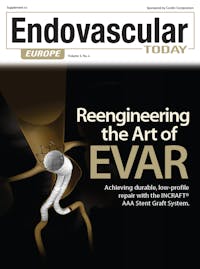
Reengineering the Art of EVAR
Achieving durable, low-profile repair with the INCRAFT® AAA Stent Graft System.
For the last 10 years, Cordis Corporation has labored over designing the INCRAFT® AAA Stent Graft System to make an optimal low-profile treatment option for abdominal aortic aneurysms (AAAs). In addition to creating a low-profile device, it was crucial for the INCRAFT® System to be durable and ensure good long-term outcomes. In August of 2014, the INCRAFT® System received CE Mark approval, allowing a broader range of patients to receive endovascular repair than ever before.
This supplement to Endovascular Today details the skillful engineering demonstrated by the INCRAFT® System through a series of articles from Cordis Corporation’s own team, the physicians that guided the development process, and top interventionists who have successfully put the stent graft into practice.
To start, Cordis engineers explain the key features of the INCRAFT® System, including its long-term durability, deliverability, proximal and distal placement accuracy, and broad anatomy coverage. Paralleling the developments in other endovascular procedures, reducing the device’s profile was of paramount importance to minimize invasiveness and provide the ability to treat a diverse set of anatomies, including those patients with tortuous, small, and/or highly calcified access vessels.* The team also presents two case studies in which the INCRAFT® System delivers precise repair without complications.
A key to the device’s refinement was the use of a multispecialty panel of experts, consisting of opinion leaders in interventional cardiology, vascular surgery, and interventional radiology. Robert Bersin, MD; Takao Ohki, MD; and Corey Teigen, MD, share the history of the product’s creation, starting with the preliminary stages and working through the rigorous testing performed to create a high quality device.
Giovanni Torsello, MD, provides insight into the device’s trimodular design, a critical component in achieving precise placement and reducing the potential for unintentional anatomy coverage in the hypogastric and renal arteries. Combined with the benefits of in-situ customization and modular junction force, the initial clinical experience has proven to have excellent results.
Cordis Corporation is conducting two trials for the INCRAFT® System, the INNOVATION Trial and INSPIRATION Trial. Roberto Chiesa, MD, and Ciochino Coppi, MD, detail the compelling 2-year data from the INNOVATION Trial as well as overviewing the rest of the clinical program.
Finally, Maxime Raux, MD; Prof. Jean-Pierre Becquemin, MD; and Kenneth Ouriel, MD, MBA, provide valuable perspective on type II endoleaks with a discussion on the identification, definition, and treatment of this unfortunately common complication that continues to be problematic in endovascular AAA repair.
I hope readers will discover an improved endovascular approach for AAA patients over the following pages.
Vincent Riambau, MD, PhD, is Professor and Chief of Vascular Surgery, Thorax Institute, Hospital Clinic, University of Barcelona in Spain. He has disclosed that he has no financial interests related to this article. Dr. Riambau may be reached at vriambau@clinic.ub.es.
Durability and long-term data of the INCRAFT® AAA Stent Graft System are based on 2-year clinical follow-up and benchtop data.
*Exercise caution in patients with irregular calcification and/or plaque as it may compromise the fixation and sealing of the implant, especially at the cranial and caudal sealing zones.
Advertisement
Advertisement