Advertisement
Advertisement
Within the past decade, there have been many technological advancements in the endovascular treatment of peripheral arterial disease (PAD) that have led to improvements in earlier interventional treatments. These less invasive procedures aim to preserve future treatment options and ultimately result in better patient outcomes. Even with these advancements, there still exists a number of patient and lesion types that pose treatment challenges, particularly the presence of calcified lesions as well as longer and more advanced lesions with high plaque burden.
Calcium is a prevalent real-world treatment challenge that is widely seen across many chronic conditions, such as diabetes and renal disease. It is a recognized predictor of lower procedural success and reduced long-term outcomes. One of the issues in treating calcium is its resistant nature. When dilated with a standard angioplasty balloon, a calcified lesion causes balloon overstretching in nondiseased tissue with subsequent vascular dissections, perforations, and recoil. This can lead to unintended bailout stenting that can limit both acute procedural and long-term success.1
Current drug-coated balloon (DCB) results are promising; however, undilatable calcium was an exclusion criterion in many of the DCB studies. DCBs do not address the physical limitations of dilating resistant plaque. More importantly, the presence of calcium acts as a mechanical barrier that may prevent an adequate concentration of drug and homogenous drug uptake from absorbing into the vessel wall. Fanelli et al evaluated a subset of 60 patients with lower extremity calcified lesions from the DEBELLUM study. The degree of calcification was determined by circumferential distribution of calcium via CT angiography and intravascular ultrasound, and length of calcified plaque was measured with digital subtraction angiography. All patients were treated with DCBs. This study demonstrated greater late lumen loss and lower 12-month patency in patients with increased calcification (Figure 1).2
Increased lesion length has also been identified as an independent predictor of restenosis in PAD treatment.3 Incidence of restenosis rates increase in longer lesions across all modalities. This has been demonstrated in multiple studies across all types of lower extremity interventions, including angioplasty balloons, stenting, atherectomy, and DCBs.
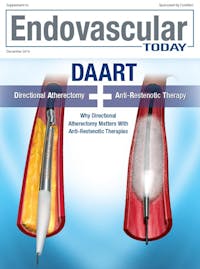
Treatment of both calcified lesions and long lesions continues to present a clinical challenge for the practicing interventionalist. A treatment option known as DAART (Directional Atherectomy plus Anti-Restenotic Therapy [DCB]) was recently studied in two separate clinical trials—DEFINITIVE AR and Cioppa et al. In this procedure, plaque is first removed using directional atherectomy, followed by drug delivery using a paclitaxel-coated balloon.
- Cioppa A, Stabile E, Popusoi, G, et al. Combined treatment of heavy calcified femoro-popliteal lesions using directional atherectomy and a paclitaxel coated balloon: one-year single centre clinical results. Cardiovasc Revasc Med. 2012;13:219- 223.
- Fanelli F, Cannavale A, Gazzetti M, et al. Calcium burden assessment and impact on drug-eluting balloons in peripheral arterial disease. Cardiovasc Intervent Radiol. 2014;37:898-907.
- Fanelli F, Cannavale A, Boatta E, et al. Lower limb multilevel treatment with drug-eluting balloons: 6-month results from the DEBELLUM randomized trial. J Endovasc Ther. 2012;19:571–580.
Advertisement
Advertisement