Advertisement
Advertisement
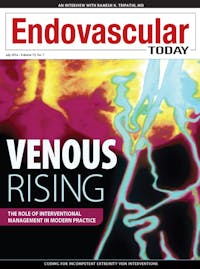
With increasing recognition of the public health importance of venous diseases, the role of endovenous therapies is expanding. The availability of more sophisticated venous-specific devices is on the horizon; these devices will further fuel the advancement of catheter-based interventions in veins.
As with inferior vena cava (IVC) filters, growth in endovenous procedures will attract the interest of industry as well as a higher level of scrutiny by regulatory agencies and payers. It is important to ensure that the application of existing and new technologies to the venous space follows a rational evidence-based path.
In this issue of Endovascular Today, we have invited experts to review select topics in the venous disease space.
IVC filters can provide important protection against pulmonary embolism when anticoagulation is not the right strategy for the patient, but global experience has shown that these risk-mitigation themselves also carry risk. Ramsey Al-Hakim, MD, and Justin McWilliams, MD, provide an update on the current guidelines and indications for placement and removal of temporary IVC filters, then draw upon their experience to describe advanced techniques for filter retrieval. In this month’s roundtable, a panel of physicians with diverse backgrounds—William T. Kuo, MD; Gerard Goh, MD; and Frank Arko, MD—offer their perspectives on the current usage of IVC filters, as well as geographic discrepancies in IVC filter use, distinctions among the filters that are available, and their hopes for future devices.
On the topic of venous thromboembolism, Mark J. Garcia, MD, describes an assessment algorithm and therapeutic protocols for the treatment of deep vein thrombosis, while Scott Genshaft, MD, and colleagues focus on endovascular approaches for safe and effective adjunctive treatment of submassive and massive PE, including catheter-directed thrombolysis and mechanical options in order to accelerate clearance of blood clot from the pulmonary arterial circulation.
It is clear there has long been a disparity between venous and arterial stent research. In an interview with Michael R. Jaff, DO, we explore the causes of this, the questions that must be answered by current and future trials, and the endpoints that modern trials will need to achieve.
Sandeep Bagla, MD, addresses the sometimes-overlooked topic of pelvic congestion syndrome. Along with treatment options and clinical data, he covers evaluation, imaging, and procedural techniques for treatment of this condition through gonadal vein embolization.
Splanchnic venous thrombosis, although rare, is potentially fatal. Mehran Midia, MD, and I provide a detailed review of this disease state that may provide interventionists a unique opportunity to play a leading role in patient management, discussing prevalence, management strategies, and percutaneous techniques for treatment.
Duplex ultrasound technology has its strengths and limitations, making the honing of ultrasound skills a vital element of venous disease evaluation. Jose I. Almeida, MD, covers patient positioning for evaluating venous disease and other tools, tips, and techniques as found in his clinic and in the literature.
Finally, recurrence remains an issue in the treatment of varicose veins. Edward G. Mackay, MD, identifies the causes and covers strategies for preventing inadequate procedures and treating new sources of incompetence, recanalized veins, neovascularization, abdominal and pelvic incompetence, and obstructive disease.
We hope that this issue of Endovascular Today will enrich your practice through providing these perspectives on the interventional management of venous disease.
Mahmood Razavi, MD
Guest Chief Medical Editor
Advertisement
Advertisement