Advertisement
Advertisement
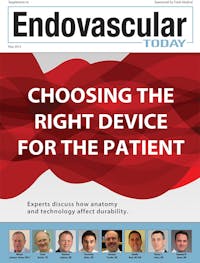
May 2014 Supplement
Sponsored by Cook Medical
Introduction: Progressive Aortic Aneurysm Disease
Aortic aneurysm repair is one of the flagships of vascular intervention. Aortic aneurysms were feared in the age of syphilis when affected aortic arches protruded up into the neck, throughout the 19th century and in the earlier half of the 20th. Even when treatment became available in the 1950s with prosthetic grafts it still daunted many in the latter half of the 20th century and, despite the quantum leaps in treatment technologies in the 1990s and first decade of this century, there is still work to be done.
Gone are the days of estimating the size of an abdominal aneurysm by palpation and retreating from treatment if the aneurysm extended above the renal arteries. Technology and knowledge have brought accurate diagnosis of the size and extent of aneurysms. Treatment of general health, with measures against accelerators such as smoking and hypertension, is reducing the prevalence and rate of growth. Technical advances in surgical techniques and prostheses have reduced the risks and increased the efficacy of intervention. However, this does not mean that the challenge of aortic aneurysm disease has been met—rather that the challenges have changed. One of these challenges is not what we can do, but what we should do and when should we do it because now we can replace every segment of the aorta, including the arch. Sometimes, we have to decide whether to treat one segment or multiple segments at the same time or which segment to tackle first. We need to bear foremost in our minds that this is a progressive disease that may require further primary or secondary intervention.
The prevalence of aortic aneurysm rises from 2.5% in white men aged 65 years to 11% in those older than 80 years. The odds ratio of developing this disease increases from 0.4 in those whose ethnicity originates near the equator to 1 in those whose ethnicity comes from northern latitudes, progressively changing toward the pole.1,2 Clearly, in the modern age, this is a disease that is influenced by genetic and environmental factors with age being the greatest risk factor. Herein lies the dilemma—treatment versus no treatment—from both an economic and a clinical riskbenefit perspective. The multicultural and ethnic mixing of modern societies may strengthen the aorta and behavioral influences may affect the rates of progression; however, with age, disease will progress.
Progression of the disease from the straight, nonbranched segments to the branched segments increases the risk and complexity of intervention by any technique until the risks outweigh the benefits. As the risk-benefit balance is steadily pushed toward a benefit with endovascular techniques in terms of quality life years, the challenge is to treat the entire length of the aorta, including the aortic root, without any or only minor adverse events.
The progression of aortic aneurysms is a reflection of the degenerative process of the aorta as a result of biological aging, constant pressure, and fatiguing pulsating forces—at times, we even feel the hammering to which our arteries are subjected. Mechanical forces weaken the aorta and balloon physics dictates that an aneurysm will expand and extend leading to tortuosity or rupture. Decussating fibers around major branches often hold the extensions back and angulation develops until the ballooning reaches the instability point. Then, the extensions progress, fascinatingly, along the line of major arteries derived from the fetal circulation, which defines those that are predisposed. Treating an aneurysm with a prosthesis demands that the prosthesis acts as a bridge from one secure bridge head to another, that we are not deceived by illusions of secure positioning and constant seal, that the repair will withstand potential worst-case disruptive force and last up to 20 years and that there may be a need for further repair or extension.
In this supplement engineers address the problems of securing and sealing at attachment sites and practicing physicians discuss the difficulties of matching the available prostheses to the pathological changes. The emphasis is on the underlying appreciation that the dynamics that caused the disease will progress along the aorta. Further intervention at the same or another site in the aorta is to be anticipated.
So, the modern challenge is to check all the predisposed arteries whenever examining the cardiovascular system, to make and install prostheses that address all of the problems in the progressively weakening aorta at an optimum time and to provide for more quality life years in a cost-effective and biologically beneficial way. Can we do this with current materials and techniques or do we need another quantum leap, like the one that was made in advancing to endovascular therapy as it is today? While this continues to be tested, every measured improvement takes us further along the way.
Professor Michael Lawrence-Brown, FRACS, is Emeritus Vascular Consultant at Royal Perth Hospital and Adjunct Clinical Professor at Curtin University in Perth, Western Australia.
- Norman PE, Jamrozik K, Lawrence-Brown MM, et al. Population based randomized controlled trial on impact of screening on mortality from abdominal aortic aneurysm. Br Med J. 2004;329:1259-1262A.
- Norman PE, Lawrence-Brown M, Semmens J, Mai Q. The anatomical distribution of iliac aneurysms: is there an embryological basis? Eur J Vasc Endovasc Surg. 2003;25:82-84.
Advertisement
Advertisement