Advertisement
Advertisement
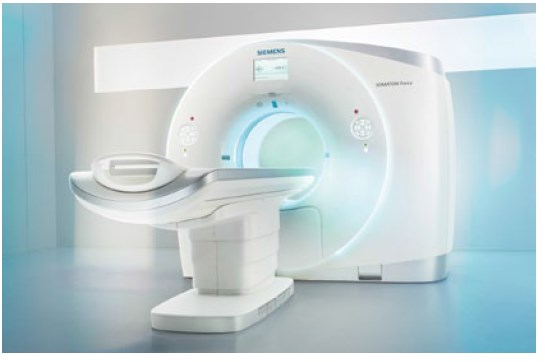
Somatom Force CT System
Siemens Healthcare
(888) 826-9702
usa.healthcare.siemens.com/computed-tomography
KEY FEATURES
• Conducts kidney-friendly scanning
• Freezes motion with free-breathing CT
• Advances preventative care initiatives with low-dose lung and colon scanning
Siemens Healthcare has received FDA approval for the Somatom Force CT system, a new-generation, dual-source CT system designed to extend advanced imaging to patients including young children, patients with renal insufficiency, and patients who are unable to hold their breath. The Vectron tube delivers routine adult imaging with fast, low-dose protocols. In cardiac imaging, the device can obtain an entire study at a native temporal resolution of 66 ms, including fast-moving anatomy, such as the right coronary artery.
“The massively enhanced tube power of the Somatom Force enables imaging that can be acquired at very low kV settings— and thus at a lower level of radiation dose,” said Joseph Schoepf, MD, Director of CT Research and Development and Professor of Radiology and Cardiology at Medical University of South Carolina.
ND Infusion Catheter
Translational Research Institute
(480) 309-2884
www.trimedical.com
KEY FEATURES
•Provides localization of physician-specified agents
• Spray mechanism improves distribution
• Low radial balloon forces minimize vessel trauma
• Single-size expandable balloon up to 4.5 mm
• Reduced shear stress on injected agents
• Easy-to-use monorail system
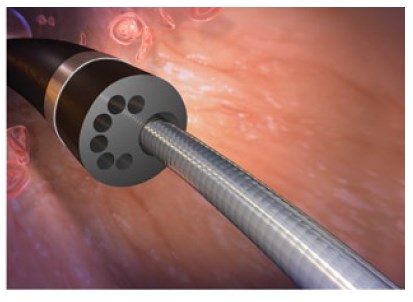
The ND infusion catheter, developed by Translational Research Institute (TRI), has received FDA 510(k) clearance and CE Mark approval. It can be used to infuse physician-specified drugs when treating conditions including cardiovascular and peripheral vascular disease.
The ND infusion catheter is a balloon catheter designed to isolate a specific treatment region from blood flow while directing the infusion of fluids into the specified region through multiple channels at the distal end of the catheter. The multiple-lumen spray mechanism helps to disperse therapeutic agents in a flow pattern that potentially allows for more homogeneous mixing and tissue distribution of the physician-specified fluid into the bloodstream compared to a single-lumen infusion catheter.
The catheter has a length of 135 cm, a diameter of 3 F, and is intended to be used with a ≥ 6-F guide catheter and 0.014-inch rapid-exchange guidewire for positioning. The variable-diameter balloon (1.7–4.5 mm) controls blood flow by adapting to different vessel diameters and is uniquely designed to reduce radial forces, potentially minimizing vascular trauma. An integrated expansion segment is designed to provide for volumetric expansion of the infusate and regulate the flow velocity before the agent enters the multiple lumens, potentially decreasing the likelihood of catheter occlusion.
Advertisement
Advertisement