Advertisement
Advertisement
May 2014
Wound Healing After Endovascular Procedures
Revascularization is the first step on a long road to recovery, but sustained healing requires customized treatments for each patient.
Patients who are candidates for revascularization procedures are frequently high risk, with comorbidities such as metabolic disorders, poor nutritional status, history of or current smoking, and/or poor glycemic control. They therefore require a systemic approach to medical management instead of one that treats only the immediate source of discomfort. This article presents an overview of integral factors that must be considered when providing wound-healing treatments.
INFECTION
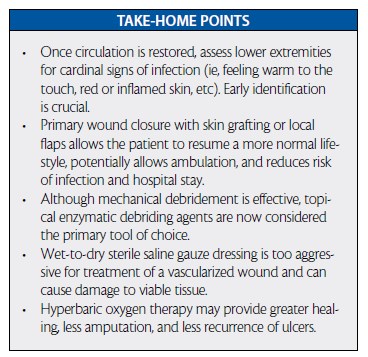
It is of paramount importance to assess the lower extremities for infection. Once circulation is restored, the lower extremities may demonstrate the cardinal signs of infection (ie, feeling warm to the touch, red or inflamed skin, etc.). Infection must be evaluated by multiple measures. Early identification and treatment of infections with appropriate, definitive antimicrobial therapy has been proven to reduce mortality risk, length of hospital stay, and health care costs.
The wound is best assessed with a tissue culture (bone and/or soft tissue) rather than a swab of the wound. DNA testing (known as target-enriched molecular multiplexing polymerase chain reaction) of the bacteria that inhabit the wound has improved the process of identifying pathogens in the wound. The test is performed via a swab of the wound but differs from a normal swab due to its sensitivity to the bacterial DNA and is not affected by the antibiotics that may be present. This process reduces the time it takes to identify the pathogen and its susceptibility, which allows an earlier onset of optimal antimicrobial treatment. If there is concern that osteomyelitis exists, a bone biopsy remains the gold standard evaluation.1 However, magnetic resonance imaging is still warranted to rule out deep abscesses.
Infection is usually the result of pre-existing foot ulceration and is the leading cause of lower extremity amputation in patients with diabetes and peripheral vascular disease.2 A staggering 80% of diabetics are hospitalized for foot ulcers, and a foot ulcer precedes 5% of amputations.3
WOUND CLOSURE
With blood flow restored and infection either nonexistent or eradicated, primary wound closure with skin grafting or local flaps become viable options.4 These treatments provide the opportunity to close wounds in a shorter period of time than they would on their own. If primary closure of the entire wound is not possible, decreasing the size of the wound followed by a combination of primary and secondary closure can also be an acceptable option. Primary closure allows the patient to resume a more normal lifestyle, with the possibility of ambulation when the appropriate shoe gear or prosthetic is used. There is also less chance of infection and less time spent in the hospital or extended care facility.
OTHER TREATMENT DECISIONS
Debridement
Debridement of the ulcer by both mechanical (with the use of a scalpel) and chemical means continues to be the cornerstone of treatment after revascularization. Debridement of nonviable tissue is essential to restoration and healing of the wound. Wound color, fluid balance, viability of the tissues, and odor should be evaluated for each wound debridement. It should be performed on a time schedule that is most beneficial to the particular wound.
Although the scalpel is mighty, topical enzymatic debriding agents that break down the necrotic tissue are now considered a primary tool of choice. The use of mechanical and chemical debridement can be effective in combination with one another or as stand-alone treatments.
Dressings
The many dressings choices, the details of which are beyond the scope of this article, continue to be a major contributor to the healing process. Fluid balance of the wound is a decisive measure of health and therefore the viability of the tissue. Once considered the standard dressing of choice, the wet-to-dry sterile saline gauze dressing is too aggressive for treatment of a vascularized wound, as it has been shown to cause damage to viable tissue.
Hyperbaric Oxygen
The use of hyperbaric oxygen (HBO) continues to be a complex issue. Patients with a recalcitrant ulcer(s) and other comorbidities (peripheral arterial disease, diabetes, ischemia, and gangrene) are often considered for this therapy, but there are currently no clear, formal criteria established for selecting patients who might be the best candidates for HBO therapy. The current studies are believed to be underpowered, and the results cannot be interpreted on a normal scale due to the multiple variants of patient selection. The high cost of HBO and timely application continue to be impediments to treatment as well.
In a study from the University of Alberta for the Canadian government, HBO therapy was compared to the standard treatment for diabetic foot ulcer(s) and found a savings of > $9,000 per patient when HBO was employed.5 Two separate studies by Löndahl6 and Kalani7 concluded that patients experienced greater healing, less amputation, and less recurrence of the ulcers when HBO was added to the treatment plan. In 2004, the Cochrane Collaborative reviewed HBO therapy for chronic wounds and concluded that HBO reduces the risk of amputation for patients with diabetic foot ulcers and increases the chance of healing at 1 year.8 This study was performed before the advent of below-the-knee below-the-ankle, pedal access, and hybrid procedures. In previous studies, all diabetic ulcers were included whether they were ischemic or not. There is a clear need for a study of HBO after revascularization.
CONCLUSION
Restoring blood flow continues to be the most important step in limb preservation and restoration. It is important to realize that in a world fraught with arterial and venous disease, cooperation and collaboration of treatment modalities and medical specialties is paramount in the fight against amputation. Despite advancements in endovascular treatment, early identification of at-risk patients still leaves much to be desired, as education of the medical and patient communities continues to be underserved.
Surveillance of the wound(s) and the patency of revascularization is key to the patient’s overall outcome. Home care wound nurses are therefore an important part of wound resolution. Communication with the patient about limitations and healing times should be discussed at every appointment, with the patient explaining this back to the health care professional.
Revascularization is the first step on a long and arduous journey to recovery, but recovery is only viable if it is sustainable. This requires treatment options that are customized to the patient and not a preset algorithm.
Alan Block, DPM, MS, FASPS, FACFAS, is Clinical Assistant Professor, Department of Orthopaedics, the Ohio State University in Gohanna, Ohio; member of the medical advisory board of Kent State University; Editor-in-Chief of the Journal of the American Society of Podiatric Surgeons; and Past President of the Ohio Foot and Ankle Medical Association. He has disclosed that he has no financial interests related to this article. Dr. Block may be reached at blockosu@gmail.com.
- Johnson BL, Conly JM. Osteomyelitis management: more art than science? Can J Infest Dis Med Microbiol. 2007;18:115-118.
- Galiano RD, Mustoe TA. Wound care. In: Thorne CH, ed. Grabb and Smith’s Plastic Surgery. 6th ed. Philadelphia, PA: Wolters Kluwer; 2007: 23-32.
- Dang CN, Boulton AJ. Changing perspectives in diabetic foot ulcer management. Int J Low Extrem Wounds. 2003;2:4-12.
- Barshes NR, Bechara CF, Pisimisis G, Kougias P. Preliminary experiences with early primary closure of foot wounds after lower extremity revascularization. Ann Vasc Surg. 2014;28:48-52.
- Chuck AW, Hailey D, Jacobs P, Perry DC. Cost-effectiveness and budget impact of adjunctive hyperbaric oxygen therapy for diabetic foot ulcers. Int J Technol Assess Health Care. 2008;24:178-183.
- Londahl M, Katzman P, Nilsson A, Hammarlund C. Hyperbaric oxygen therapy facilitates healing of chronic foot ulcers in patients with diabetes. Diabetes Care. 2010;33:998-1003.
- Kalani M, Jorneskog G, Naderi N, et al. Hyperbaric oxygen (HBO) therapy in treatment of diabetic foot ulcers: long-term follow-up. J Diabetes Complications. 2002;16:153-158.
- Kranke P, Bennett M, Martyn-St James M, et al. Hyperbaric oxygen therapy for chronic wounds. Cochrane Database Syst Rev. 2012;4:CD004123.
Advertisement
Advertisement