Advertisement
Advertisement
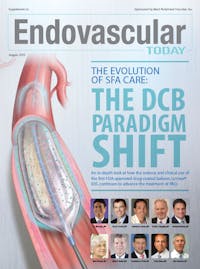
August 2015 Supplement
Sponsored by Bard Peripheral Vascular, Inc.
The Role of SFA Stenting in the DCB Era
How will drug-coated balloons change the role of stenting in the SFA?
Few endovascular technologies have been as anticipated as drug-coated balloons (DCBs). For at least 5 years, the endovascular community has been discussing the role of paclitaxel in the peripheral arterial system and its potential value, first on stents and now on angioplasty balloons. Do we finally have a solution for restenosis and intimal hyperplasia? Can we potentially eliminate the need to leave stents in patients? How will the long-term patency and, more importantly, the clinical efficacy of these technologies change our practice? These are all questions that we are just beginning to answer.
EVOLVING TREATMENT PARADIGMS AND TRIAL DATA
The treatment of patients with claudication has always been questioned. Should we treat a patient who has claudication if there is a 33% chance that he or she will require reintervention within the first 12 months with a plain old balloon angioplasty (POBA) and then likely have worse disease and symptoms, or at least harder-to-treat disease? More importantly, if an endovascular stent is placed as a first-line treatment option, are we limiting or making future treatments more difficult?
We welcomed DCB technology into our institution once it was made available. The inherent value of decreasing the restenosis rate without the need for a permanent implant was very appealing. The hope of increasing vessel patency and clinical outcomes after interventions made DCBs a natural replacement for POBA. Our initial experience included patients who would have traditionally undergone POBA treatment, as well as those in whom we traditionally would have utilized stents. Unfortunately, limitations, including the cost of the technology, were further magnified by a limited availability of balloon lengths. With the latest changes in outpatient reimbursement and the availability of longer balloon lengths for the LUTONIX® DCB (Bard Peripheral Vascular, Inc.), these initial limitations seem to have been addressed.
The LEVANT 2 trial led to the L® DCB becoming the first DCB to receive US Food and Drug Administration approval to treat the femoral and popliteal arteries. This trial randomized 476 patients in a 2:1 ratio between DCBs and POBA in a blinded fashion. At 12 months, the primary patency (peak systolic velocity ratio > 2.5) was shown to be superior for the DCB compared to POBA (73.5% vs. 56.8%). Furthermore, although no head-to-head studies have been conducted, the reported target lesion revascularization rates for the DCB at 12 months were similar to previous superficial femoral artery (SFA) stenting trials (with only a 2.5% bailout stenting rate in the DCB arm). LEVANT 2 also demonstrated the safety of the L® DCBs. The global registry trial (n = up to 1,000 patients) is evaluating the real-world use of the L® DCB. This registry is expected to provide important results as it represents a realistic lesion mixture, including chronic total occlusions, calcified lesions, and popliteal lesions. There is likely little reason to use POBA when a DCB can be used.
The RESILIENT trial demonstrated improved patency and target lesion revascularization rates with LIFESTENT® vascular stent (Bard Peripheral Vascular, Inc.) compared to angioplasty in moderate-length lesions, and a number of less rigorous self-expanding stent trials that have followed demonstrated similar results in the short term. The role of DES was met with optimism, and the long-term data demonstrated significantly improved patency compared to angioplasty and supported paclitaxel for treating neointimal hyperplasia. However, DES use has been limited in terms of widespread use because routine lesion lengths can exceed 20 cm.
As we evaluate stent technology in the SFA, do we understand the long-term risk compared to the potential benefits of leaving a permanent implant in the vessel? The use of stents in the SFA developed due to the need to increase patency over POBA; however, there are certain factors that may affect stent placement and retreatment options following stent placement. The decision to place a stent, as compared to angioplasty alone, may be based on a number of factors including the patient’s age and symptoms along with the lesion’s location, length, morphology, and native vessel diameter.
In patients with long-segment SFA disease, we are usually faced with the decision between DCB and primary stenting. The current DCB regulatory status, plus the lack of long lesion data for DCBs and lack of long DCB and DES lengths, makes the use of self-expanding stents more frequent, especially in older patients who may require more than 15 cm of coverage in order to treat the SFA. The 200-mm LIFESTENT® SOLO™ vascular stent has demonstrated favorable results in lesions between 150 and 180 mm.* Additionally, in patients with critical limb ischemia, multilevel disease is common. When these patients have long-segment SFA disease, the importance of maintaining SFA inflow becomes paramount to support tibial interventions. This is another situation in which self-expandable stents may be used to provide inflow for wound healing.
Is there value in treating all SFA lesion lengths up to 150 mm with a DCB and limiting the use of stents to areas that may demonstrate less-than-ideal results (> 30% residual or flow-limiting dissection)? Is it better for the patient if we place a focal stent in a long lesion instead of placing a stent throughout the treatment length?
CONCLUSION
In the DCB era, we will find out whether the push toward less stenting proves to be the best treatment paradigm and whether DCBs, such as the L® DCB, effectively limit restenosis and allow patients to have more durable results while limiting the use of stents in the SFA. Without a doubt, drug elution has a true benefit. How we develop the best treatment algorithm will likely require further experience and evaluation of the outcomes.
Constantino S. Peña, MD, is an interventional radiologist with Miami Cardiac and Vascular Institute in Miami, Florida. He has disclosed that he serves on advisory boards for Bard Peripheral Vascular, Inc., Penumbra, Inc., and Boston Scientific Corporation. He has also been involved with teaching and speaking for Cook Medical. Dr. Peña may be reached at tinopena@msn.com.
Disclaimer: The opinions and clinical experiences presented herein are for informational purposes only. The results may not be predictive for all patients. Individual results may vary depending on a variety of patient-specific attributes. Dr. Peña has been compensated by Bard Peripheral Vascular, Inc. for the time and effort in preparing this article for Bard’s further use and distribution.
*The LIFESTENT® vascular stent system is intended to improve luminal diameter in the treatment of symptomatic de novo or restenotic lesions up to 240 mm in length in the native SFA and proximal popliteal artery with reference vessel diameters ranging from 4 to 6.5 mm.
Advertisement
Advertisement