Advertisement
Advertisement
Europe January 2015 Supplement
Sponsored by Covidien
A Brief Discussion of the Midterm Results Using Onyx™ Liquid Embolic System in Treating Persistent Type II Endoleaks After EVAR
By Michel Bosiers, MD; Arne Schwindt, MD; Konstantinos P. Donas, MD, PhD; and Giovanni Torsello, MD, PhD
STUDY OVERVIEW
We retrospectively reviewed our prospectively maintained database in search of patients who, until December 2011, had persistent type II endoleaks, with growth of their aneurysm diameter of > 5 mm and were treated with Onyx™ liquid embolic system.
RESULTS
Our mid-term results in 10 patients with 13 type II endoleaks resulted in technical success in nine patients (12 out of 13 endoleaks [92%]). In one patient, a strong angulated orifice of the iliolumbar artery led to a rupture of the internal iliac artery, which required us to abort the procedure and instead place a covered stent in the internal iliac artery. In the remaining nine patients, treatment with Onyx™ liquid embolic system succeeded very well.
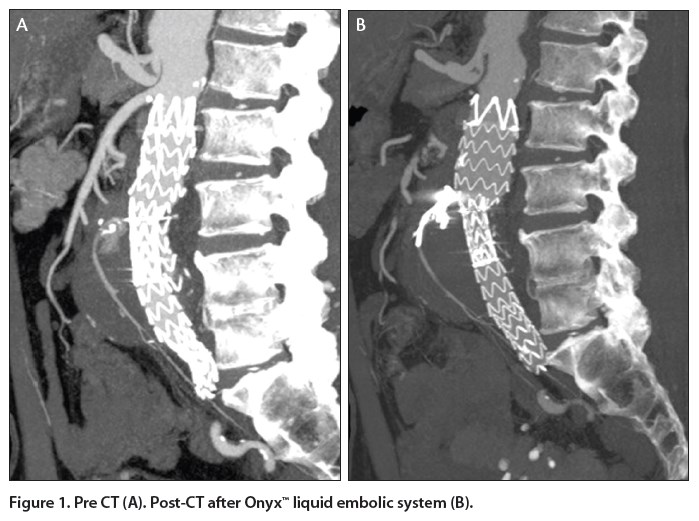
There were two patients in whom we had to perform a staged procedure due to unconnected type II endoleaks.
During the follow-up period of 3 to 31 months, we observed that all patients with successful embolization remained stable or exhibited shrinkage of their aneurysms.
In one patient there was extravasation of the Onyx™ liquid embolic system out of the aneurysm sac into the inferior vena cava, which required retrieval with a GooseNeck™ snare maneuver.
CONCLUSIONS
We also looked at patients with type II endoleaks we had treated previously with mainly coil embolization or open conversion. We saw that in the coil embolization group, we had to perform reinterventions because they did not remain stable or did not exhibit shrinkage. We can conclude that embolization with Onyx™ liquid embolic system is a feasible and safe procedure, as well as being more efficient compared to coil embolization alone. In our institution, we use Onyx™ liquid embolic system as our standard treatment for type II endoleaks.
Advertisement
Advertisement