Advertisement
Advertisement
March 2015 Supplement
Sponsored by Gore & Associates
Management of Aortoiliac Aneurysms: Preserve or Sacrifice the Hypogastric Artery?
Clinical experience with the GORE® EXCLUDER® Iliac Branch Endoprosthesis.*
More than 30% of patients with abdominal aortic aneurysms have further aneurysmal changes in the common iliac artery or internal iliac artery.1 Endovascular abdominal aortic aneurysm repair (EVAR) is frequently applied to a large variety of patients with aortoiliac aneurysms. The key question in the management of aortoiliac aneurysms is whether to preserve or sacrifice the hypogastric artery.
The EUROSTAR registry showed a significant risk for Type 1B endoleak, reintervention, and rupture when aortoiliac aneurysms were treated with standard endografts.2
Current literature indicates the frequency and intensity of pelvic ischemia resulting from embolization or from covering of the hypogastric artery remain unpredictable, and upon onset, there is no standard solution for an adequate technical repair.3,4 In theory, the occlusion of the hypogastric artery can be well tolerated; however, in real life, the issue is more complex.
Different complications (e.g., buttock claudication, colitis, sexual dysfunction, and paraplegia) that can potentially occur after occlusion of the internal iliac artery can hardly be predicted or treated with standard procedures. In terms of individual treatment planning, it is in general agreement regarding these uncertain circumstances to preserve at least one hypogastric artery.5 Iliac branched EVAR devices provide a completely endovascular method for treating extensive aortoiliac or iliac aneurysms (Figures 1 , 2, and 3) while concomitantly preserving hypogastric artery flow. Iliac branched device technology has evolved over the past decade and has demonstrated a low complication rate both during and after the procedure.6
DEVICE
The GORE EXCLUDER Iliac Branch Endoprosthesis has been available in Europe since November 2013 and is specifically designed to treat common iliac aneurysms and aortoiliac aneurysms while preserving flow in the hypogastric artery. This complete system is compatible with a 16 Fr introducer sheath and offers repositionability using a simple, two-stage deployment mechanism via a nested deployment knob. Based on the GORE EXCLUDER Device platform, the GORE EXCLUDER Iliac Branch Endoprosthesis is flexible and low profile and is intended to achieve high conformability and sealing in the often considerably tortuous iliac arteries (Figures 4A and 4B).
Required anatomical characteristics include a proximal diameter of the common iliac artery of at least 17 mm. There is no limitation regarding the length of the iliac common artery; the prosthesis can be deployed above the aortic bifurcation. It is recommended, however, that the distance between the renal artery and iliac bifurcation should be at least 16.5 cm.
DISCUSSION
Common iliac artery aneurysmal changes complicate standard EVAR. The hypogastric artery is at risk of occlusion in 20% to 40% of patients with abdominal aortic aneurysms.7-9
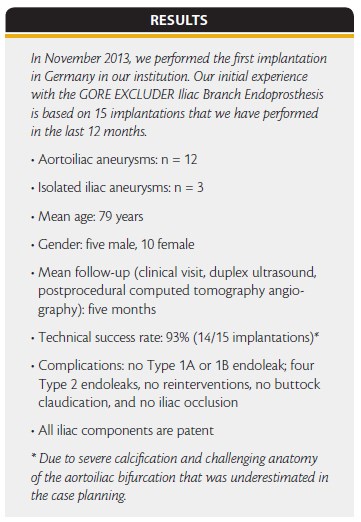
Occlusions of the internal iliac artery are associated with several potential complications. Regarding the morbidity that is associated with these complications, from today’s perspective and technical feasibility, iliac branch technology for hypogastric preservation is a promising option for patients with appropriate anatomy. The GORE EXCLUDER Iliac Branch Endoprosthesis technology has the potential for an effective and safe treatment of most of the iliac artery aneurysms. In the short-term follow-up from our center's experience, the exclusion of the aneurysm, as well as prevention of ischemic complications, was effectively achieved.
Reza Ghotbi, MD, is with the Department of Vascular and Endovascular Surgery, Helios Hospital Munich-West, Teaching Hospital of Ludwig-Maximilian University of Munich, in Munich, Germany. He has disclosed that he has no financial interests related to this article. Dr. Ghotbi may be reached at reza.ghotbi@helios-kliniken.de.
Sylvia Schoenhofer, MD, is with the Department of Vascular and Endovascular Surgery, Helios Hospital Munich-West, Teaching Hospital of Ludwig-Maximilian University of Munich, in Munich, Germany. He has disclosed that he has no financial interests related to this article.
- Armon MP, Wenham PW, Whitaker SC, et al. Common iliac artery aneurysms in patients with abdominal aortic aneurysms. Eur J Vasc Endovasc Surg. 1998;15:255-2557.
- Hobo R, Sybrandy JE, Harris PL, Buth J; EUROSTAR Collaborators. Endovascular repair of abdominal aortic aneurysms with concomitant common iliac artery aneurysm: outcome analysis of the EUROSTAR Experience. J Endovasc Ther. 2008;15:12-22.
- Henretta JP, Karch LA, Hodgson KJ, et al. Special iliac artery considerations during aneurysm endografting. Am J Surg. 1999;178:212-218.
- Paty PK, Shah DM, Chang BB, et al. Pelvic ischemia following aortoiliac reconstruction. Ann Vasc Surg. 1994;8:204-206.
- Farahmand P, Becquemin JP, Desgranges P, et al. Is hypogastric artery embolization during endovascular aortoiliac aneurysm repair innocuous and useful? Eur J Vasc Endovasc Surg. 2008;35:429-435.
- Karthikesalingam A, Hinchliffe RJ, Holt PJ, et al. Endovascular aneurysm repair with preservation of the internal iliac artery using the iliac branch graft device. Eur J Vasc Endovasc Surg. 2010;39:285-294.
- Wyers MC, Schermerhorn ML, Fillinger MF, et al. Internal iliac occlusion without coil embolization during endovascular abdominal aortic aneurysm repair. J Vasc Surg. 2002;36:1138-1145.
- Bergamini TM, Rachel ES, Kinney EV, et al. External iliac artery-to-internal iliac artery endograft: a novel approach to preserve pelvic inflow in aortoiliac stent grafting. J Vasc Surg. 2002;35:120-124.
- Carpenter JP, Baum RA, Barker CF, et al. Impact of exclusion criteria on patient selection for endovascular abdominal aortic aneurysm repair. J Vasc Surg. 2001;34:1050-1054.
*CE Mark approved.
Caution: Investigational Device. Limited by United States Law to Investigational Use
Advertisement
Advertisement