Advertisement
Advertisement
November 2015
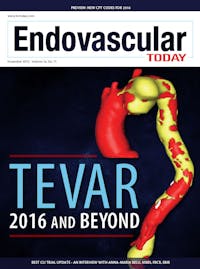
TEVAR: Advances and Remaining Questions
By Edward Y. Woo, MD, and Ian M. Loftus, MD, FRCS, Guest Chief Medical Editors


The endovascular management of thoracic aortic pathologies continues to develop in tandem with exciting technological advances and a recognition of the potential benefits compared to open surgical options. There remain many controversial aspects in this field in terms of in whom, when, and how we intervene—topics we have tried to cover in this month’s edition of Endovascular Today.
The Holy Grail for many endovascular enthusiasts is the complete solution to the aortic arch. Cherrie Z. Abraham, MD, and Victor M. Rodriguez, MD, provide a review of the latest developments in this field, including a number of subclavian branch devices and double branch grafts—which are undergoing clinical trials with promising results. Because these devices are not widely available, many still rely on hybrid and parallel graft solutions.
Matthew P. Sweet, MD, and Benjamin W. Starnes, MD, further review endovascular options for arch pathologies and the current status of branch grafts for the treatment of thoracoabdominal aneurysms. They touch on the potential to integrate valve, coronary, ascending, and arch devices to create the complete arch solution. They remind us that conventional thoracic devices continue to develop in tandem with more ambitious solutions with lower profiles, better conformability, and deployment improvements. It is vital that, as we expand our ambitions in the management of the thoracic aorta, we continue to improve the safety, applicability, and durability of conventional TEVAR.
The distinct lack of randomized trials focused on the thoracic aorta is an issue due to the diversity of thoracic aortic pathologies, and the deficit contributes to a lack of consensus on the management of a number of clinical scenarios. This is clearly demonstrated in the review of aneurysmal complications of aortic coarctation by Colin D. Bicknell, MD, FRCS, and Mohamad Hamady, MBChBm, FRCR. They suggest that, with improvements in stent technologies, an endovascular approach should be first-line treatment.
There remain a number of controversies relating to many aspects of the management of acute aortic syndromes. The INSTEAD trial was designed to guide management of uncomplicated type B dissection, and long-term results suggest a benefit from early endovascular intervention compared to optimum medical therapy and surveillance. This is supported by a number of observational cohort studies and other clinical trials are in the pipeline.
Zhu Ting, MD, PhD, and Weiguo Fu, MD, PhD, from Shanghai, outline their practice of routine intervention in the subacute phase with coverage of the left subclavian and minimal aortic coverage to reduce spinal cord ischemia risk. They note, however, that further work is needed to fully define treatment protocols.
Young-Wook Kim, MD; Yang-Jin Park, MD; and Duk-Kyung Kim, MD, examine the optimal imaging for aortic dissection and how this can be used to optimize current management protocols, including the use of MRI and echocardiography.
Prof. Michael Jacobs, MD, PhD; Dr. Barend Mees, MD, PhD; and Prof. Geert Willem Schurink, MD, PhD, look at thoracoabdominal aortic repair in patients with connective tissue disorders. Benjamin O. Patterson, PhD, MRCS, and Robert J. Hinchliffe, MD, FRCS, discuss the poor understanding of the natural history of thoracic aneurysms and the heterogenous nature of the available literature. They also outline the results of the major TEVAR clinical trials and put this into the context of balancing risk of intervention versus risk of aortic rupture/death. They suggest an individualized approach with different aortic diameter thresholds set for various clinical scenarios but stress that better long-term natural history studies are essential.
Finally, we asked a group of experts to consider two further areas of controversy: whether coverage of the celiac artery without revascularization is acceptable, and the management of penetrating aortic ulcers.
We hope you enjoy these reviews and personal observations relating to this exciting and fast-moving field.
Edward Y. Woo, MD
Ian M. Loftus, MD, FRCS
Guest Chief Medical Editors
Advertisement
Advertisement