Advertisement
Advertisement
October 2015 Supplement
Sponsored by Cordis Corporation
Placement Accuracy and Customization
Prof. Jose M. Abadal, MD, PhD; Prof. Miguel Araujo, MD; and Prof. Esther Vazquez, MD, discuss their clinical experience using this innovative stent graft system.
By Prof. Jose M. Abadal, MD, PhD; Prof. Miguel Araujo, MD; and Prof. Esther Vazquez, MD



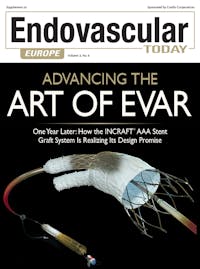
An essential feature of any endovascular device used to treat abdominal aortic aneurysms (AAAs) is the ability to accommodate any necessary changes after the delivery system has been introduced. The INCRAFT® AAA Stent Graft System (Cordis Corporation) was designed to solve the limitations of previous-generation endovascular devices, particularly with regard to versatility, accuracy, and real-time customization.
Profs. Abadal, Araujo, and Vazquez discuss two key attributes of the INCRAFT® AAA Stent Graft System—placement accuracy and in situ customization—and present several cases illustrating the device’s benefits in real-world clinical practice.
Why did you decide to first try the INCRAFT® AAA Stent Graft System?
We have extensive experience in AAA endovascular treatment, but in working with other endografts over the years, we have encountered problems, such as difficulties with femoral and iliac access and navigation as well as a need for multiple device sizes and lengths to account for different anatomies. The launch of the INCRAFT® System has made our daily practice easier, not only because of the ultra-low profile and flexible delivery system, but also the trimodular design of the graft, which allows the procedure to be optimized using the fewest prostheses and covers a broad number of cases with simplified inventory management.
How have you adopted the INCRAFT® AAA Stent Graft System in your practice?
The INCRAFT® System has become a device that is routinely used in our practice. Specifically, it is our first choice to treat AAA patients with narrowed and diseased aortoiliac vessels and access. The main benefits of the INCRAFT® AAA Stent Graft System are the device’s ultra-low profile and its in situ iliac extension customization.
Why is placement accuracy important to you?
Placement accuracy is one of the key goals of the AAA endovascular procedure and enables a great result, reducing any unexpected complications. Placement accuracy is also related to long-term clinical success. Device misplacement can result in endoleaks and persistence of aneurysmal sac enlargement, which increases endovascular and surgical complexity and risk of reintervention.
In your experience, how does the placement accuracy of the INCRAFT® System compare to other devices?
Placement accuracy of the INCRAFT® System is enhanced by the distinctive proximal and distal radiopaque markers that can be partially repositioned prior to full deployment. Although every case is planned in advance with precise measurements, and the optimal graft is selected for each patient, there is always a minimal intraprocedural discrepancy. The INCRAFT® device is versatile and aids in intraprocedural graft adjustment, without requiring other unplanned grafts. That is an important difference from competitors and a very important issue in emergency cases.
What are the benefits of placement accuracy of the INCRAFT® System to the patient, physician, and institution?
The INCRAFT® endograft offers customized treatment to a broader range of patients. Moreover, it may allow patients with AAAs to be treated who otherwise would not be candidates for endovascular repair using other devices because of anatomic constraints, for example, narrowed iliac vessels (diameter < 7 mm) or tight aortoiliac bifurcation (10-mm limb diameter).
For the clinician, the easier the procedure, the better results in terms of surgery, access and placement complications, grafts needed, radiation exposure, etc. Our feeling is that the anatomic variations during the surgery do not have an important impact on your planning and resource management.
For the institution, we can stock less inventory using the INCRAFT® System compared with any other endoprostheses, because of its in situ length customization. In our experience, the flexibility of the INCRAFT® System allows placement in up to 90% of AAA procedures. Billing prediction per procedure has been simplified because fewer product codes are needed, and there is a low variation in the number of devices used in patients because of its trimodular design.
Does improved placement accuracy lead to a reduction in acute and chronic complications?
Data on placement accuracy from the INNOVATION study have demonstrated a 2-mm median distance from the lowest renal artery to the graft edge markers in 58 interventions, with no reports of stent migration in 50 cases at 2 years. Data on in situ limb adjustment also outline distal limb accuracy with a median 12-mm distance from the origin of the internal iliac artery. These technical data correlate with the excellent 1-year results and absence of complications: 0% type I or III endoleaks and no aneurysmal sac enlargement.1
Can you explain in situ length customization? How does this work? What are the benefits of this feature?
In situ length customization allows a clinician to adjust the graft in real time during the procedure. The limb length can be adjusted bilaterally, up to 3 cm ipsilaterally and 2 cm contralaterally. This substantially improves placement accuracy and reduces the risk of inadvertent side branch coverage.
The safety of variable limb overlapping is enhanced by suture knots in the outer surface of the limb stent, which provides more stability and firms up the modular junction.
The benefit is obvious, because you can use the same iliac extension for different lengths; as a result, a broad range of patients can be treated with a small stock. This issue is very important in ruptured AAAs. The device’s versatility allows us to treat patients easily and quickly, even in emergency cases, when there is little time for planning and measurements.
What are the main benefits of the INCRAFT® System as compared to other devices you use in your practice?
First, the iliac limbs of the main graft have 11 mm in diameter; this feature is important in small and diseased aortic bifurcations. The very low profile system (equivalent to a 12-F catheter sheath introducer profile*) allows the device to be introduced through the superficial femoral artery in high and diseased femoral bifurcations. The delivery system is extremely easy and precise for suprarenal fixation and the aortic main body, and without a cap at the top, deployment and the retrieval of the graft is simplified. The learning curve is also reduced when compared to other devices.
*The iliac limb delivery system has a 12-F outer diameter for prothesis diameters between 10 mm and 20 mm and the 13-F outer diameter for the 24-mm diameter prosthesis.
1. Torsello G, Scheinert D, Brunkwall JS, et al. Safety and effectiveness of the INCRAFT AAA Stent Graft for endovascular repair of abdominal aortic aneurysms. J Vasc Surg. 2015;61:1-8.
CASE 1: NARROWED AORTIC BIFURCATION
CASE 2: TORTUOUS AORTOILIAC ARTERIES†
†Exercise particular care in areas that are difficult to navigate, such as areas of stenosis, intravascular thrombus, calcification or tortuosity, or where excessive resistance is experienced, as vessel or catheter damage could occur. Consider performing balloon angioplasty at the site of a narrowed or stenotic vessel, and then attempt to gently reintroduce the catheter delivery system. Also exercise care with device selection and correct placement/positioning of the device in the presence of anatomically challenging situations such as areas of significant stenosis, intravascular thrombus, calcification, tortuosity, and/or angulation, which can affect successful initial treatment of the aneurysm.
CASE 3: NARROWED ILIAC VESSELS†
*The iliac limb delivery system has a 12-F outer diameter for prothesis diameters between 10 mm and 20 mm and the 13-F outer diameter for the 24-mm diameter prosthesis.
†Exercise particular care in areas that are difficult to navigate, such as areas of stenosis, intravascular thrombus, calcification, or tortuosity, or where excessive resistance is experienced, as vessel or catheter damage could occur. Consider performing balloon angioplasty at the site of a narrowed or stenotic vessel, and then attempt to gently reintroduce the catheter delivery system. Also exercise care with device selection and correct placement/positioning of the device in the presence of anatomically challenging situations such as areas of significant stenosis, intravascular thrombus, calcification, tortuosity, and/or angulation, which can affect successful initial treatment of the aneurysm.
CASE 4: ISOLATED COMMON ILIAC ANEURYSM
‡The third-party trademarks used herein are trademarks of their respective owners.
Advertisement
Advertisement