Advertisement
Advertisement

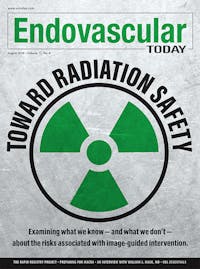
Exposure to ionizing radiation during procedures is something that interventionists from every specialty have in common. However, the risks to ourselves, our coworkers, and our patients are not well understood, in part because it is still so hard to quantify exposure. Yet, we are confronted with disturbing and confusing signals, such as those that have raised concerns about radiation-induced brain cancers in interventionists. As a result, there is dramatic variation in how much risk each person is willing to accept.
We all know that ionizing radiation carries risk, that less radiation is better, and that the person with “the foot on the pedal” is in most control of exposure. The purpose of this issue of Endovascular Today is to raise your awareness of radiation risks to the people working in the room—you and your staff. The more that you understand and are aware of what you can do to decrease exposure, the safer the procedural suite will be for everyone. I am very grateful to the superb group of experts who have contributed very interesting, helpful, and thought-provoking articles for this issue, often on very short timelines. In particular, Dr. Gabriel Bartal (whom I am privileged to call a friend) provided invaluable advice and assistance in putting this together—a testimony to his commitment to advancing radiation safety.
The cover focus begins with a helpful field guide to radiation terminology by Robert G. Dixon, MD, and Kent M. Ogden, PhD. Because the average interventionist may not use this terminology on a regular basis, we wanted to provide a brief overview of the commonly used definitions and acronyms to be sure there is clear communication on these important topics. With the language down, what steps can we take to minimize radiation risk to our patients, ourselves, and our fellow staff? Gabriel Bartal, MD, and colleagues discuss the growing use of fluoroscopically guided interventional procedures and the practical steps that can be taken to protect everyone involved.
The next few articles hone in on the specific radiation-related risks that we may be exposed to in the procedural suite. Ariel Roguin, MD, and Gabriel Bartal, MD, present an article detailing radiation exposure to the brain, data on the associated risk of cancer, and possible neurologic effects. Rebecca M. Marsh, PhD, and Michael Silosky, MS, continue this conversation by evaluating the risks of brain exposure to radiation, highlighting the fact that there is still much controversy about how great these risks actually are.
Unfortunately, fewer than 10% of interventional radiology and interventional cardiology trainees are women, which is one of the lowest percentages of women among all 41 medical specialties. This is partly due to concerns over radiation exposure during the childbearing years. Therefore, Christine Ghatan, MD, and Nishita Kothary, MD, break down the data on these risks and discuss safety measures and dose reduction tips for these operators. The last specific risk factor we examine is that of cataract development. Kevin Seals, MD, and colleagues present an excellent analysis of this risk to the interventionist and the appropriate preventive measures that can be undertaken.
To close this feature, Graciano Paulo, PhD, et al review how radiographers can develop a professional culture of safety to reduce the risk of radiation to their colleagues and patients and emphasize the importance of education, training, and communication to maximize protective efforts. We must always keep in mind that everyone in the room is being exposed and is therefore at risk.
Apart from our focus on radiation protection, we also have two articles highlighting the top five essential components to consider when practicing in an office-based lab. Jeffrey Wang, MD, provides his top tips for deep venous care in this setting, while Nicholas J. Petruzzi, MD, and colleagues, take on peripheral artery disease and critical limb ischemia.
Also, in our Regulatory Update, Jose Pablo Morales, MD, and colleagues share an overview of and goals for RAPID (Registry Assessment of Peripheral Interventional Devices), one of the PASSION CV registry projects approved by the Scientific Oversight Committee of the Medical Device Epidemiology Network Public-Private Partnership. Next, we have an article from our expert on coding and reimbursement, Katharine L. Krol, MD, who shares a brief summary of what you need to know to be prepared for when MACRA (Medicare Access and Children's Health Insurance Program Reauthorization Act) is implemented early next year.
To close this issue, our featured interview with William J. Mack, MD, covers some of the key topics of discussion at the recent Society of NeuroInterventional Surgery annual meeting and the ongoing work in the field of neurointerventional stroke care.
Image-guided interventions will continue to expand in scope and application, so it is likely that ionizing radiation will remain a part of our work lives for a long time to come. As Sergeant Phil Esterhaus used to say at the beginning of every day, “Let's be careful out there.”
John A. Kaufman, MD, MS
Advertisement
Advertisement