Advertisement
Advertisement
June 2016
Tissue-Engineered Vascular Grafts for Dialysis Access
Jeffrey H. Lawson, MD, PhD, discusses the present status of this technology and its path from concept to reality.
Tissue-engineered vascular grafts (Humacyte, Inc.) utilize donated human cells placed on a tubular scaffold to form a vessel, which is then cleansed of the qualities that might trigger an immune response. The receiving patient’s own cells then populate the vessel, with the goal of creating a viable option for use in dialysis access.

What was the genesis of your work toward developing tissue-engineered vascular grafts?
Dr. Lawson: It started when my partner, Dr. Laura Niklason, recognized how difficult it was to harvest leg veins for use in heart surgery and became inspired to engineer a human blood vessel. She and I met at Duke when we were both starting our careers (I was a vascular surgeon/biologist, and she was an anesthesiologist/biomedical engineer), and we formed a partnership to see if, on a very basic level, we could make bioengineered blood vessels and implant them in small animals.
What were some of the early challenges you encountered, and how did you overcome them?
Dr. Lawson: Some early challenges were simple structural issues. We had a lot of prototypes that failed because the mechanical structure just wasn’t strong enough. It took several years to figure out how to make a bioengineered blood vessel on a scaffold, in the shape of a tube, that could be strong enough to sew into an animal and withstand the forces required for normal arterial blood flow. We worked extensively in the late 1990s on those kinds of issues, and by the early 2000s, we were able to make prototypes for animals that were relatively robust.
The next step was making a universally available tissue-engineered structure, which is what we believe we’ve been able to accomplish. This required a new step in the manufacturing process to remove the original cells that were used to make the tissue, thus removing the donor antigens from the vessel. By having these universally available vessels ready for use, patients are not required to use their own tissue in order to make the implant.
The final significant hurdle in developing this technology has been navigating the regulatory process. Although we have had great support in working with the US Food and Drug Administration (FDA), when you’re making a novel tissue or therapy, no one really knows what the technology is and how to treat it. I would say the engineering hurdles and navigating the regulatory pathways were equally significant in moving this technology forward.
Were you surprised when the first human tissue grafts implanted in patients undergoing hemodialysis maintained long-term patency?
Dr. Lawson: There is a leap of faith when you’ve been doing years of preclinical work, but you don’t really know how it will work in humans until you try it. This technology was engineered to be a blood vessel, but it wasn’t initially designed specifically to be a dialysis vessel, which goes through the process of needle cannulation. So, this very precious structure we’ve made is subject to the real world of a dialysis unit in which it is poked with sharp needles three times a week.
That being said, we’ve now performed over 80 human implantations, and the longest-lasting vessel is nearly 3.5 years old. Some of those implants have worked continuously without requiring any intervention, so they’ve performed remarkably well. The enduring or secondary patency is well above what has been published for expanded polytetrafluoroethylene dialysis grafts, and there is significant freedom from infection—maybe one vessel out of the total group developed an infection related to a needle injury from a dialysis stick.
We’ve had remarkable results with our phase 2 program both in Europe and the United States, which were recently published in the The Lancet.1 In Europe, we have also performed a limited number of arterial bypasses for lower extremity arterial disease, which hasn’t been published yet. In the United States, we’re starting on an additional phase 2 program for peripheral artery bypass this year. At the same time, we’re launching the phase 3 clinical trial for dialysis access, which has just gotten underway in the past month with our first implants in the United States. We are also in the process of initiating implantation at clinical sites in other countries around the world, including Germany, England, Poland, Portugal, and Israel.
Can you tell us more about the design and early results of these trials?
Dr. Lawson: As previously mentioned, our phase 3 pivotal clinical trial has been designed for FDA regulatory approval, and we’ve just begun enrollment in the United States. Our aim is to enroll at least 350 patients over the next few years, and if the trial is successful, we will hope to have the data required to convince the FDA that this product is safe and worthy of approval.
Watch Now
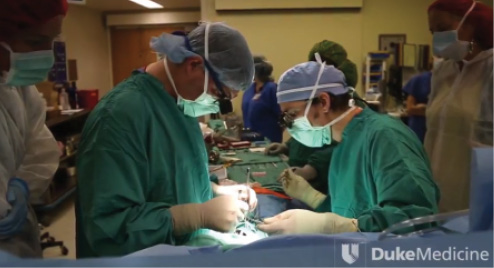
First-of-Its-Kind Blood Vessel Implant Performed at Duke
Human Tissue-Engineered Blood Vessels
There has been a lot of support from the FDA, and we’ve come to an agreement on a study design that will provide sufficient experience with this novel material to give them confidence in its safety and efficacy. We have to prove that the technology is durable in a large number of patients. Therefore, the primary endpoint of our phase 3 clinical trial is secondary patency in terms of how long the vessel can be used for dialysis after implantation. We’ve used a randomized, head-to-head clinical trial design to measure our outcomes against traditional expanded polytetrafluoroethylene dialysis access grafts.
Logistically, it’s a very challenging clinical trial, but our team is committed to every aspect of it. We believe we have developed a transformative vascular tissue. I think if this technology is successful, other tissues will be engineered from the platform, and some day, it will be the fundamental platform for more complex organs.
Have you seen any unique complications with these grafts?
Dr. Lawson: When you’re aiming to make a tissue-engineered blood vessel that can be available for everybody, there are two fundamental questions: (1) will it fall apart? and (2) is the body going to reject it? To date, we’ve seen no evidence of these types of complications. On hundreds of serial ultrasounds of these vessels after implantation, we have seen no evidence of any structural deterioration of the tubes out to well over 3 years in many patients. There has also been no evidence of immune recognition of the vessel to date. To accomplish this, we’ve basically made a human acellular tissue in the shape of a blood vessel. I say “acellular” because all of the cells that the immune system would recognize have been removed. It’s basically like an empty house of human extracellular matrix. When we implant the tissue, the patient’s own vascular and endothelial cells repopulate the vessel over a process of weeks to months, so it truly becomes the patient’s own tissue, which is really one of the most amazing parts of the whole story.
So, not only have we been able to demonstrate durability and acceptance by the host patient, but in every opportunity in animals and humans in which we’ve been able to get a sample of the tissue, we’ve seen it repopulate with the host’s own cells.
Do you foresee these grafts being cost-effective compared to current options?
Dr. Lawson: We believe that in a successful business model, the tissue vessel must be readily available, so hospitals can store and provide it to any patient. We won’t know what the cost of the vessel itself will be until we get through clinical approval. But, I think if the vessel prevents complications, such as wound infections related to harvesting saphenous veins, graft infections related to dialysis cannulation, or catheter infections related to fistula nonmaturation, avoiding these medical expenses will make this product truly cost-effective. The final piece of this puzzle is the pharmacoeconomic piece that will bring the whole package together. In fact, we already have a team working on that part of the program.
Assuming all continues to go well with the trials, what are some of the next applications of tissue engineering that you hope to see over the next decade?
Dr. Lawson: If we’re successful in what we are trying to accomplish, I think this is a potentially transformative technology and the future is very bright. Initially, we’re making dialysis vessels because it’s the safest entry point into human clinical experience. This is because dialysis access is a relatively reproducible operation and a relatively predictable clinical scenario in which we have good knowledge of the patients and what the product is being used for in the dialysis units.
We had always intended to make vascular conduit in a more global fashion for arterial reconstruction in the lower extremities. We know we can make smaller-caliber vessels, and we have every intention of using those for leg bypasses for use in traumatic reconstruction and lower extremity arterial disease. We have partners in the US Department of Defense who are interested in having this technology available for injured warfighters.
Staying in the realm of blood vessels, we also anticipate having small-caliber vessels for procedures such as coronary artery bypass grafting. But, we’ve also made other types of tubular structure prototypes that might be able to replace tissues in the esophagus or trachea. These other structures are in our line of sight going forward, and more complex organs like kidneys, hearts, or lungs are not beyond the realm of science fiction anymore. I believe that our technology will be the method of providing blood flow through those structures. Our current job is to get the blood vessel right—getting a kidney right, maybe that will be for the next generation, but I think it’s possible. Within the next 15 to 20 years, I wouldn’t be surprised to see a complex organ generated that will be at least partially based on our technology; building on these lessons we’ve learned, the mistakes we’ve made, and successes we’ve enjoyed will be used to help drive this field forward.
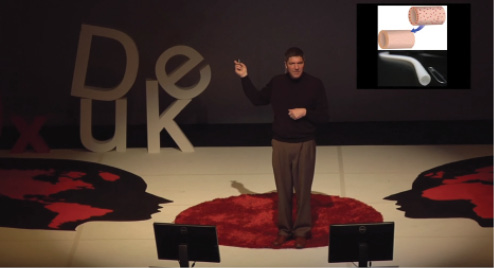
In 2014, you gave a TED Talk on your work. How did that come to be, and were you able to note a “TED Talk bump” in interest after it was posted online?
Dr. Lawson: You never can predict the media with respect to when something gets picked up and who runs with it. After we did the first United States implantations in the summer of 2013, Duke University was able to put together a really nice video that went viral. I got calls and was doing interviews with media outlets from all over the world.
Later that year, Duke University was preparing a TEDx program, and the organizers asked me if I would be willing to give a “Ted Talk” on our technology. It was actually quite challenging to put together that talk. Being a physician, I’m used to giving the conventional medical/science talk, but with TED Talks, you’re also trying to make it cool and interesting while still scientifically honest. It took a long time to put together a talk that I was comfortable with, but people actually still reference it, much to my amazement.
I think we’ve received this level of media interest because it’s not only a science story, it’s a success story. The technology has the potential to meet a significant clinical need due to collaboration, innovation, and hard work. We are very fortunate to have a lot of smart and dedicated people working on every aspect of this. All of a sudden, it goes from the concept phase that seems really far out in the future to something that is now operational. It’s hard to believe we’re manufacturing vessels for a phase 3 clinical trial and someday will be able to distribute these tissues to patients around the world who need vascular reconstruction and dialysis access care.
1. Lawson JH, Glickman MH, Ilzecki M, et al. Bioengineered human acellular vessels for dialysis access in patients with end-stage renal disease: two phase 2 single-arm trials. Lancet. 2016;387:2026-2034.
Jeffrey H. Lawson, MD, PhD
Professor of Surgery
Professor of Pathology
Duke University School of Medicine
Durham, North Carolina
lawson@humacyte.com
Disclosures: Chief Medical Officer, Humacyte, Inc.
Advertisement
Advertisement