Advertisement
Advertisement
October 2017
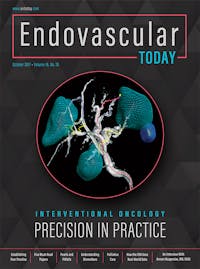
Interventional Oncology: Precision in Practice
By Ripal Gandhi, MD, FSVM, and David M. Liu, MD, FRCPC, FSIR

Over the past decade, interventional oncology (IO) has seen a continued rise in enthusiasm from its practitioners. A mix of practical problem solvers and data-driven investigators, interventional oncologists have ridden fast the momentum of their successes and those of their colleagues and have also encouraged each other to learn quickly from suboptimal results to better inform the next endeavors. Within the interventional field, there is no question that IO is on the rise.
As we get further from the cath lab, our anecdotal experiences become less convincing. We must continue to bring these experiences into our trial designs and the data from our trials into our practices to produce quantifiable, relatable, reproducible outcomes that will define the role of IO in a post-Moonshot health care environment. And, while doing so, we must focus on the needs of the patient sitting in front of us tomorrow.
In this IO-focused edition, we have sought to touch on many points along the spectrum from practical to relatable experiences. To start, Eric A. Wang, MD, and colleagues provide recommendations on how to establish a successful IO practice based on their experience in developing their own IO clinical care model. Next, Suvranu “Shoey” Ganguli, MD, summarizes the five must-read IO publications from the last year. Nicholas Fidelman, MD, and colleagues contribute two articles for this issue, outlining 10 pearls and pitfalls they have established and encountered in their IO practice.
The IO field is increasingly utilizing biomarkers and genomics to treat patients with cancer. Samuel L. Rice, MD, and Constantinos T. Sofocleous, MD, emphasize the importance of understanding clinically validated biomarkers and highlight specific biomarkers used to treat diseases such as hepatocellular carcinoma, colon cancer liver metastases, and non–small cell lung cancer. Next, Martin Edwards, MD, and Siddharth A. Padia, MD, discuss their approach to treating tumors in the liver caused by primary liver cancer, colorectal cancer, and neuroendocrine tumors.
Interventionalists play an integral role throughout the spectrum of oncologic care, including palliative needs. Joshua D. Kuban, MD, and Alda Tam, MD, review the different sources of cancer pain and discuss interventions that can be used to manage pain in the palliative setting, including thermal ablation, nerve blocks, and enteral tube placement.
In addition to our feature coverage, Eleni Whatley and Misti Malone discuss how the US Food and Drug Administration leverages real-world evidence in both the pre- and postmarket settings to evaluate the benefit-risk profile of medical devices. Finally, Armen Roupenian, MD, discusses the upcoming American College of Phlebology meeting and what’s needed most in venous and lymphatic disease.
As in previous years, we feel this edition is full of insight and practical tips, and yet we have barely scratched the surface. We look forward to the continued exploration of the role and capabilities of IO in the years to come.
Ripal Gandhi, MD, FSVM
David M. Liu, MD, FRCPC, FSIR
Guest Chief Medical Editors
Advertisement
Advertisement