Advertisement
Advertisement
July 2019 Supplement
Sponsored by The PERT Consortium™
The Pulmonary Embolism Response Team Movement: Advancing Practice, Science, and Quality of Care for Acute PE
By Christina Fanola, MD, MSc; Michael Rosenberg, MD; Robert Lookstein, MD, MHCDL, FSIR, FAHA, FSVM; and Kenneth Rosenfield, MD, MHCDS
Pulmonary Embolism: A Complex and Costly Disease State
Venous thromboembolism is a worldwide problem and leading cause of cardiovascular death.1 Untreated pulmonary embolism (PE) has a mortality rate of 30%,2 and historical data demonstrate that even with standard treatment, the 3-month mortality rate still ranges from 15% to 30%, especially in patients with comorbid cardiopulmonary disease.3,4 Those with cardiogenic shock from PE have up to a sevenfold increased mortality risk, with death often occurring within the first hour of presentation.5 PE is also associated with increased costs and utilization of health care resources with average hospital charges per case exceeding $40,000 and average length of inpatient hospitalization over 8 days.6 Annual overall national health care expenditures are conservatively estimated to be in excess of $1.5 billion.6 Recognition of the complexities and high mortality surrounding PE has lead to the development of multiple risk stratification tools, novel therapies, and proposed treatment algorithms in an effort to improve outcomes.
Risk prediction scores, such as the Geneva Score and Pulmonary Embolism Severity Index, were developed to quantify risk of short-term mortality in those with acute PE.7 Mortality varies greatly based on comorbidities and hemodynamics in “major” acute PE, ranging from 8% for stable patients versus 65% for those requiring cardiopulmonary resuscitation.8 As the wide variation in outcomes was further understood, categories of severity emerged, defining PE as minor (low risk), submassive (intermediate) with low- and high-risk subtypes, and massive (high risk). These categories incorporated existing (limited) data regarding risk of in-hospital mortality, hemodynamic status, and imaging and biomarker findings indicative of right ventricular dysfunction.7
Treatment options (standalone or in combination) can include intravenous or subcutaneous anticoagulation, full- and half-dose systemic thrombolytics, full- or reduced-dose catheter-directed thrombolytics, catheter-based embolectomy, and/or surgical embolectomy. The use of mechanical circulatory support has also come into the equation, both in patients who demonstrate ongoing hemodynamic instability despite advanced therapies and in select patients at risk for clinical decompensation during an intervention or procedural sedation/intubation. Although there has been a significant movement to advance PE care—particularly in patients with submassive and massive PE who are at the highest risk for mortality—the complexity of the disease, the large number of available diagnostic and treatment options, and the paucity of controlled clinical trial data have limited the establishment of standardized guidelines for acute PE.7,9,10 Consequently, there remains a high degree of variability in therapeutic decision-making surrounding PE management. A patient with a given clinical presentation will receive very different treatment from hospital to hospital, and often even within the same institution, depending upon the service provider. Such a high degree of variability should not exist within medicine; it is a reflection of our need to close the existing knowledge gap in PE and to better define what constitutes high-quality PE care.
ADDRESSING UNMET CLINICAL AND SCIENTIFIC PE NEEDS: RISE OF THE MULTIDISCIPLINARY PERT
The concept of a multidisciplinary team-based approach in complex cardiovascular disease has been promoted by the European Society of Cardiology, European Association for Cardiothoracic Surgery, American College of Cardiology, and American Heart Association for coronary revascularization and transcatheter aortic valve replacement.11 Such teams engage multiple specialties in an effort to synthesize complex treatment options and optimize shared decision-making with patients and their families. This approach enhances the cognitive interchange among medical specialties and reduces the risk of individual physician bias, which benefits both patients and physicians alike. Better decision-making aims to improve quality of care and patient outcomes.11
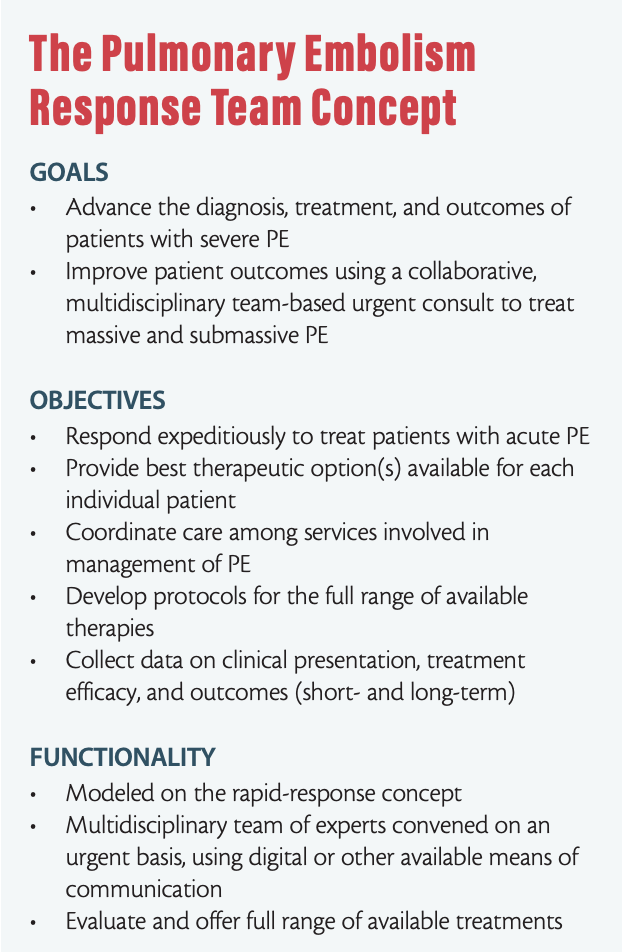
There is growing recognition that a multidisciplinary approach has the potential to greatly enhance care for patients with complex PE. The first formal multidisciplinary pulmonary embolism response team (PERT) was established at Massachusetts General Hospital.12 Goals and objectives of this initial effort are listed in the sidebar. This single-institution effort fueled a worldwide movement in the development of similar treatment teams, with over 150 institutions currently managing acute PE with a multidisciplinary PERT. This approach not only helps to advance clinical care in submassive and massive (intermediate to high risk) PE but also to develop an educational platform and research infrastructure to address current gaps in scientific evidence surrounding the multitude of available advanced treatment options.
Acute PE requires prompt diagnosis and treatment decision-making, especially when associated with hemodynamic instability. In this regard, the PERT concept differs from transcatheter aortic valve replacement, cancer care, and other teams that require less urgent decision-making. The optimal PERT can rapidly establish communication involving multiple specialties as needed for an individual PE patient, including but not limited to cardiology, pulmonary, critical care, cardiovascular surgery, anesthesia, interventional radiology, hematology, vascular medicine, vascular surgery, emergency medicine, and pharmacology. An organized and coordinated approach to the utilization of information technology for connectivity; bed placement and/or hospital transfer; pharmacy, echocardiography, and radiology services; and perfusion and respiratory therapy is also critical for successful program implementation. Because mortality is high within the first hour of a hemodynamically significant PE, there is major potential for improved outcomes with a successful PERT if it can quickly and effectively mobilize personnel and resources to deliver advanced therapies and mechanical support when required.
QUALITY IMPROVEMENT ASSOCIATED WITH PERTs
A major challenge in PE has been the establishment of standards of care and what constitutes “high-quality care.” This is in large part due to the evidence gap in PE, but also due to the rapid evolution of technology and challenges/inconsistencies in defining and reporting outcomes. There are limited multicenter prospective outcomes registries for diagnosis and treatment of acute PE. The ICOPER registry recorded outcomes of patients with high-risk PE as compared to intermediate- and low-risk patients.3 This registry laid the foundation for the aggressive management of high-risk cases, specifically with the use of thrombolytics and inferior vena cava filters.
In the modern era, there is a tremendous need to redefine the role of thrombolytics and establish the appropriate role of novel endovascular therapies for both high- and intermediate-risk patients. The exact role and timing of the use of direct oral anticoagulants is also currently poorly understood for the high-, intermediate-, and even low-risk populations. Results from surgical thrombectomy have improved, and use of advanced support (eg, extracorporeal membrane oxygenation, right ventricular support devices) clearly has impacted survival. The major advances in PE treatment options are a positive step, yet there remains an absence of comparative data regarding use and outcomes and what constitutes “best practice” and “high-quality care” for PE.
The emergence of PERTs across the United States and the world has created a unique pathway to engage these highly motivated clinical teams and redefine what constitutes best practice in the modern era. In 2018, the national PERT Consortium™ partnered with the Boston Clinical Research Institute to establish the national PERT quality database to prospectively record all encounters for intermediate- and high-risk PE around the country and, ultimately, the globe. At present, over 1,700 unique patient encounters have been recorded, and almost two dozen clinical sites are receiving regular feedback related to diagnosis and triage, initiation of medical therapy, and escalation to advanced therapies. The response thus far has been uniformly positive, and another 50 clinical sites are about to start enrolling their patients.
In the near future, based on ongoing conversations with federal regulatory bodies, this database will allow for refinement of what is considered best practice and will likely lead to prospective research as new medical, endovascular, and surgical therapies are introduced into clinical practice. The database is uniquely designed to provide feedback to the clinical sites based on predetermined quality metrics, enabling PERTs at each institution to benchmark their practice and outcomes to those of the entire consortium. Equally powerful is the opportunity for the PERT registry to serve as a backbone for comparative effectiveness research, as well as postmarket device and drug safety and efficacy studies.
In summary, the national PERT quality database is uniquely positioned to establish quality standards and define best practice for years to come. We strongly encourage any institutions with an existing PERT, or an interest in developing a PERT, to contact the national PERT Consortium™ and participate in this new opportunity (through the registry and other PERT programs) to redefine best practice for the treatment of acute PE in the 21st century.
1. Centers for Disease Control and Prevention. Blood clots: a serious but preventable medical condition. http://www.cdc.gov/ncbddd/dvt/documents/blood-clots-fact-sheet.pdf. Accessed June 6, 2019.
2. Carson JL, Kelley MA, Duff A, et al. The clinical course of pulmonary embolism. N Engl J Med. 1992;326:1240-1245.
3. Goldhaber SZ, Visani L, De Rosa M. Acute pulmonary embolism: clinical outcomes in the International Cooperative Pulmonary Embolism Registry (ICOPER). Lancet. 1999;353:1386-1389.
4. Heit JA, Silverstein MD, Mohr DN, et al. Predictors of survival after deep vein thrombosis and pulmonary embolism: a population-based, cohort study. Arch Intern Med. 1999;159:445-453.
5. Tapson VF. Acute pulmonary embolism. N Engl J Med. 2008;358:1037-1052.
6. Park B, Messina L, Dargon P, et al. Recent trends in clinical outcomes and resource utilization for pulmonary embolism in the United States findings from the nationwide inpatient sample. Chest. 2009;136:983-990.
7. Jaff MR, McMurtry MS, Archer SL, et al. Management of massive and submassive pulmonary embolism, iliofemoral deep vein thrombosis, and chronic thromboembolic pulmonary hypertension: a scientific statement from the American Heart Association. Circulation. 2011;123:1788-1830.
8. Kasper W, Konstantinides S, Geibel A, et al. Management strategies and determinants of outcome in acute major pulmonary embolism: results of a multicenter registry. J Am Coll Cardiol. 1997;30:1165-1171.
9. Kearon C, Akl EA, Comerota AJ, et al. Antithrombotic therapy for VTE disease: antithrombotic therapy and prevention of thrombosis, 9th ed: American College of Chest Physicians Evidence-Based Clinical Practice Guidelines. Chest. 2012;141:e419S-496S.
10. Konstantinides SV. 2014 ESC guidelines on the diagnosis and management of acute pulmonary embolism. Eur Heart J. 2014;35:3145-3146.
11. Holmes DR Jr, Rich JB, Zoghbi WA, Mack MJ. The heart team of cardiovascular care. J Am Coll Cardiol. 2013;61:903-907.
12. Provias T, Dudzinski DM, Jaff MR, et al. The Massachusetts General Hospital Pulmonary Embolism Response Team (MGH PERT): creation of a multidisciplinary program to improve care of patients with massive and submassive pulmonary embolism. Hosp Pract (1995). 2014;42:31-37.
Christina Fanola, MD, MSc
Division of Cardiovascular Medicine
Department of Medicine
University of Minnesota
Minneapolis, Minnesota
cfanola@umn.edu
Disclosures: Receives consulting fees from Janssen Pharmaceuticals and Bristol-Myers Squibb/Pfizer.
Michael Rosenberg, MD
Division of Interventional Radiology
Department of Radiology
University of Minnesota
Minneapolis, Minnesota
Disclosures: Receives consulting fees from Medtronic and Boston Scientific Corporation.
Robert Lookstein, MD, MHCDL, FSIR, FAHA, FSVM
Professor of Radiology and Surgery
Executive Vice Chairman
Department of Diagnostic, Molecular, and Interventional Radiology
Icahn School of Medicine at Mount Sinai
New York, New York
robert.lookstein@mountsinai.org
Disclosures: Consultant/scientific advisory board member for Medtronic and Boston Scientific Corporation.
Kenneth Rosenfield, MD, MHCDS
Section Head, Vascular Medicine and Intervention
Chairman, STEMI & Acute MI Quality Improvement Committee
Massachusetts General Hospital
Boston, Massachusetts
Disclosures: Consultant/scientific advisory board member for Abbott Vascular, Access Vascular, BTG Vascular, Cordis, a Cardinal Health company, EXIMO, Philips, Surmodics, Shockwave, Cruzar, Capture Vascular, Endospan, Janssen Pharmaceuticals, Magneto, MD Insider, Micell, Silk Road Medical, Summa Therapeutics, Valcare, Thrombolex, University of Maryland; receives grants/contracts from National Institutes of Health and Inari Medical; equity with AccessClosure, AngioDynamics, Access Vascular, Contego, Endospan, Embolitech, EXIMO, JanaCare, PQ Bypass, Primacea, MD Insider, Silk Road Medical, Summa Therapeutics, Cruzar Systems, Capture Vascular, Magneto, Micell, Valcare; board member of VIVA Physicians and The PERT Consortium™.
Advertisement
Advertisement