Advertisement
Advertisement
April 2020 Supplement
Sponsored by Guerbet
Prostate Artery Embolization
By Simone Bongiovanni, MD; Alberto Balderi, MD; Enrico Peano, MD; and Maurizio Grosso, MD
CASE PRESENTATION
A 68-year-old man with a medical history of hypertension and paraplegia after a car accident at a young age presented with benign prostatic hyperplasia (BPH) and lower urinary tract symptoms (LUTS), including incomplete emptying, frequency, urgency, weak stream, and nocturia. The patient presented to our center because he was not responsive to medical therapy with &aplha;-blockers and refused transurethral resection of the prostate. Therefore, diagnostic investigations were performed so he could undergo prostate artery embolization (PAE).
DIAGNOSTIC TESTING AND PROCEDURAL APPROACH
An ultrasound demonstrated enlargement of the prostate with a 70-mL volume and a bladder without lesions protruding into the lumen. Uroflowmetry demonstrated a pathologic emptying curve with a maximum flow of 10.8 mL/second. Results of blood testing showed a prostate-specific antigen (PSA) level of 3.33 ng/mL, with normal coagulation, platelet count, and creatinine. Scores on the International Index of Erectile Function (IIEF-5), International Prostate Symptom Score (IPSS), and quality-of-life (QOL) questionnaires were 5, 22, and 5 points, respectively, demonstrating an impaired sexual function, severe LUTS symptoms, and a poor QOL.
PAE was performed via 5-Fr right femoral access, and digital subtraction angiography (DSA) of the iliac axes and the internal iliac arteries showed the origin of the left prostatic artery from the obturator artery and the origin of the right prostatic artery from the internal pudendal artery, which were respectively classified as type III and type IV anatomy, according to the classification system described by de Assis et al (Figure 1A–C).1 Embolization was carried out using the 2.4-Fr SeQure® microcatheter (Guerbet) with 300–500-µm Embosphere microspheres (Merit Medical Systems, Inc.) (Figure 1D). Bilaterally, the PErFecTED technique was used, in which the prostatic artery was embolized proximally to near stasis after passing all collateral arteries; subsequently, the microcatheter tip was advanced deeper into the parenchymal branches, which were then embolized to complete stasis.2
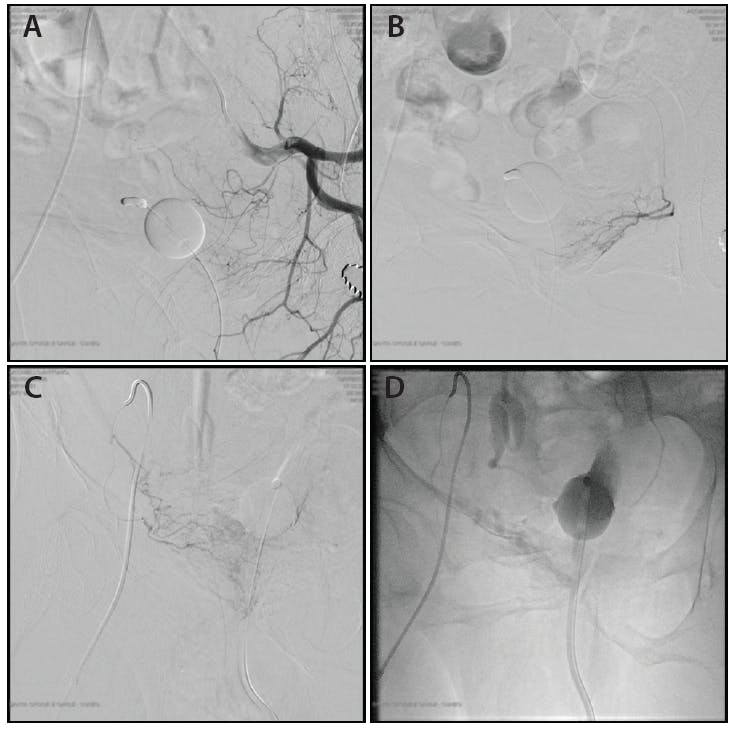
Figure 1. DSA of left internal iliac artery (A). Selective DSA of the left prostatic artery (B). Selective DSA of right prostatic artery (C). DSA showing embolization of right prostatic artery (D).
CASE SUMMARY
The patient was discharged the day after the procedure, after catheter removal. No periprocedural complications were observed. At 1-month follow-up, his PSA decreased to 1.17 ng/mL (from 3.33 ng/mL). At 3-month follow-up, the patient’s IPSS score decreased to 14, the QOL score improved to 2, and the IIEF-5 score improved to 22.
DISCUSSION
PAE is a technique that is best performed by highly experienced interventional radiologists due to the complexity of the arterial pelvic anatomy. Periprostatic organs and structures such as the bladder, rectum, penis, seminal vesicle, pelvis, bones, and skin may be damaged by nontarget embolization, especially due to the misidentification of normal vascular anatomy and variants or due to inadvertent embolic reflux. Indeed, cases of nontarget embolization are described in the literature, including bladder ischemia, transient ischemic proctitis, rectal ulcers, transient rectal bleeding, penile ulcers, and pubic bone ischemia.
The 2.4-Fr SeQure® microcatheter is a technology with side holes localized proximally to the tip that radially filter contrast media during embolization, creating a fluid barrier around the microcatheter, which allows the delivery of more microspheres and also reduces the risk of nontarget embolization. In this case, the SeQure® microcatheter was used successfully to manage LUTS caused by BPH.
Results from case studies are not necessarily predictive of results in other cases. Results in other cases may vary.
P20000018
1. de Assis AM, Moreira AM, de Paula Rodrigues VC, et al. Pelvic arterial anatomy relevant to prostatic artery embolization and proposal for angiographic classification. Cardiovasc Intervent Radiol. 2015;38:855-861.
2. Carnevale FC, Moreira AM, Antunes AA. The “PErFecTED technique”: proximal embolization first, then embolize distal for benign prostatic hyperplasia. Cardiovasc Intervent Radiol. 2014;37:1602-1605.
Advertisement
Advertisement