Advertisement
Advertisement
August 2020 Supplement
Sponsored by Silk Road Medical
Shared Decision-Making: Addressing the Medicare Directive and What This Means in a Busy Practice
How are busy vascular practices like the University of Rochester Medical Center proactively engaged in shared decision-making with their patients and families?


Even though Medicare has not mandated shared decision-making (SDM) requirements in all Medicare National Coverage Determinations (NCDs) and Local Coverage Determinations (LCDs), variations of SDM are already incorporated in a vascular surgeon’s everyday practice. The two primary components of SDM in all Medicare coverage guidance involve: (1) scheduling a separate SDM visit with the individual and family; and (2) using an evidence-based decision tool.
The Agency for Healthcare Research and Quality (AHRQ) provides some general guidelines for SDM in their document titled “Shared Decision-Making Tools for Lung Cancer Screening.”1 These include:
- Good communication between clinicians and patients
- Decision aids that provide a structured approach to providing information about options and trade-offs, values related to options and outcomes, and can help foster deliberation
- Tools that provide clinicians with a concise summary of the current clinical evidence and recommendations
CHALLENGES
One of the primary challenges facing vascular surgeons, as well as other providers, is to develop a readable and understandable evidence-based decision tool that can be used during the SDM visit. Based on a 1992 National Assessment of Adult Literacy (NAAL) survey, Medicare beneficiaries read at the 5th grade level.2 Another updated and more specific 2003 NAAL survey showed that adults aged 65 years and older had a lower average health literacy than adults in younger age groups. As a result, the Centers for Medicare & Medicaid Services developed an 11-part health literacy toolkit (www.cms.gov/Outreach-and-Education/Outreach/WrittenMaterialsToolkit) for making written materials easier to understand and use.
The key takeaways are that written materials must be developed using a reader-centered approach and written from the mindset of the readers.3 The materials must:
- Attract the intended readers’ attention
- Hold their attention
- Make them feel respected and understood
- Help them understand the messages in the material
- Move them to take action
The University of Rochester Medical Center (URMC) Division of Vascular Surgery has developed a solution addressing SDM and authorizing patient consent using a module within their medical record system (Epic Systems Corporation) that can be adopted by other Epic system users.
SHARED DECISION-MAKING IN THE URMC VASCULAR PRACTICE
At URMC, workflow for a patient with a flow-limiting or symptomatic carotid artery stenosis involves a well-established SDM process. After identification of a potential case via ultrasound, patients are screened for both indication (asymptomatic stenosis > 70% or symptomatic stenosis > 50%) and physiologic appropriateness for revascularization. All carotid stenosis patients are treated with best medical therapy via cardiovascular risk factor reduction, multimodal antiplatelet therapy, and statin class lipid-lowering therapy. Once a potential has been identified for possible revascularization, a brief discussion regarding the role of risk-reduction procedures is undertaken, including information regarding the need for further axial imaging via CTA, and a return visit to review the data is arranged. The patient is encouraged to bring family members and health care decision-makers to that second visit.
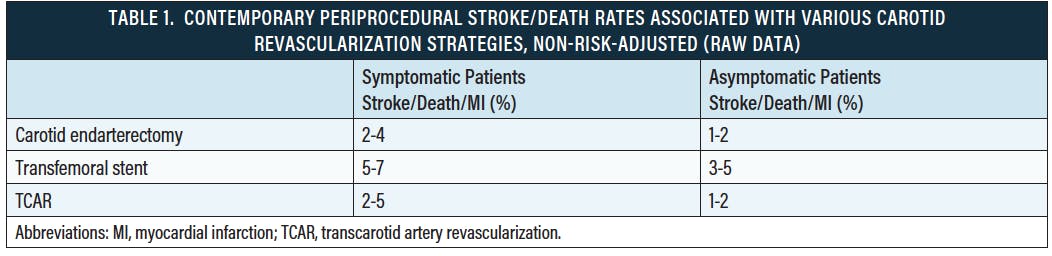
At the time of the second visit, patients are given information regarding the risks associated with carotid revascularization. Our site is fully vested in the Vascular Quality Initiative (VQI) and closely tracks internal data regarding treatment strategy and outcome. These data are validated and compared with regional and national benchmarks on a continuous basis. National data are used to quote stroke/death risks for each of the three procedural modalities for both symptomatic and asymptomatic patients (Table 1).4,5
Upon review of the anatomic data, patients are then offered one of the four possible treatments: (1) continued best medical therapy, (2) carotid endarterectomy, (3) transfemoral stenting, or (4) transcarotid artery revascularization (TCAR). Our institutional preference for minimal-access carotid surgery is toward TCAR based on internal experience and the strong literature supporting its role as a revascularization strategy for high-risk patients. Potential TCAR patients are screened for inclusion and exclusion criteria in the Society for Vascular Surgery VQI TCAR Surveillance Project.6
As a tool to assist with the SDM goal, an electronic consent is generated in the Epic medical record system using a standard template. Via modular and separately maintained rich text documents, the generated consent contains general and patient-specific risks and benefits associated with the procedure (for an example of this form, click here). Several figures are used to illustrate key steps of the case and improve patient understanding. The patient is given both a hard copy and electronic copy of the document. The surgeon fully explains the document to the patient and addresses any questions or concerns with the patient and their representatives. Once a shared decision to proceed with the case is reached, the visit is concluded with the attending surgeon entering a formal case request order into the electronic medical system to ensure fidelity and laterality.
1. Agency for Health Care Research and Quality. Is lung cancer screening right for me? Accessed June 11, 2020. https://effectivehealthcare.ahrq.gov/decision-aids/lung-cancer-screening/decisionmaking-tool.html.
2. Aruru M, Salmon JW. Assessment of Medicare Part D communications to beneficiaries. Am Health Drug Benefits. 2010;3:310-317.
3. Centers for Medicare & Medicaid Services. Toolkit for making written material clear and effective. Accessed June 11, 2020. https://www.cms.gov/Outreach-and-Education/Outreach/WrittenMaterialsToolkit.
4. Sidawy AN, Zwolak RM, White RA, et al. Risk-adjusted 30-day outcomes of carotid stenting and endarterectomy: results from the SVS vascular registry. J Vasc Surg. 2009;49:71-79. doi: 10.1016/j.jvs.2008.08.039
5. Malas MB, Dakour-Aridi H, Wang GJ, et al. Transcarotid artery revascularization versus transfemoral carotid artery stenting in the Society for Vascular Surgery Vascular Quality Initiative. J Vasc Surg. 2019;69:92-103.e2. doi: 10.1016/j.jvs.2018.05.011
6. ClinicalTrials.gov. SVS VQI TransCarotid Revascularization Surveillance Project (VQI-TCAR). Accessed May 27, 2020. https://clinicaltrials.gov/ct2/show/NCT02850588.
Advertisement
Advertisement