Advertisement
Advertisement
May 2020 Supplement
Sponsored by BIOTRONIK
Case Report: Low-Profile Crossing and Stenting of a Long SFA Occlusion
A 78-year-old man with severe claudication of the right leg was admitted to our angiology department. Cardiac risk factors included poorly controlled diabetes and hyperlipoproteinemia. On duplex ultrasound, a long 30-cm occlusion of the superficial femoral artery (SFA) from the origin to the popliteal artery (PA) segment 1 was diagnosed. The mid- and distal PA exhibited no significant stenosis. The posterior tibial artery was the only patent artery below the knee, as the anterior tibial artery showed a long occlusion from the proximal third of the vessel. Ankle-brachial index on the right side was 0.55. No wounds were present on the right extremity.
PROCEDURE
Subsequent diagnostic angiography confirmed the long SFA occlusion with diminished contrast flow below the knee and into the foot (Figure 1). For recanalization of the long SFA occlusion, a crossover approach from the left groin over the bifurcation was performed using a 6-F crossover Fortress® reinforced introducer sheath (BIOTRONIK). The flush occlusion of the SFA (Figure 2) was penetrated with an 0.018-inch guidewire and a Carnelian® Support 18 microcatheter (BIOTRONIK). The Carnelian Support microcatheter family has a low tip profile of 1.6* or 1.8 F to enable crossing of chronic total occlusions.1 It provides a smooth transition from the soft distal tip, allowing trackability to the stiffer proximal part that ensures additional push. Using Carnelian Support to support the guidewire in this case made it easy to achieve distal reentry into the true lumen. Next, a 3-minute lesion preparation was performed with a 5- X 200-mm Passeo®-18 angioplasty balloon (BIOTRONIK) inflated to 10 atm over the entire length of the target lesion, followed by 6-mm-diameter Passeo®-18 Lux™ drug-coated balloons (BIOTRONIK) with 2-minute inflations over the length of the lesion (Figure 3). Subsequent angiographic analysis revealed a persistent long type C dissection after lesion treatment. On-table Doppler ultrasound showed a significant increase of flow velocity (250 cm/sec) within the first 150 mm of the target lesion. Following the REACT™ (REsponse Adapted Combination Therapy) treatment concept, it was decided to proceed with bailout stent implantation using the new triaxial, 4-F Pulsar®-18 T3 nitinol self-expanding stent system (6 X 150 mm; BIOTRONIK; Figure 4).2 The decision to implant a Pulsar-18 T3 nitinol stent was supported by the encouraging outcome data of the PEACE and other trials, which showed low target lesion revascularization rates even after complex lesion interventions with the Pulsar nitinol stent.3-6†
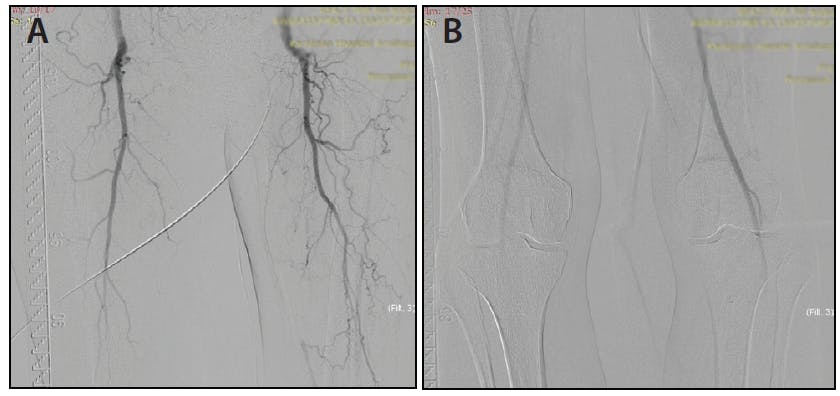
Figure 1. Diagnostic angiography showing a long SFA occlusion (A) and diminished contrast flow (B).
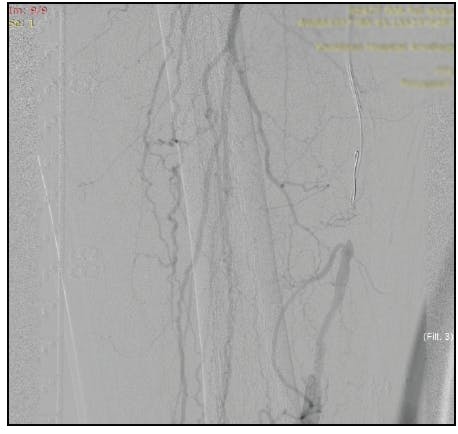
Figure 2. The flush occlusion was crossed using a guidewire and Carnelian Support 18 microcatheter.
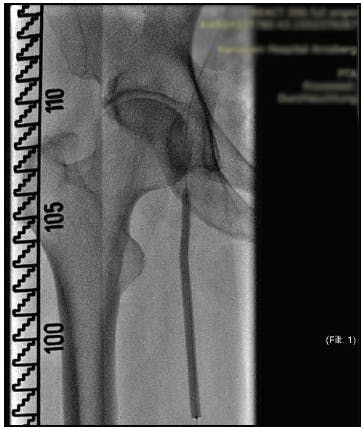
Figure 3. Balloon angioplasty of the lesion.
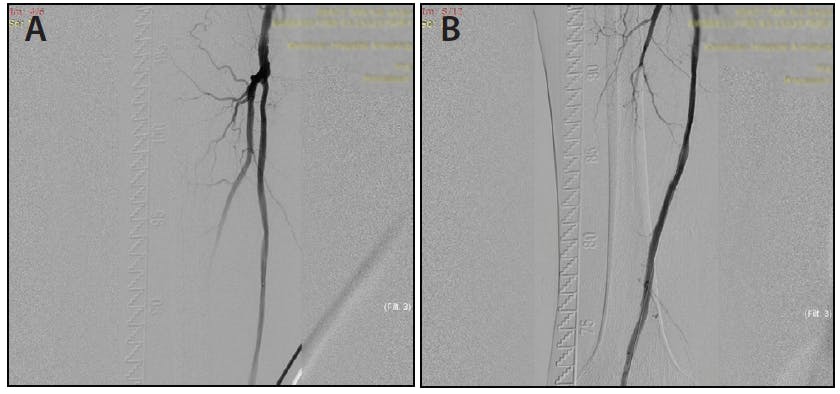
Figure 4. Due to a type C dissection, it was decided to place a Pulsar-18 T3 self-expanding stent (A, B).
RESULTS
After implantation of the Pulsar-18 T3 stent and postdilatation, a brisk flow was seen within the whole length of the target and there was a straight flow into the foot via the patent posterior tibial artery (Figure 5). Follow-up examination of the patient the next day showed an ankle-brachial index of 0.9 on the right side and a significant improvement in pain-free walking distance, with no pain in the target limb on the treadmill test after 500 meters.
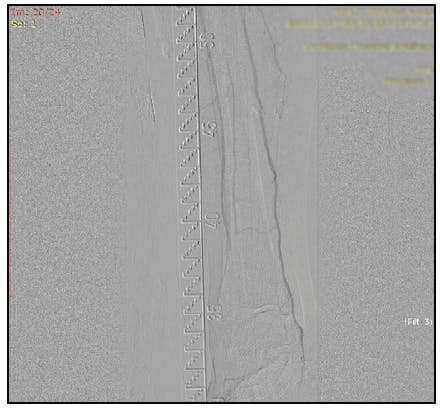
Figure 5. The final result showing flow into the foot via the patent posterior tibial artery.
1. Tokai Medical Products, Inc. data on file.
2. BIO REsponse Adapted Combination Therapy Pilot Study. Clinicaltrials.gov website. https://clinicaltrials.gov/ct2/show/NCT03547986. Accessed March 2, 2020.
3. Lichtenberg M, Breuckmann F, Kramer V, et al. Effectiveness of the Pulsar-18 self-expanding stent with optional drug-coated balloon angioplasty in the treatment of femoropopliteal lesions–the BIOFLEX PEACE all-comers registry. Vasa. 2019;48:425-432.
4. Lichtenberg M, Kolks O, Hailer B, et al. PEACE I all-comers registry: patency evaluation after implantation of the 4-French Pulsar-18 self-expanding nitinol stent in femoropopliteal lesions. J Endovasc Ther. 2014;21:373-380.
5. Deloose K. 4EVER 24m: Long-term results of 4F Pulsar stents in femoropopliteal lesions. Presented at: Leipzig Interventional Course (LINC); January 29, 2014; Leipzig, Germany.
6. Lichtenberg M. Superficial femoral artery TASC D registry: 12-month effectiveness analysis of the Pulsar-18 SE nitinol stent in patients with critical limb ischemia. J Cardiovasc Surg (Torino). 2013;54:433-439.
†Clinical data obtained with Pulsar-18, a predecessor of Pulsar-18 T3 that uses the same stent.
*Indicated for below-the-ankle treatment.
Advertisement
Advertisement