Advertisement
Advertisement
November 2020
Essential Technology in a Hybrid Room
Minimizing radiation exposure and improving efficiency during complex endovascular aortic cases.
By Mohamed A. Abdelhalim, MRCS, and Bijan Modarai, PhD, FRCS
With the ever-expanding applications of endovascular intervention, cases are growing in both quantity and complexity.1 More complex cases inevitably lead to longer fluoroscopy time, more frequent digital subtraction angiography (DSA) acquisitions, and ultimately, greater radiation exposure to the patient and operator. Studies have shown that the median effective dose of radiation absorbed by the patient during complex branched and fenestrated endovascular aortic repairs can approach the 100-mSV threshold that is known to significantly increase cancer risk, with some exposures sixfold above this threshold.2 Although the increased cancer risk associated with these exposures is relatively small and must be weighed against the benefits of the procedure, all possible steps to minimize radiation exposure to the patient and operator are obligatory. Technologic innovation has played a key role in the evolution of imaging equipment in the hybrid room, with multiple adjuncts now available that improve the efficiency of complex endovascular procedures and reduce radiation exposures.
DOSE-OPTIMIZING ANGIOGRAPHY SYSTEMS
The fixed imaging systems used in hybrid suites provide superior image quality during interventional procedures, but this comes at the cost of increased radiation exposure for the patient and, in turn, for the operator. Newer-generation angiography systems incorporate software that allows a reduction in radiation energy required while maintaining image quality. Two examples are the AlluraClarity (Philips) and the Artis with Care+Clear (Siemens Healthineers). The AlluraClarity combines the latest hardware with “noise reduction” software that filters out greater amounts of radiation to reduce scatter and optimize pulse width and focal spot size for specific patient anatomy.3 These developments may allow a significant reduction in intraoperative patient dose during endovascular aneurysm repair (EVAR) compared with traditional angiography systems.3 Care+Clear refers to a package of image quality–enhancing, dose-saving tools that similarly enable variable pulse rates and filtration that automatically adjust according to the thickness of the penetrated tissue and the C-arm angulation.4 It also includes a graphical outline of the next image, allowing movement of the table or C-arm without fluoroscopy. With these innovations, the system is reported to reduce radiation dose by 13% during fluoroscopy and 27% during DSA acquisition.4
FUSION IMAGING
Fusion technology allows preoperative anatomic CT images to be overlaid with real-time fluoroscopy images, creating an augmented reality to facilitate guidewire and catheter navigation and stent placement.5 This technology reduces the need for DSA acquisitions (which account for the highest organ doses received by the patient during EVAR) and minimizes the volume of contrast injected.6,7 There is also less reliance on oblique DSA acquisitions, which exponentially increase radiation exposure and are frequently required during complex aortic interventions. Fusion imaging can be considered an essential component of the workflow for complex EVAR; its use has been shown to reduce radiation dose and contrast usage by half and shorten the operative time.8
Standard CT fusion techniques use on-table anteroposterior and lateral x-rays to manually align images from fluoroscopy to the preoperative CT scan immediately before the procedure. Any intraoperative change in the patient’s position after the initial registration of images will disrupt this alignment and require adjustment. Furthermore, significant anatomic deformation occurs after the insertion of stiff wires and the endograft delivery systems, requiring adjustment of the image to ensure accurate overlay.9
The Cydar EV (Cydar Medical) is an image fusion platform that uses artificial intelligence–powered image tracking to three-dimensionally display an overlay CT map when the patient position can be confidently identified, using vertebral anatomy on a two-dimensional x-ray image delivered on fluoroscopy video feed. This continuous video feed is used to maintain > 99.8% registration accuracy throughout the case in real time, obviating the need for manual registration and significantly reducing misregistration compared with traditional systems.10 A deformable anatomy tool allows for manual correction of the overlay to account for deformation after the introduction of stiff wires and devices (Figure 1). The technology also uses patient-specific, digitally reconstructed (virtual) radiographs to preview the operative plan (Figure 2).
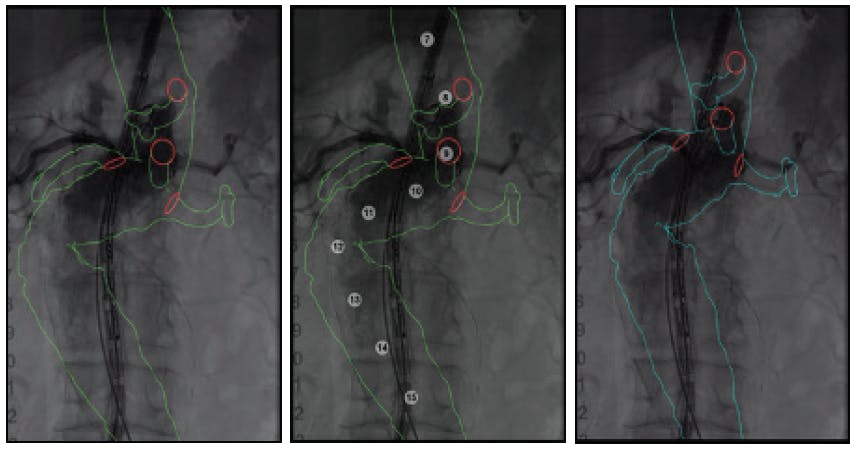
Figure 1. Manual correction of deformation is possible by selecting numbered parts of the overlay and adjusting the appropriate segment.
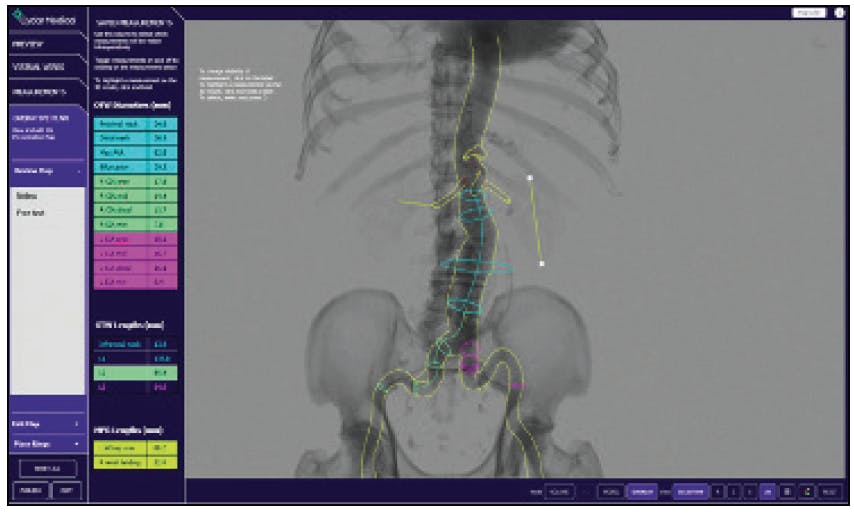
Figure 2. The operative plan is displayed on a digitally reconstructed virtual radiograph.
CONE-BEAM TECHNOLOGY
Reinterventions after complex EVAR are a major source of additional radiation exposure. It has been demonstrated that after fenestrated EVAR, the rate of early reintervention (within 30 days) can approach 6%, and the rate of late reintervention ranges from 7% to 16%.11 To detect complications that require reintervention and preserve the longevity of these repairs, a strict postoperative imaging follow-up protocol is required, further adding to the radiation burden if CT is used.
Cone-beam CT (CBCT) technology uses rotational acquisition in the hybrid theater to construct a three-dimensional CT image. When combined with the injection of contrast, this process mimics CTA. CBCT has been shown to be superior to standard completion angiography at detecting kinks or stent graft compression.12 These technical issues that may otherwise only have been detected on postoperative CT follow-up can then be treated immediately, thus reducing the need for reinterventions. Although concerns have been raised about the ability of CBCT to adequately detect and categorize endoleak, more recent studies have been reassuring and have reported superiority of CBCT at detecting endoleaks compared with both completion angiography and CTA.13 Based on these results, some centers have eliminated the need for completion angiography and 1-month postoperative CTA by using CBCT at the end of complex aortic repairs.14 Given that CBCT is associated with a lower effective dose of radiation compared with standard CT, this approach may provide an overall radiation saving.
STRATEGIES TO REDUCE RADIATION DOSE TO OPERATORS
Reducing the radiation dose absorbed by the patient indirectly reduces the occupational radiation exposure to the operator by lowering scatter. However, additional measures are also crucial to minimize the significant chronic doses that complex endovascular operators are exposed to.
Simple measures such as stepping away from the radiation source during DSA acquisition must be routinely employed. The intensity of radiation is related to the distance from its source according to Newton’s inverse square law, and therefore, this basic practice very effectively reduces radiation dose to the operator. To maximize the quality and efficiency of image acquisition, the International Atomic Energy Agency recommends that the patient be as close as possible to the image intensifier and as far as possible from the source.15 In practice, this means reducing the “air gap” between the patient and the receptor to reduce occupational radiation exposure. There is evidence for using the full complement of lead-lined personal protective equipment, including leg shields and eye protection.16,17
Live personal dosimetry systems that connect wirelessly to a hub and display monitor provide staff with a visual representation of the x-ray dose they are receiving in real time.18,19 This can be in the form of dose rate, cumulative dose, or a traffic light warning system. Real-time dosimetry provides staff with a heightened awareness of radiation exposure, reminding and enabling them to effectively employ all of the radiation protection solutions in the hybrid suite. As a result, the use of real-time dosimetry may reduce occupational radiation exposure in the hybrid suite, with dose reductions of up to 65% reported after the introduction of these systems.18,19
FUTURE TECHNOLOGIES
Despite optimal efforts to minimize radiation exposure during x-ray–guided procedures, exposure is inevitable and the threshold for safe exposure remains uncertain. With this in mind, efforts to develop technology that allows radiation-free guidance should be applauded. The Fiber Optic RealShape technology (Philips) integrates optical fibers into catheters and wires to allow visualization of these devices inside the body, using light instead of ionizing radiation. This system is currently undergoing clinical evaluation and promises to facilitate complex procedures, particularly once the range of devices that incorporate this technology is expanded.
An alternative approach, IOPS (Intra-Operative Positioning System; Centerline Biomedical) integrates sensors into catheters and guidewires to allow for three-dimensional visualization through an electromagnetic tracking system as an adjunct to fluoroscopy. Currently, an anatomic overlay from a preoperative CT scan is required for this guidance, but perhaps future avenues of research should involve developing a system combining MRI fusion imaging with radiation-free device tracking, with the aim of allowing a truly radiation-free intervention. In the United States, IOPS has received 510(k) clearance and is currently in a controlled launch.
Ultimately, futuristic guidance for endovascular interventions may incorporate a combination of the aforementioned modalities and others (such as intravascular ultrasound), which may be integrated and displayed intelligently on-screen to facilitate safe and efficient treatment of complex pathologies.
1. Suckow BD, Goodney PP, Columbo JA, et al. National trends in open surgical, endovascular, and branched-fenestrated endovascular aortic aneurysm repair in Medicare patients. J Vasc Surg. 2018;67:1690-1697.e1. doi: 10.1016/j.jvs.2017.09.046
2. Howells P, Eaton R, Patel AS, et al. Risk of radiation exposure during endovascular aortic repair. Eur J Vasc Endovasc Surg. 2012;43:393-397. doi: 10.1016/j.ejvs.2011.12.031
3. de Ruiter QM, Moll FL, Gijsberts CM, et al. AlluraClarity radiation dose-reduction technology in the hybrid operating room during endovascular aneurysm repair. J Endovasc Ther. 2016;23:130-138. doi: 10.1177/1526602815622433
4. Dehairs M, Bosmans H, Desmet W, et al. Evaluation of automatic dose rate control for flat panel imaging using a spatial frequency domain figure of merit. Phys Med Biol. 2017;62:6610-6630. doi: 10.1088/1361-6560/aa7a9d
5. Markelj P, Tomaževič D, Likar B, Pernuš F. A review of 3D/2D registration methods for image-guided interventions. Med Image Anal. 2012;16:642-661. doi: 10.1016/j.media.2010.03.005
6. Maurel B, Martin-Gonzalez T, Chong D, et al. A prospective observational trial of fusion imaging in infrarenal aneurysms. J Vasc Surg. 2018;68:1706-1713.e1. doi: 10.1016/j.jvs.2018.04.015
7. Harbron RW, Abdelhalim M, Ainsbury EA, et al. Patient radiation dose from x-ray guided endovascular aneurysm repair: a Monte Carlo approach using voxel phantoms and detailed exposure information. J Radiol Prot. 2020;40:704-726. doi: 10.1088/1361-6498/ab944e
8. McNally MM, Scali ST, Feezor RJ, et al. Three-dimensional fusion computed tomography decreases radiation exposure, procedure time, and contrast use during fenestrated endovascular aortic repair. J Vasc Surg. 2015;61:309-316. doi: 10.1016/j.jvs.2014.07.097
9. Maurel B, Hertault A, Gonzalez TM, et al. Evaluation of visceral artery displacement by endograft delivery system insertion. J Endovasc Ther. 2014;21:339-347. doi: 10.1583/13-4471MR.1
10. Rolls AE, Maurel B, Davis M, et al. A comparison of accuracy of image- versus hardware-based tracking technologies in 3D fusion in aortic endografting. Eur J Vasc Endovasc Surg. 2016;52:323-331. doi: 10.1016/j.ejvs.2016.05.001
11. Jones AD, Waduud MA, Walker P, et al. Meta-analysis of fenestrated endovascular aneurysm repair versus open surgical repair of juxtarenal abdominal aortic aneurysms over the last 10 years. BJS Open. 2019;3:572-584. doi: 10.1002/bjs5.50178
12. Törnqvist P, Dias N, Sonesson B, et al. Intra-operative cone beam computed tomography can help avoid reinterventions and reduce CT follow up after infrarenal EVAR. Eur J Vasc Endovasc Surg. 2015;49:390-395. doi: 10.1016/j.ejvs.2015.01.009
13. Schulz CJ, Schmitt M, Böckler D, et al. Intraoperative contrast-enhanced cone beam computed tomography to assess technical success during endovascular aneurysm repair. J Vasc Surg. 2016;64:577-584. doi: 10.1016/j.jvs.2016.02.045
14. Rhee RY. Benefits of immediate cone-beam CT after EVAR: assessing technical success after standard and fenestrated EVAR. Endovasc Today. 2017;16:82-84, 86.
15. International Atomic Energy Agency. Good practices in interventional fluoroscopy. Accessed October 26, 2020. https://www.iaea.org/resources/rpop/health-professionals/interventional-procedures/good-practices-in-interventional-fluoroscopy
16. El-Sayed T, Patel AS, Cho JS, et al. Radiation-induced DNA damage in operators performing endovascular aortic repair. Circulation. 2017;136:2406-2416. doi: 10.1161/CIRCULATIONAHA.117.029550
17. Barnard SG, Ainsbury EA, Quinlan RA, et al. Radiation protection of the eye lens in medical workers—basis and impact of the ICRP recommendations. Br J Radiol. 2016;89:20151034. doi: 10.1259/bjr.20151034
18. Poudel S, Weir L, Dowling D, Medich DC. Changes in occupational radiation exposures after incorporation of a real-time dosimetry system in the interventional radiology suite. Health Phys. 2016;111(suppl 2):S166-171. doi: 10.1097/HP.0000000000000546
19. Müller MC, Welle K, Strauss A, et al. Real-time dosimetry reduces radiation exposure of orthopaedic surgeons. Orthop Traumatol Surg Res. 2014;100:947-951. doi: 10.1016/j.otsr.2014.09.016
Advertisement
Advertisement
