Advertisement
Advertisement
August 2021
Chronic Upper Extremity AVG Thrombosis With Concomitant Central Thoracic Venous Occlusion
Moderator: Mark L. Lessne, MD, FSIR;
Panelists: Karem Harth, MD; Brian P. Holly, MD; and Theodore F. Saad, MD
CASE PRESENTATION
A 47-year-old man with end-stage renal disease (ESRD) presented with right neck and chest swelling and a chronically thrombosed right upper extremity (RUE) arteriovenous graft (AVG). The patient had a history of multiple failed RUE arteriovenous fistulas (AVFs) and a failed renal transplant and a remote history of right brachiocephalic vein (BCV) occlusion treated 2 years prior with recanalization and stent placement. His current RUE AVG was placed 7 months before presentation and was cannulated at home until 3 months ago when his wife noticed absent thrill and was unable to cannulate him. He had an attempted AVG declot 2 months ago at an outside facility, which failed when the operator was unable to cross the thrombosed right BCV stent. A left-sided dialysis catheter was placed.
On examination, the patient had mild RUE swelling without pitting. Prominent veins were noted over the right chest. No thrill or bruit was evident over the RUE accesses.
Given this patient’s chronic RUE AVG occlusion with concomitant, ipsilateral, chronic thoracic venous occlusion, would you attempt salvage of this access or plan for a new access? If salvage is attempted, how would you approach the procedure?
Dr. Harth: A new patient with previous work and redo access procedures/surgery is deserving of a bilateral upper extremity venogram evaluation to make the best choice for the patient. As a baseline, I also start with bilateral upper extremity vein mapping, arterial duplex ultrasound, and pulse-volume recording/ankle-brachial index as additional data to consider. A bedside ultrasound evaluation of the redo arm is important to get a “hands-on” understanding of what the current anatomy looks like and if any surgical options exist. With a catheter currently in place, I would expedite this workup.
The decision of salvage in this case is difficult, but my preference is to plan for a new access in someone who has failed multiple previous attempts on the same side. Although the expectation for a dialysis patient is to have repeated interventions for access maintenance throughout their time on dialysis, if an intervention repeatedly fails over short periods (< 1-2 months), then this is a herald for poor outcome and an indication to pursue a new access, in my opinion. Certainly, one would need to ensure that the best technical interventions have been offered to the patient and that these are the ones that have failed. If better alternatives exist, then these should be pursued if the anatomy allows.
I would work to see if the catheter can be moved to an alternate location away from the “good” side. Thus, we could prevent long-term central venous stenosis on the contralateral side. If I were to pursue salvage attempt on this access, I would proceed from an ipsilateral approach with a femoral and/or jugular access available for backup.
Dr. Holly: For chronic dialysis patients, it is imperative to fully exhaust every access site before moving on to new access. For this patient, I think it is reasonable to start the planning process for a new access given all the difficulty with the RUE, but I would first attempt to salvage that access. To adequately address all aspects of this dialysis circuit, I would plan both arm and groin venous access, as it is likely the combination of the central venous reocclusion and the narrowing at the venous anastomosis or within the graft that have caused it to thrombose. A preprocedure CT scan of the chest may also be beneficial for preprocedural planning and help give the patient and their dialysis team some idea of the likelihood of success.
Dr. Saad: My simple answer is yes, I would try to salvage this graft, but there is quite a bit of nuance behind this decision. The graft is relatively new, and there is potential for it to realize its expected “service life” of 3 to 5 years, a huge benefit to this “access-challenged” patient. The 2-month delay is of some concern in terms of potential thrombectomy outcome, but there has been plenty of experience with long-delayed graft thrombectomy, and the odds of success are still pretty high. It was recently functional prior to this thrombosis, so there is good reason to expect that it could be restored to that same level of function now, irrespective of what is done with the central vein occlusion. It is not clear why the attempted thrombectomy 2 months ago was a failure or abandoned. That should have been a technically successful thrombectomy, even without fixing the right BCV occlusion at that time. The graft could have functioned just as well as before it thrombosed because the right BCV was probably occluded long before that episode. The patient may have tolerated the right BCV occlusion without severe or immediate consequences. The occlusion could have been approached at a later date in the appropriate setting, with the operator and tools most likely to succeed. In fact, dialysis patients typically have had a missed or ineffective dialysis treatment prior to thrombosis, so it is preferable to get the access running, allow them to catch up on their treatment schedule, and then complete the more complex procedure when they are in their best shape (ie, euvolemic with normal electrolytes and better able to safely tolerate the greater amount of time, contrast, and sedation necessary). In the “worst case,” if the graft had been opened and the patient developed immediate, severe, symptomatic venous hypertension with superior vena cava (SVC) syndrome, the graft could have simply been ligated.
Of course, if the original attempted thrombectomy had been successful, the left-sided catheter would have been unnecessary. This has obvious importance in terms of infection risks and vein preservation. We don’t know anything about the patient’s left arm access history, but it is plausible that future access will require preservation of left-sided central veins. Furthermore, the patient should not have developed head and neck swelling based on the right BCV occlusion alone with an ipsilateral thrombosed graft. The fact that he did have signs of cranial venous hypertension strongly suggests another central vein pathology is present. Without clear knowledge of this anatomy, adding a left-sided venous hemodialysis catheter is very concerning.
CASE CONTINUED
The decision was made to attempt salvage of the patient’s current RUE AVG. The patient was brought to the interventional radiology suite, and the procedure was performed with moderate sedation. Initially, the thrombosed RUE AVG was accessed toward the venous anastomosis, but this could not be crossed with a stiff Glidewire (Terumo Interventional Systems) (Figure 1). A 30-g, weighted-tip, chronic total occlusion wire was used to cross the anastomosis, which was dilated to 4 mm and then 8 mm, allowing for delivery of a 0.035-inch guidewire into the subclavian vein, and the right BCV in-stent reocclusion was confirmed (Figure 2).
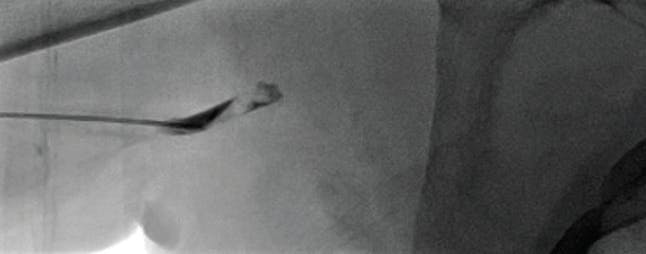
Figure 1.
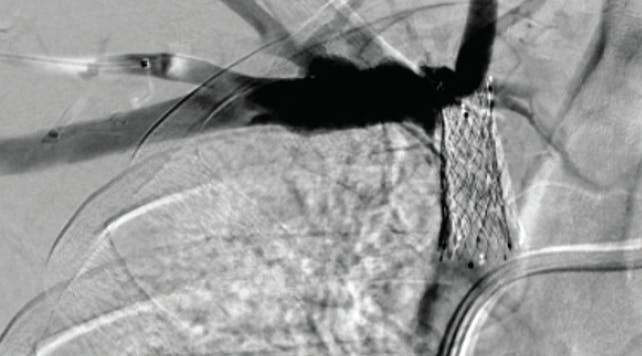
Figure 2.
Describe your general approach to crossing and treating thoracic venous occlusions. Does your strategy change with in-stent reocclusions versus native vein occlusions?
Dr. Holly: For thoracic venous occlusion, I prefer to have a preprocedure CT of the chest with intravenous contrast for planning purposes. I plan for venous access in the ipsilateral arm and groin but always access the arm first in an attempt to cross the occlusion. Initial venography is performed in hopes of identifying a small remnant of the thrombosed portion of the BCV or SVC. I typically use a coaxial (support catheter such as a 7-F MPA guide catheter with a crossing catheter inside) or triaxial (long vascular sheath, support catheter, crossing catheter) system with a stiff Glidewire. If this is unsuccessful, I will perform similar attempts from the groin access side. Often, both access sites are necessary when a snare can be used as a target. If these measures fail, as a last resort I will employ sharp recanalization techniques such as a radiofrequency energized wire or percutaneous needle access through the occlusion.
Dr. Saad: I begin with a 0.035-inch, straight-tip, stiff hydrophilic wire through a 6-F “hockey-stick” guide catheter and a 5-F Berenstein manipulated to the point of occlusion. Then, I gently and persistently probe with the wire, advancing the angiographic catheter incrementally. Periodic small-volume contrast injection helps to identify a potential pathway or demonstrate wire-induced extravasation, which is usually inconsequential if recognized. If/when the wire passes across the occlusion, I advance the imaging catheter and perform angiography to confirm placement in the SVC. Then, I replace the wire with a stiff exchange wire deep into the inferior vena cava (IVC). At this point, angioplasty is pretty straightforward; sequential upsizing from a small to larger balloon is rarely necessary, except for the most resistant lesions. I am not convinced that “bigger is better”; a 10- or 12-mm balloon should be sufficient. Adding a stent depends on the post–percutaneous transluminal angioplasty (PTA) appearance of the lesion, the history, and/or the degree of difficulty crossing it.
If attempting to cross the lesion from the arm approach is unsuccessful, I will then approach from the femoral vein using the same tools and technique. Parking a catheter tip on the other side of the occlusion provides a target to direct the wire. At some point, if these efforts have been unsuccessful, I may use the stiff end of a hydrophilic wire to probe the occlusion. I will only advance 2 to 3 mm and then turn the wire around and use the soft tip to probe further. Never jam the stiff end blindly deep into the occlusion.
As an interventional nephrologist working primarily in a freestanding “access center,” I recognize certain limits to what can and should be done in that setting. It is important to appreciate that successful recanalization is not mandatory. If I’m not making progress, if there is a significant wire-induced extravasation, or the case goes on for more than 30 to 45 minutes, it is probably time to stop. If I still believe the anatomy is salvageable, I will ask one of my interventional radiology colleagues to take a crack at it in the hospital because they have more advanced tools and techniques for “sharp recanalization,” which gives the patient the best chance of a safe and successful procedure.
Dr. Harth: I generally approach a thoracic venous occlusion from both antegrade and retrograde access points. The antegrade approach is from the ipsilateral side of the occlusion. The retrograde approach would be from the common femoral vein in the groin. I get long working sheaths for support and place them close to the occlusion point, and then I proceed with a stiff Glidewire and an angled catheter. If standard combination of a 0.035-inch Glidewire and angled catheters don’t work, I would then use an 0.018-inch Glidewire Gold guidewire and NaviCross catheter (Terumo Interventional Systems). I’ve used the curl of a Rosen wire to “sit” my catheter in a cul-de-sac and then advance the 0.018-inch Glidewire Gold from that point forward. I would use these techniques from both an antegrade and/or retrograde approach as needed.
Once my wire is through the occlusion, I would externalize/body floss the wire and work in an antegrade fashion. I externalize and body floss the wire if dual access is required; otherwise, I just place a stiff supporting wire distally to provide support. I find it preferable to work from the arm ipsilateral to the occlusion.
For chronic native disease or stent occlusions, I would predilate with a noncompliant high-pressure balloon and follow that with a drug-coated balloon (DCB). The decision to stent would depend on the completion venogram. For acute/subacute disease, I would attempt a ClotTriever (Inari Medical) if appropriate and follow that with PTA/DCB. The decision to stent depends on response to this therapy and improvement in collateral flow (ie, resolution of collaterals). If collaterals are no longer present, then I would defer stent therapy. Significant vessel recoil without response to PTA/DCB is another indication for stenting. I typically avoid stenting across thoracic outlet lesions, as these do poorly due to mechanical/rib-related compression.
CASE CONTINUED
A triaxial system with a sheath, guide catheter, and angiographic catheter was used, but the BCV occlusion could not be crossed. Therefore, the right common femoral vein was accessed, and the occlusion was crossed retrograde using a 0.035-inch stiff Glidewire, which was snared and externalized through the arm sheath (Figure 3). The right BCV occlusion was dilated to 14 mm and subsequently to 16 mm.
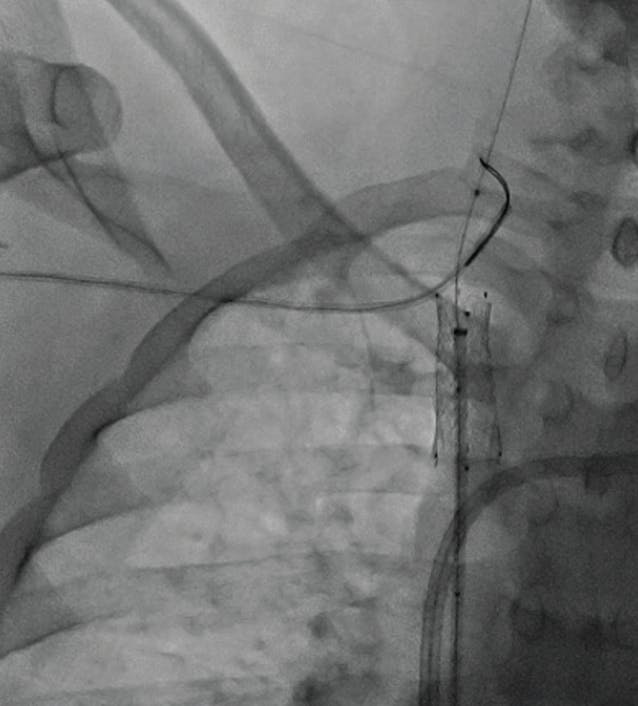
Figure 3.
Where do covered stents fit into your hemodialysis access maintenance practice? Do you use covered stents in the central thoracic veins—if so, when?
Dr. Harth: I reserve covered stents for rupture after a procedure and anastomotic outflow stenosis that has failed standard therapy with PTA/DCB.
Dr. Holly: I prefer covered stents when treating the venous anastomosis of a dialysis graft. The REVISE study specifically addressed this situation and demonstrated superior patency with fewer reinterventions when compared with balloon angioplasty alone.1 Stent grafts are also used if the outflow vein ruptures during angioplasty. I generally stay away from stent grafts in the central veins, unless the patient has an ipsilateral hemodialysis access. I think the increased flow from the fistula or graft improves the patency of a stent graft in that scenario. I will also use a stent graft when I have to recanalize the SVC and am worried I may have gone extravascular and there is risk of pericardial injury. However, in a more typical subclavian/brachiocephalic recanalization without an ipsilateral fistula, I prefer to use self-expanding nitinol stents.
Dr. Saad: I think covered stents are phenomenal when the appropriate, properly sized device is perfectly deployed at a suitable lesion; however, they can do far more harm than good if these criteria are not met. The right BCV is particularly challenging, as it is short length, and we don’t want the covered stent to obstruct the right internal jugular vein above or the left BCV below. It is not uncommon to see a “stovepipe” configuration at this location (as in this case), with a 90° angle at the subclavian vein, which is not favorable to maintaining patency and makes inevitable future percutaneous interventions more challenging. This is also a site prone to stent migration during or after deployment, which is never a good thing. We always place the guidewire deep into the IVC to mitigate potential harm from a floating stent graft.
Either subclavian vein may be suitable for a stent graft, but lesions that occur at the confluence of the subclavian, brachiocephalic, and internal jugular veins are very challenging. Positioning to avoid crossing the jugular vein leaves the end of the stent pinched by the lesion and prone to early stenosis or occlusion. The most attractive anatomy for a covered stent is when the internal jugular vein is known to be occluded and the stent can be placed from subclavian to BCV. In this case, the right internal jugular vein is patent, and it would be ill-advised to sacrifice it with a stent or stent graft. Using a bare-metal stent (BMS) is no assurance that the right internal jugular vein will remain patent; in fact, this may accelerate its closure, so I would definitely not place any stent in this situation. I would monitor this patient very closely; a follow-up angiogram in 4 to 6 weeks is justifiable to determine the rate and nature of in-stent restenosis. If rapid and/or severe, I would reinforce this with a fully covered stent. It is critically important to size the stent properly, and to do so, lesion length and vessel diameter should be measured precisely. It is important not to excessively oversize a stent graft, as this will lead to compression and pleating.
CASE CONCLUSION
An 8-F AngioJet ZelanteDVT catheter (Boston Scientific Corporation) was used for graft thrombectomy, which then followed in standard fashion with crossing sheaths. The venous anastomosis was reconstructed using a 10-mm covered stent (Figure 4 and Figure 5). After thrombectomy, there was restoration of inline flow with excellent thrill and bruit. The patient’s wife successfully cannulated the AVG for dialysis the next day, and the graft was still in use at 3-month follow-up.
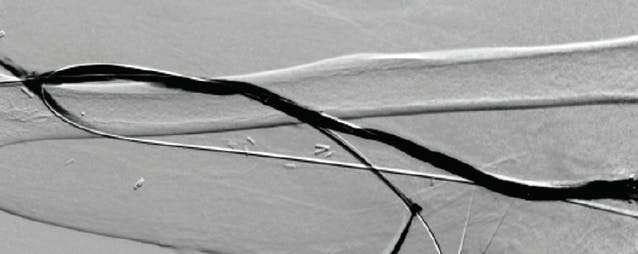
Figure 4.
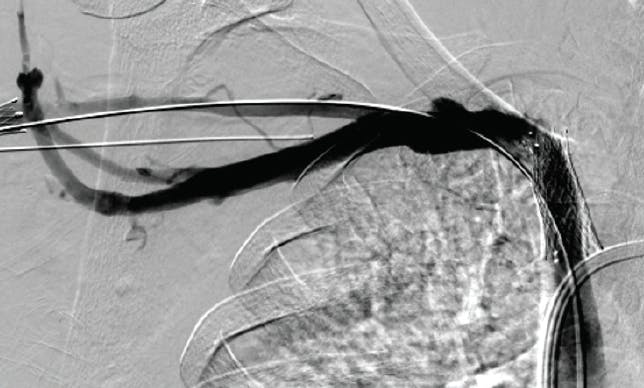
Figure 5.
MODERATOR’S SUMMARY
Some questions were posed to me by the panelists as to the medical management and surveillance of this patient and if recanalized stents could be considered. As Dr. Holly mentions, I believe an AVF/AVG ipsilateral to the recanalized segment assists with maintaining patency, and I therefore defer anticoagulation in this setting. In the absence of ipsilateral AVF/AVG or in the setting of recurrent thrombosis, I would consider apixaban. It is important to note that many of our patients with ESRD are also at high risk for cardiovascular disease, and thus antiplatelet agents should be considered for risk reduction irrespective of dialysis maintenance procedures.
We know covered stents may be preferred to plain old balloon angioplasty when recanalizing BMS occlusions.2 However, I completely agree with the comments regarding the limitations for and potential pitfalls associated with these devices in the central thoracic veins. Finally, I think antiproliferative technology is a very promising option for recanalized BMSs, although data are limited, and additional studies are needed. Regarding surveillance, I believe clinical symptom monitoring is most important. In my practice, we do not repeat ultrasound or CT studies unless there is a clinical suspicion of lesion recurrence.
1. Vesely T, DaVanzo W, Behrend T, et al. Balloon angioplasty versus Viabahn stent graft for treatment of failing or thrombosed prosthetic hemodialysis grafts. J Vasc Surg. 2016;64:1400-1410.e1. doi: 10.1016/j.jvs.2016.04.035
2. Falk A, Maya ID, Yevzlin AS; RESCUE investigators. A prospective, randomized study of an expanded polytetrafluoroethylene stent graft versus balloon angioplasty for in-stent restenosis in arteriovenous grafts and fistulae: two-year results of the RESCUE study. J Vasc Interv Radiol. 2016;27:1465-1476. doi: 10.1016/j.jvir.2016.06.014
Advertisement
Advertisement