Advertisement
Advertisement
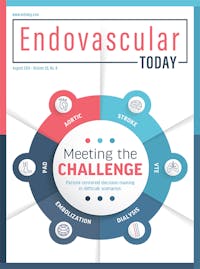
The practice of sharing the details of challenging cases we encounter with our colleagues is longstanding and vital, as the experiences described by the operator can better prepare their audience should they someday encounter a similar presentation. Presenting the nuances of these cases to expert panels and posing probing questions as to optimal management and pitfall avoidance is also of great value. Particularly in the diverse, multispecialty fields comprising the vast landscape of vascular interventions, opinions can and should vary considerably given the multitude of options that must be considered.
These concepts, along with intellectual curiosity, data-driven decisions toward patient-centric approaches, and the enduring pursuit of ever-improving outcomes, shape this special edition of Endovascular Today. We have invited key voices from a variety of specialty training and practice backgrounds to weigh the specifics of cases from the cerebral circulation to the lower extremities.
To open, James Milburn, MD, poses decision-making questions for a stroke case of tandem occlusion with internal carotid artery dissection to panelists Matthew Amans, MD; Stavropoula I. Tjoumakaris, MD; and Gabor Toth, MD. Moving to the aortic realm, Brant W. Ullery, MD, leads Venita Chandra, MD; Sukgu Han, MD; and Grace J. Wang, MD, in a discussion of an enlarging aortoiliac aneurysm with hostile neck and iliofemoral access challenges.
Aditya Sharma, MD, presents a patient with partial bowel obstruction who was diagnosed with bilateral acute pulmonary embolism after a prophylactic dose of heparin and asks Riyaz Bashir, MD; Linda M. Harris, MD; and Srini Tummala, MD, how they would approach treatment. Then, Gloria Salazar, MD, gathers Kirema I. Garcia-Reyes, MD, and Vincent Vidal, MD, to wrestle with imaging and management decisions for a woman with a renal mass found incidentally on an ultrasound for recurrent urinary tract infections.
For a case of a chronically thrombosed right upper extremity arteriovenous graft in a patient with concomitant central thoracic venous occlusion, Mark L. Lessne, MD, asks Karem Harth, MD; Brian P. Holly, MD; and Theodore F. Saad, MD, questions regarding access salvage, crossing and treating thoracic venous occlusions, and the role of venous stents.
Closing out our feature, Leigh Ann O’Banion, MD, walks Yolanda Bryce, MD; Laura Drudi, MD; and Shant Vartanian, MD, through a case of acute-on-chronic limb ischemia, highlighting the challenge of calcium and clot.
Finally, our featured interview is with Sonya Noor, MD, who shares her story of cofounding her vascular surgery practice, thoughts on prioritizing vascular health for women, the importance of clinical pathways for deep vein thrombosis and amputation prevention, managing burnout, and more.
I want to thank all of the moderators and panelists for their time and careful consideration of each case. I particularly appreciate the humility with which each moderator shared their experiences and the respectful collegiality put forth as the panelists voiced their opinions. As with good medical care, good medical journalism requires teamwork; the outstanding editorial staff at Endovascular Today share our passion and commitment to advancing medicine. We hope that each case, even those from anatomies and disease states you might not treat, prove useful in their descriptions of the how, why, when, and in whom.
John A. Kaufman, MD
Guest Chief Medical Editor
Advertisement
Advertisement