Advertisement
Advertisement
August 2021
Tandem Occlusion With ICA Dissection
Moderator: James Milburn, MD, FACR;
Panelists: Matthew Amans, MD, MSc; Stavropoula I. Tjoumakaris, MD, FAANS; and Gabor Toth, MD, FAHA
CASE PRESENTATION
A man in his mid 40s with a history of hyperlipidemia experienced sudden-onset left facial droop and left body weakness while playing with his children. Telestroke consultation showed a National Institutes of Health Stroke Scale (NIHSS) of 16 with left arm and leg hemiplegia, facial droop, right gaze preference, and left neglect. Noncontrast CT (NCCT) revealed an Alberta stroke program early CT score (ASPECTS) score of 8 with early ischemic changes in the right insula and putamen. The patient received intravenous (IV) tissue plasminogen activator (tPA) and was transferred, arriving at the comprehensive stroke center (CSC) at 3 hours from symptom onset with the NIHSS still at 16.
What would you do next upon arrival to the CSC?
• Repeat NCCT
• Go straight to intervention
• MRI
• CTA with perfusion
• Multiphase CTA
Dr. Amans: This patient is a candidate for IV lysis therapy (eg, tenecteplase/tPA), which at our institution would be started immediately if it wasn’t already administered before transfer (assuming there was no hemorrhage on the NCCT or other contraindication). We would then obtain a CTA to evaluate for a large vessel occlusion (LVO). The perfusion would be obtained as part of our routine, but at our institution, the patient would be a candidate for embolectomy if there is an LVO regardless of the perfusion.
Dr. Tjoumakaris: Upon arrival to a CSC, I would recommend an urgent multiphase CTA of the head and neck and a repeat NCCT. Repeat NCCT is most helpful, especially if the patient received IV tPA, to exclude hemorrhagic transformation. Although an LVO is strongly suspected, a preoperative CTA is still recommended to confirm the presence, extent, and location of the occlusion(s) in addition to relevant vascular anatomies, such as the type of arch or vessel tortuosity. This information will guide the preparation for the endovascular intervention and catheter selection. I would not recommend CTA with perfusion, as this is a young patient and well within the 6-hour window from the time of symptom onset.
Dr. Toth: It is reasonable to consider going directly to mechanical thrombectomy for presumed LVO based on the high NIHSS and presence of cortical signs on examination, if repeat NCCT or cone-beam CT on arrival does not suggest any hemorrhage after tPA. If CTA imaging can be obtained within a short time upon arrival, this may help confirm the suspected LVO and assess for other factors potentially useful for decision-making about the procedure. Unexpected anatomic features, difficult or bovine aortic arch, tandem occlusions, underlying dissection, aneurysms, and carotid bifurcation disease are a few examples that may change the interventionalist’s approach to the problem.
CT perfusion can normally provide ischemic core and penumbra estimation, but it is mostly recommended for patients presenting beyond the early time window. In this case, CT perfusion is not likely to show a large core given an ASPECTS of 8 on prior NCCT in this patient who is only 3 hours from symptom onset. In addition, the penumbra is predictably large based on high NIHSS. Therefore, it would not change the management.
CASE CONTINUED
Multiphase CTA was performed showing a right internal carotid artery (ICA) occlusion beyond the bulb. Intracranially, the right ICA reconstitutes at the cavernous segment, and there was a right M1 occlusion beyond a large anterior temporal artery with intermediate-grade leptomeningeal collaterals to the right middle cerebral artery (MCA) territory on the second CTA phase. The left ICA cervical segment was very tortuous with a loop below the skull base (Figure 1).
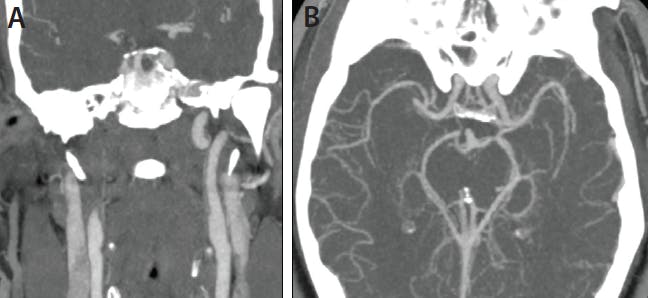
Figure 1. Multiphase CTA maximum-intensity projection images showed right ICA occlusion just beyond the bulb (A) and right M1 occlusion beyond the anterior temporal artery (B).
The patient was taken to the interventional suite, and light sedation was administered. Right common carotid artery (CCA) injection showed an irregular dissection beginning just beyond the bulb extending into a loop in the cervical right ICA with complete occlusion. Injection of the right ICA with the Neuron Max guide catheter (Penumbra, Inc.) showed contrast flow intracranially where there was a right M1 occlusion beyond the anterior temporal artery. The guide catheter was occlusive (Figure 2).
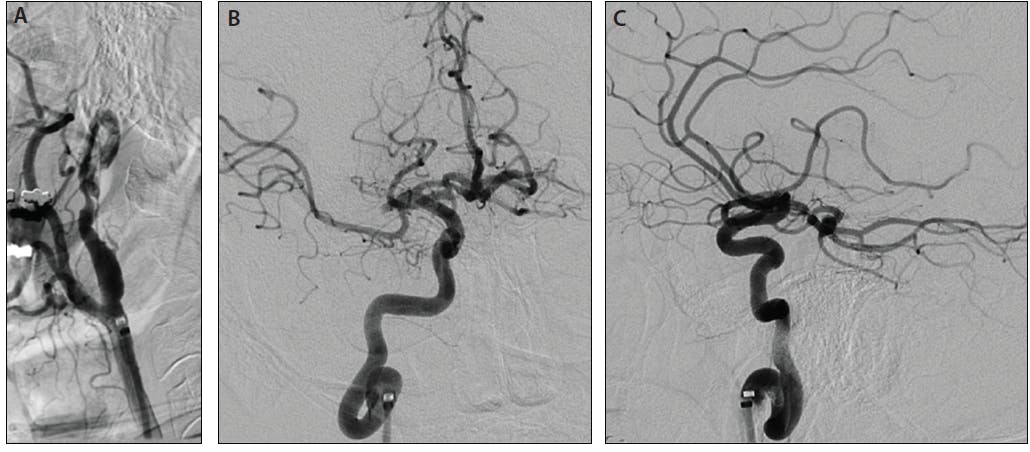
Figure 2. Right CCA angiogram showed dissection of the right ICA extending into a loop (A). Injection of the Neuron Max guide catheter within the cervical ICA opacified the distal ICA and showed the right M1 occlusion (B, C). The ACom was patent.
Do you proceed with thrombectomy of the M1 occlusion, or would you treat the extracranial occlusion first? How would you approach a dissection in a tight extracranial right ICA loop?
Dr. Tjoumakaris: As long as the guide catheter can cross the dissection and occlusion in the cervical ICA, I would proceed with mechanical thrombectomy of the M1 occlusion. I would recommend the aspiration technique over stent retriever to minimize any additional endothelial injury. After recanalization of the intracranial thrombus, I would address the extracranial dissection.
Treatment of dissections in tortuous vasculature can be very challenging, and care must be taken to ensure that the catheters/wires are in the true vessel lumen. When crossing the dissection, I would initially recommend the use of a microcatheter and microwire and confirmatory microinjection. In this case, if the cervical ICA before the loop has a flow-limiting dissection, I would recommend conventional carotid stenting without balloon angioplasty. If the dissection extends in the vascular loop, then one could consider an intracranial stent such as a Neuroform Atlas (Stryker). However, we should recognize that crossing tortuous lesions could reocclude the carotid or induce more endothelial damage. Ultimately, if extracranial revascularization is not successful, a contralateral carotid injection and cross-filling through the anterior communicating artery (ACom) complex are sufficient for functional recovery.
Dr. Toth: This challenging question, whether to focus on the extra- or intracranial problem first, is often faced by neurointerventionalists. If the dissected segment can be safely crossed with a microcatheter/microwire, and then a larger-bore suction catheter can be gently advanced over the two as a coaxial system. I would favor trying to revascularize the intracranial M1 occlusion first in this case. One of the main reasons is the presence of patent ACom and posterior communicating artery (PCom), which are visualized on the intracranial digital subtraction angiography image. These collaterals should theoretically be able to supply the right MCA territory as soon as the M1 segment is revascularized, then attention could be turned toward the cervical dissection. One risk of this approach is the potential to dislodge another thrombus from the cervical carotid dissection flap later, and (re)occlude the MCA and/or anterior cerebral artery territories.
Dr. Amans: Our approach would be to treat the M1 occlusion first. If the cervical ICA lesion can be navigated, we would navigate it with as large of a catheter as possible and try and maintain the position distal to the dissection with this “base camp” catheter. We would then treat the M1 occlusion. Of note, the patient’s M1 occlusion is an M1 because it is in the horizontal Sylvian fissure, but the “anterior temporal artery” appears to be functionally an M2. My suspicion at this point is this is an M2 occlusion and the M1 is quite short using traditional angiographically defined anatomy.
I would try and avoid treating the dissection in the acute phase if possible. The main concern is the patient will likely have to be on antiplatelet medications when a stent is needed. Rarely is angioplasty durable when treating a dissection. Antiplatelet medications have the potential to render any reperfusion hemorrhage a fatal event. In addition, the patient’s symptoms are presumably due to the M1 occlusion. The source of the M1 occlusion is likely the carotid dissection. It would be my preference to try and address the cervical ICA lesion 48 hours after the embolectomy to allow reperfusion hemorrhage to “declare itself” if possible. It may be possible to treat the dissection with anticoagulation/antiplatelets and avoid a stent entirely if the patient recovers neurologic function after the M1 embolectomy.
CASE CONTINUED
A large-bore aspiration catheter system (ACE 68 and 3Max, Penumbra, Inc.) was navigated through the dissection flap and used to perform aspiration thrombectomy with a single pass resulting in thrombolysis in cerebral infarction (TICI) 3 recanalization (Figure 3). The patient regained strength on the table.
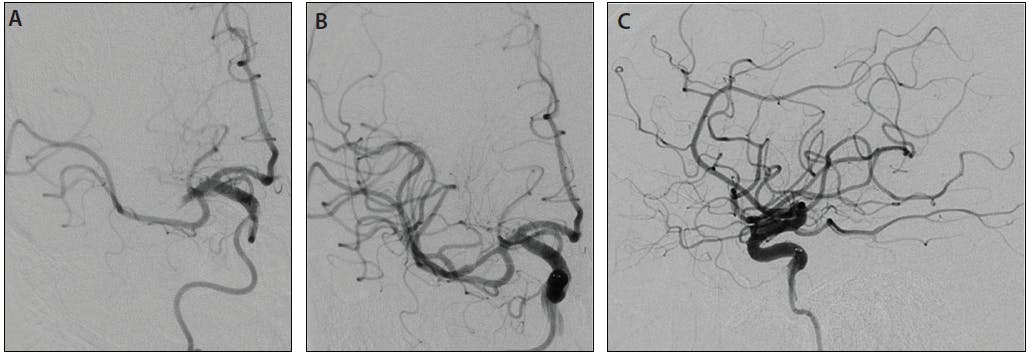
Figure 3. Distal right ICA injection showed the initial right M1 occlusion (A). After thrombectomy, there was complete TICI 3 recanalization (B, C).
Treatment of the right ICA dissection was then attempted with an 8- X 29-mm Carotid Wallstent (Boston Scientific Corporation). Initially, there was good antegrade flow, but this was quickly slowed by a 5-minute delay due to recurrent irregular stenosis at the distal dissection point in the loop. There was still good flow to the right MCA from the patent ACom (Figure 4).
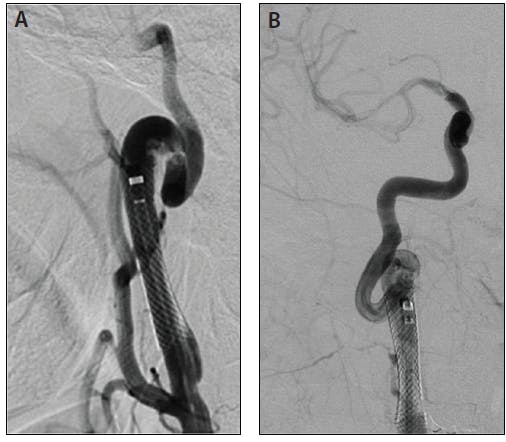
Figure 4. Extracranial right ICA stent was placed from the bulb to the cervical ICA before the loop with slow intracranial flow through the residual dissection flap (A). Intracranially, there was washout of contrast by left to right flow from the patent ACom and PCom (B).
Would you try to stent the right ICA loop? What medication regimen would you start?
Dr. Toth: Our current neuroendovascular options to stent large-caliber cervical vessels with significant associated tortuosity are still limited. Available carotid stents are too stiff to go around severe bends, kinks, or curves, as presented in this case. More flexible intracranial stents (or potentially flow diverters) often have less radial force and insufficient diameter for large cervical arteries. In this case, depending on the vessel diameter, the latter option may be considered.
Stenting in acute stroke patients who also received tPA is challenging due to an increased risk of hemorrhage with multiple blood thinners on board. If a stent is successfully placed, an intraprocedural glycoprotein IIb/IIIa inhibitor could be given (eg, eptifibatide). This regimen can be followed with immediate postprocedural oral/nasogastric dual antiplatelet loading, especially if post-intervention NCCT or intraprocedural cone-beam CT does not suggest hemorrhagic conversion. Otherwise, gentle angioplasty by itself can sometimes achieve acceptable vessel caliber and antegrade flow without stenting.
Lastly, if no angioplasty/stenting options are feasible, the above-mentioned circle of Willis flow through the patent ACom and PCom would hopefully provide sufficient supply to the now-patent right MCA territory. With or without stenting, antiplatelet therapy, as soon as safe after the procedure, is recommended to reduce further thromboembolism from the area of endothelial injury at the dissection site.
Dr. Amans: I would have tried to avoid stenting the dissection entirely, if possible, especially given the neurologic improvement and tPA. I would pull back through the lesion and evaluate for stability angiographically. However, poor flow through this lesion is worse than no flow through the ICA lesion.
If the patient’s neurologic status remains intact, he may tolerate occluding the ICA without having to risk antiplatelet therapy. If the lesion required a stent, I would try and place as long of a construct as possible trying to avoid the loop. If a stent is required, I would use a cangrelor bolus and drip because it has the fastest time to onset, and more crucially, the shortest biologic half-life of the antiplatelet options available at this time.
If the loop started to close again, as in this case, it probably requires stenting. The choice of the stent in this situation is unclear. Most carotid stent delivery systems are too stiff to navigate that loop and will likely exacerbate the dissection. We have had some success using LVIS Blue (MicroVention Terumo) in similar situations. If a 0.071-inch catheter could be navigated beyond the loop and partially straighten the loop, it could be used as a conduit to bring an open-celled stent such as the Precise Pro (Cordis, a Cardinal Health company) (I like it because it is relatively flexible) through the loop while the 0.071-inch catheter protects the lumen from the stent and its delivery system. Then, the 0.071-inch catheter can be pulled back while maintaining the stent in position (unsheathed) and then the stent is delivered.
Dr. Tjoumakaris: Stenting the dissected ICA loop would be high risk for acute reocclusion and additional endothelial damage. Therefore, I would not recommend it in this case. I would initiate the patient on dual antiplatelet therapy (DAPT) after the procedure. If the dissection is stented, then I would bolus with IV tirofiban and heparin 5 minutes before stenting, then initiate DAPT within 2 hours postoperatively. If the patient continues to have active thromboembolic events during recovery, one could consider anticoagulation as long as the ischemic burden is small on subsequent MRI.
CASE CONCLUSION
Brief attempts to recross the right ICA stenosis were unsuccessful. Left ICA angiography showed good flow to the right MCA across the ACom. The patient was loaded with 300 mg of clopidogrel and 325 mg of aspirin via a nasogastric tube, and 75 mg of clopidogrel and 81 mg of aspirin daily was begun. The patient was discharged on day 4 to rehab with an NIHSS of 4. At 90 days, his modified Rankin score was 1. Follow-up CTA showed occlusion of the right cervical ICA and patency of the right MCA.
APPROACH OF THE MODERATOR
This case presented a decision-making challenge due to the complex extracranial ICA dissection and loop, but the widely patent ACom and PCom proved to be a great benefit. This case occurred before the availability of IV cangrelor, and I agree that might have been a good option prior to stenting as a bridge to DAPT.
Because this patient already made a rapid clinical recovery on the table before opening the ICA, further attempts to stent the loop would risk propagating the dissection intracranially or generating new emboli, potentially losing the benefit already achieved from successful thrombectomy. In my opinion, allowing the ICA to occlude was the safest option, and DAPT was continued to protect this patient from new emboli. We were fortunate that he had an excellent clinical outcome.
Advertisement
Advertisement