Advertisement
Advertisement
February 2021
Baseline Stroke Core and Time From Onset Metrics: How the Landscape Is Changing
Predicting favorable outcomes after thrombectomy through imaging techniques.
For the treatment of acute ischemic stroke, the goal of thrombectomy is the removal of the thrombus causing a large vessel occlusion (LVO) of the anterior circulation to stop the growth of the ischemic core and maintain it at a size that safeguards a favorable clinical outcome. Figure 1 illustrates the basic physiology of acute ischemic stroke of a patient with an occlusion of the M1 segment of the right middle cerebral artery (MCA). The irreversibly injured brain (the ischemic core) may be small at first but may grow if the occlusion persists. The rate of growth is highly variable and depends on the strength of the collateral circulation. Some patients have cores that grow rapidly, but many (possibly the majority) have cores that remain small for 24 hours or longer because the collateral circulation is robust.
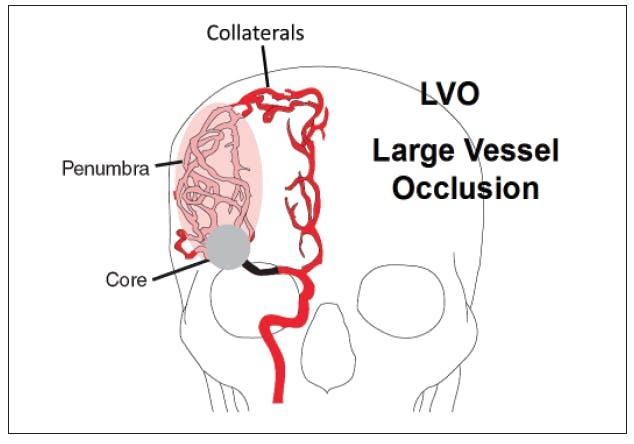
Figure 1. Basic LVO physiology. Adapted from Neuroimaging Clinics of North America, 28, Leslie-Mazwi TM, Lev MH, Schaefer PW, et al, MR imaging selection of acute stroke patients with emergent large vessel occlusions for thrombectomy, 573-584, 2018, with permission from Elsevier.
Historically, the commonly held assumption was that core growth rates in different people were similar and that time was an adequate surrogate for ischemic core size. This assumption has since been shown to be incorrect. Early research on the use of imaging to guide endovascular therapy suggested that visualization of the relevant physiology was a better guide than time.1,2 More recent analyses of prospective thrombectomy trials have confirmed that individual physiology varies widely. The common expression “time is brain” has evolved to “physiologic time is brain.”3 According to current American Heart Association guidelines, the role of imaging is vital, and in patients treated within 6 hours of ictus, only a simple CT scan to exclude hemorrhage is needed. However, in patients beyond 6 hours or with an unknown time of onset, advanced imaging is essential. This is important because most potential patients will be outside the 6-hour threshold.
BASELINE CORE VOLUME AND CLINICAL OUTCOMES AFTER THROMBECTOMY
When advanced imaging is used for patient selection, the measurement of the core is essential, and direct measurement of the penumbra is not necessary.4 This was confirmed in the DAWN trial where patients were selected if they had a small core and a clinical penumbra (ie, deficits that were unexplained by the core size).5 This is physiologically reasonable. As shown in Figure 1, the sizes of the core and penumbra are not independent but are linked by the collateral circulation. Thus, in the presence of an LVO, if the core is small, the penumbra is typically large and direct penumbra measurement is unnecessary as first suggested by Copen et al.4
There is no single core volume threshold that separates patients with favorable or poor outcomes because of differences in the eloquence of the tissue at risk. For example, a 100-mL infarct in the left MCA territory may result in severe paralysis and aphasia, with the patient requiring intense lifelong care. On the other hand, an infarct of 200 mL in the left posterior cerebral artery territory may result in visual deficits, but the patient may be fully independent. The relationships between tissue eloquence, infarct size, and outcome were brilliantly illuminated by Boers et al in a meta-analysis of seven prospective thrombectomy trials.6
Figure 2 illustrates a three-dimensional plot of the probability of a favorable outcome with respect to baseline tissue (National Institutes of Health Stroke Scale [NIHSS]) and follow-up infarct volume as measured by MRI. The blue areas represent the conditions under which the patient has a low probability of a good outcome. Examination of the figure indicates that a patient with a low NIHSS score of 5 could sustain an infarct of 150 mL and still have a favorable outcome after thrombectomy. On the other hand, if the NIHSS is > 10, reflecting threatened eloquent cortex, there is a sharp drop from a high to a low probability of favorable outcomes with increasing core size. For example, if someone has an NIHSS of 25 and the follow-up infarct volume is < 60 mL, the probability of a favorable outcome is very high. However, the same patient would have a low probability if the follow-up infarct volume is > 80 mL. These data inform us that the therapeutic window with respect to the final infarct volume is small when eloquent cortex is involved; a difference between a good and poor outcome may be due to an infarct volume difference of 20 to 30 mL. Because of this narrow therapeutic window, we need to measure the infarct core with high precision and accuracy when eloquence of the threatened brain region is significant.
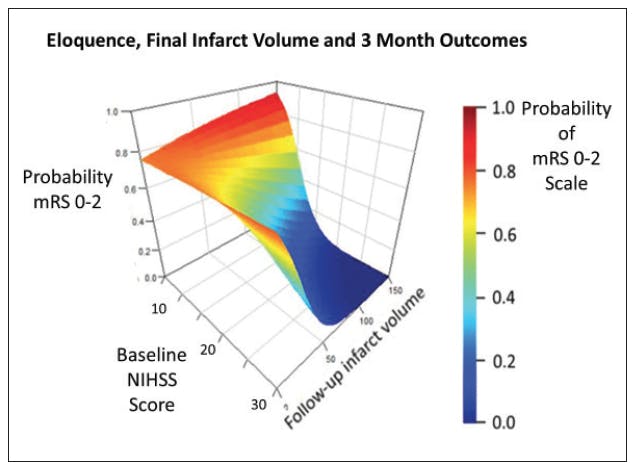
Figure 2. Probability of a favorable outcome with respect to baseline core volume and baseline eloquence of tissue at risk (NIHSS). mRS, modified Rankin Scale. Reproduced from Journal of NeuroInterventional Surgery, Boers AMM, Jansen IGH, Haussen DC, et al, volume 10, pages 1137-1142, copyright 2018 with permission from BMJ Publishing Group Ltd.
CORE MEASUREMENT METHOD AND OUTCOMES AFTER THROMBECTOMY
There are four commonly used methods to estimate the size of the ischemic core; two are direct and the others estimate the core indirectly. The most reliable and accurate method is diffusion MRI, commonly known as diffusion-weighted imaging (DWI). Severe ischemia produces reduced diffusivity of water in the brain by mechanisms that are not fully understood. Reduced diffusivity is manifest within 30 minutes after the onset of severe ischemia. The other direct method is identification of an ischemia-induced hypodensity on a noncontrast head CT. Ischemia produces increased local water content and is the physical basis of the hypodensity. However, this process takes hours because the amount of water increase must be > 1% to 2% before it is detectable. This makes noncontrast CT imaging unsuitable in most situations.
The two indirect methods most commonly used to estimate the ischemic core are CT perfusion (CTP) and CTA collaterals. CTP is widely employed and relies on the reduction of the relative cerebral blood volume or blood flow to estimate the core. Either CTP or DWI was used for patient selection in nearly all published prospective thrombectomy studies. Meta-analysis of these prospective trials provides direct information on the relative efficacy of each method. Results from the Hermes collaboration are shown in Table 1.
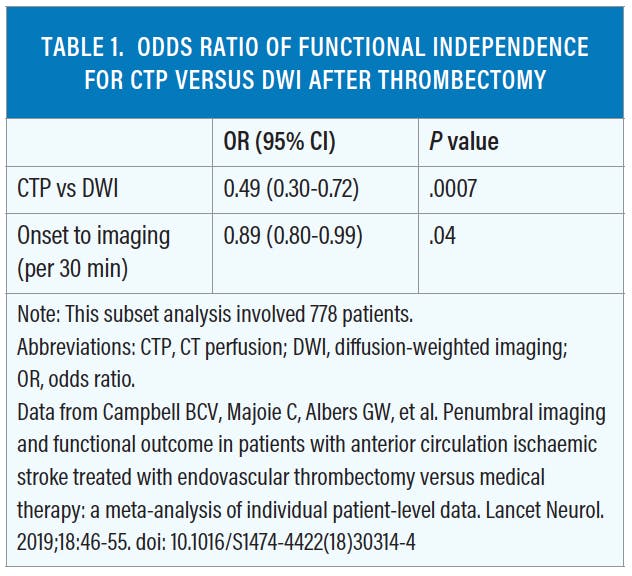
The odds ratio for a favorable outcome in patients chosen for thrombectomy using CTP was fewer than half of patients selected for thrombectomy using DWI. In other words, the likelihood of a patient having a good outcome was a factor of two better if DWI was used rather than CTP. This effect was present even though patients selected with DWI on average were treated 30 minutes later than those selected with CT.7 These results are best explained by the superior precision of DWI for core measurement; it is more effective in selecting patients more likely to benefit from thrombectomy and excluding those who are not.
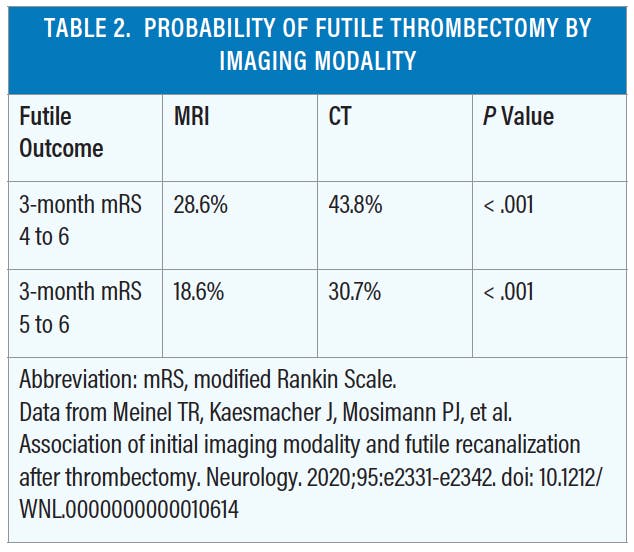
Another potential outcome is futile thrombectomy. Futile thrombectomy occurs when the clot is successfully removed but the clinical outcome for the patient is poor. An example would be if the patient died or if they lived but acquired severe disability. This topic has been specifically examined by a group led by Meinel and Kaesmacher.8 They analyzed 2,011 patients for the occurrence of futile thrombectomy (defined as 90-day modified Rankin Scale score of 4 to 6 despite successful recanalization) in patients selected by MRI (n = 690) and CT (n = 1,321). The results demonstrated that CT selection for thrombectomy was associated with an increased risk of futile outcome compared to MRI selection (Table 2). Again, the results are best explained by the superior precision of MRI to identify those who are unlikely to benefit from thrombectomy.
ISCHEMIC CORE DYNAMICS AND THROMBECTOMY: IDENTIFYING SLOW PROGRESSORS
Extensive literature to date confirms that baseline ischemic core size has a vital impact on patient outcome when thrombectomy is considered. A related topic is the growth of the infarct core over time, known as ischemic core dynamics. This is important because most patients who may potentially benefit from thrombectomy may be situated many hours away from a center capable of performing thrombectomy. The critical issue is whether the patient’s ischemic core will be suitably small on arrival at a thrombectomy-capable center and whether such patients are identifiable at the first hospital where only CT scanners are available.
Ischemic Core at Presentation Does Not Correlate With Time of Onset
Previously, it was assumed that ischemic core growth rates were similar for all patients with LVO. If true, the prediction is that there is a correlation between the size of the core and the time since occlusion onset. In fact, there is no correlation. This was first shown by Hakimelahi et al and is illustrated in Figure 3.9 In this study, the infarct core was measured using DWI in 186 consecutive patients with an LVO who presented in the emergency department. Each circle in Figure 3 represents a patient. The vertical axis displays the diffusion lesion volume in milliliters. The horizontal axis is the time from stroke onset that extends to 24 hours. There is no correlation between lesion volume and time (r2 < .0006; P > .5). Assuming linear initial growth, more than half of these patients had cores with an initial growth rate of ≤ 4.1 mL per hour. The significance of this growth rate is discussed subsequently.
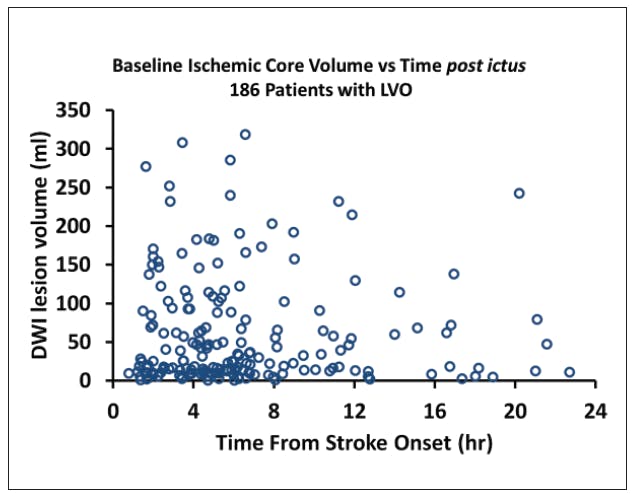
Figure 3. Admission DWI volume versus time from stroke onset. Baseline core volumes by DWI in 186 LVO stroke patients. Adapted from Hakimelahi R, Vachha BA, Copen WA, et al, Time and diffusion lesion size in major anterior circulation ischemic strokes, Stroke, volume 45, issue 10, pages 2936-2941. https://www.ahajournals.org/doi/10.1161/STROKEAHA.114.005644
Slow Progressors and Opportunities for Thrombectomy at 24 Hours
Growth of the ischemic core is highly variable and begs the question of how many LVO stroke patients have growth of core that would permit thrombectomy many hours after presentation. These are the “slow progressors,” a term coined by University of Pittsburgh investigators.9 We defined slow progressors as those patients who have ischemic cores < 50 mL 24 hours post ictus (Figure 4). In two investigations, we found that more than half of LVO patients were slow progressors.10,11
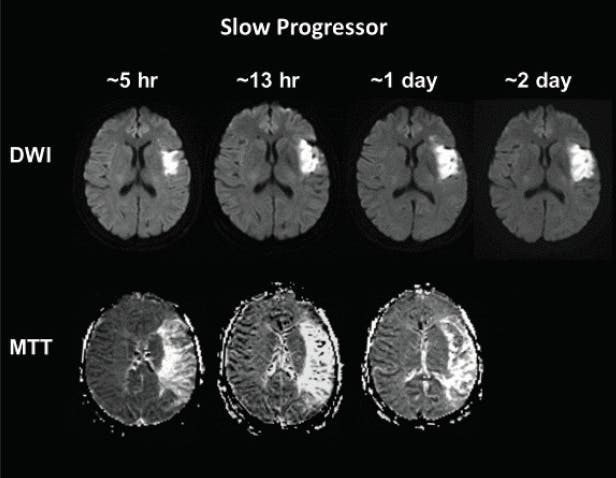
Figure 4. Example of a slow progressor. The patient with a a left MCA occlusion was first imaged 5 hours after stroke onset. Despite persistence of occlusion and a large mismatch, the core remained < 50 mL for 2 days. MTT, mean transit time. Adapted from Gonzalez RG, Silva GS, He J, et al. Identifying severe stroke patients likely to benefit from thrombectomy despite delays of up to a day. Sci Rep. 2020;10:4008. doi: 10.1038/s41598-020-60933-3. http://creativecommons.org/licenses/by/4.0/
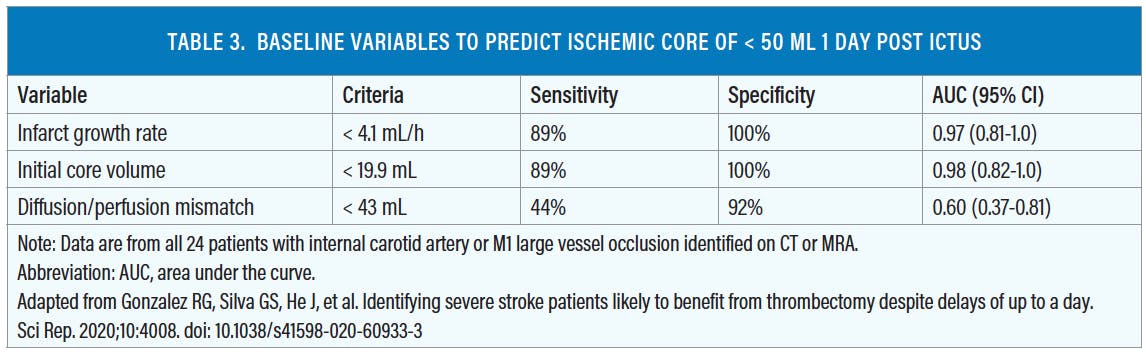
We performed frequent MRI of 38 untreated LVO patients over 2 days and found logarithmic growth of the ischemic infarct core. In 24 patients with terminal internal carotid artery or proximal MCA occlusions (Table 3), we found that an infarct core growth rate (IGR) < 4.1 mL/hour and initial infarct core volumes < 19.9 mL had accuracies > 89% for identifying patients who would still have a core of < 50 mL 24 hours after stroke onset, a core size that should predict favorable outcomes with thrombectomy even if eloquent tissues were involved. Published initial IGRs from multiple centers3,9,12-14 indicate that up to half of all LVO stroke patients have an IGR < 4.1 mL/hour. We conclude that many LVO patients have a stroke physiology that is favorable for late intervention and that imaging biomarkers can accurately identify them at early time points as suitable for transfer for intervention.
IDENTIFYING SLOW PROGRESSORS WITHOUT ADVANCED IMAGING
Thrombectomy would benefit many more patients if a method to identify slow progressors was commonly available. Identification is possible with advanced imaging such as DWI and CTP, but they are often not readily accessible. However, CT and CTA are widely available. It is possible that collateral pattern on CTA may be an excellent surrogate marker for identifying slow progressors. The Massachusetts General Hospital group has previously noted the predictive value of characterizing the collateral pattern on the side of an occlusion.15-17 Based on this experience, we are testing the hypothesis that a pattern of excellent collateral flow could identify slow progressors. We tested this hypothesis in the same cohort of patients who underwent multiple MRI studies over 2 days.11 Excellent collateral flow pattern was defined as an approximately symmetric pattern of the arterial enhancing pattern in both hemispheres (Figure 5). Preliminary results were presented at the American Society of Neuroradiology 2020 annual meeting.18 This pattern was found to be highly predictive of a small ischemic core, a core initial growth rate of < 5 mL/hour, and a 24-hour core size of < 50 mL. Because CTA is nearly universally available at centers that receive patients experiencing stroke, this symmetric collateral pattern identification may ease the timely transfer of patients likely to benefit from thrombectomy-capable centers even if they are located many hours away.
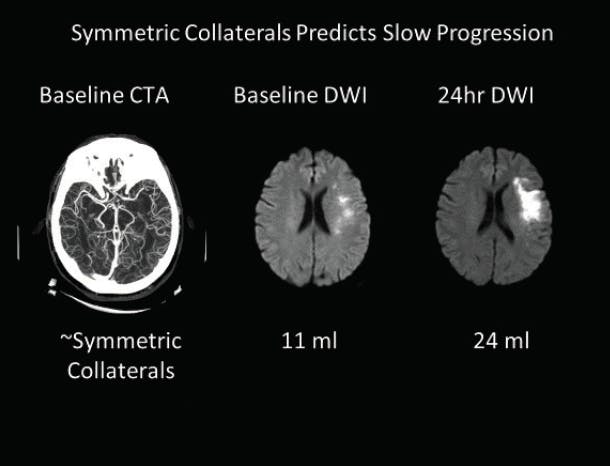
Figure 5. Slow progressor with symmetric collaterals. The patient was first imaged < 6 hours after stroke onset. He had a left MCA stem occlusion but nearly symmetric collaterals on the left. Despite persistence of the occlusion, the core remained < 25 mL for 24 hours post ictus.
SUMMARY
Thrombectomy for LVOs in patients with a major ischemic stroke syndrome is the most important neurologic therapeutic advance in decades. Making it widely available promises a substantial reduction of major morbidity and death due to stroke. Advanced imaging is key to making this possible in patients treated after 6 hours post ictus through its ability to estimate the size of the core. A higher proportion of favorable outcomes and fewer futile thrombectomies are achieved by using DWI rather than CTP because of the higher precision of the former. Studies on the dynamics of ischemic core growth indicate that up to half of LVO patients are slow progressors who may be treated up to 24 hours after stroke onset because the ischemic core remains small. These slow progressors may be identified by core measurement using advanced imaging, especially DWI. Early evidence suggests that slow progressors may also be identified by a robust collateral pattern on CTA.
1. Gonzalez RG. Imaging-guided acute ischemic stroke therapy: From “time is brain” to “physiology is brain”. AJNR Am J Neuroradiol. 2006;27:728-735.
2. Yoo AJ, Chaudhry ZA, Nogueira RG, et al. Infarct volume is a pivotal biomarker after intra-arterial stroke therapy. Stroke. 2012;43:1323-1330. doi: 10.1161/STROKEAHA.111.639401
3. Vagal A, Aviv R, Sucharew H, et al. Collateral clock is more important than time clock for tissue fate. Stroke. 2018;49:2102-2107. doi: 10.1161/STROKEAHA.118.021484.
4. Copen WA, Rezai Gharai L, Barak ER, et al. Existence of the diffusion-perfusion mismatch within 24 hours after onset of acute stroke: dependence on proximal arterial occlusion. Radiology. 2009;250:878-886. doi: 10.1148/radiol.2503080811.
5. Nogueira RG, Jadhav AP, Haussen DC, et al. Thrombectomy 6 to 24 hours after stroke with a mismatch between deficit and infarct. N Engl J Med. 2018;378:11-21. doi: 10.1056/NEJMoa1706442
6. Boers AMM, Jansen IGH, Beenen LFM, et al. Association of follow-up infarct volume with functional outcome in acute ischemic stroke: a pooled analysis of seven randomized trials. J Neurointerv Surg. 2018;10:1137-1142. doi: 10.1136/neurintsurg-2017-013724
7. Campbell BCV, Majoie C, Albers GW, et al. Penumbral imaging and functional outcome in patients with anterior circulation ischaemic stroke treated with endovascular thrombectomy versus medical therapy: a meta-analysis of individual patient-level data. Lancet Neurol. 2019;18:46-55. doi: 10.1016/S1474-4422(18)30314-4
8. Meinel TR, Kaesmacher J, Mosimann PJ, et al. Association of initial imaging modality and futile recanalization after thrombectomy. Neurology. 2020;95:e2331-e2342. doi: 10.1212/WNL.0000000000010614
9. Hakimelahi R, Vachha BA, Copen WA, et al. Time and diffusion lesion size in major anterior circulation ischemic strokes. Stroke. 2014;45:2936-2941. doi: 10.1161/STROKEAHA.114.005644
10. Gonzalez RG, Hakimelahi R, Schaefer PW, et al. Stability of large diffusion/perfusion mismatch in anterior circulation strokes for 4 or more hours. BMC Neurol. 2010;10:13. doi: 10.1186/1471-2377-10-13
11. Gonzalez RG, Silva GS, He J, et al. Identifying severe stroke patients likely to benefit from thrombectomy despite delays of up to a day. Sci Rep. 2020;10:4008. doi: 10.1038/s41598-020-60933-3
12. Olivot JM, Sissani L, Meseguer E, et al. Impact of initial diffusion-weighted imaging lesion growth rate on the success of endovascular reperfusion therapy. Stroke. 2016;47:2305-2310.
13. Wheeler HM, Mlynash M, Inoue M, et al. The growth rate of early DWI lesions is highly variable and associated with penumbral salvage and clinical outcomes following endovascular reperfusion. Int J Stroke. 2015;10:723-729. doi: 10.1111/ijs.12436
14. Desai SM, Rocha M, Jovin TG, Jadhav AP. High variability in neuronal loss. Stroke. 2019;50:34-37. doi: 10.1161/STROKEAHA.118.023499
15. Lima FO, Furie KL, Silva GS, et al. The pattern of leptomeningeal collaterals on CT angiography is a strong predictor of long-term functional outcome in stroke patients with large vessel intracranial occlusion. Stroke. 2010;41:2316-2322. doi: 10.1161/STROKEAHA.110.592303
16. Maas MB, Lev MH, Ay H, et al. Collateral vessels on CT angiography predict outcome in acute ischemic stroke. Stroke. 2009;40:3001-3005. doi: 10.1161/STROKEAHA.109.552513
17. Souza LC, Yoo AJ, Chaudhry ZA, et al. Malignant CTA collateral profile is highly specific for large admission DWI infarct core and poor outcome in acute stroke. AJNR Am J Neuroradiol. 2012;33:1331-1336. doi: 10.3174/ajnr.A2985
18. Gonzalez RG. Is Automation the Answer? Presented at: American Society of Neuroradiology 2020 annual meeting; May 18, 2020.
Advertisement
Advertisement