Advertisement
Advertisement
February 2021
Middle Meningeal Artery Embolization for Subdural Hematoma: What We’ve Learned, What We Need to Know
The current state of middle meningeal artery embolization for subdural hematoma.
By Joseph A. Carnevale, MD; Gary Kocharian, MD; Jacob Goldberg, MD; Alexander D. Ramos, MD, PhD; Justin Schwarz, MD; and Jared Knopman, MD
Nonacute subdural hematoma (NASDH) is an increasingly challenging condition to medically and surgically manage due to a variety of factors, most notably its rising prevalence, baseline patient substrate, recrudescent pathophysiology, current treatment paradigms, and the impact on the health care system. NASDH is an extremely common pathology, with an overall incidence of up to 20 persons per 100,000 per year in the general population, and even more so in the elderly population, with up to 74 persons per 100,000 for those aged ≥ 65 years.1-7 Considering the overall aging population, the morbidity burden associated with this population, and the increasing use of antiplatelet and anticoagulant medications, it is no surprise why NASDH is already one of the most common neurosurgical conditions, and its incidence is expected to double over the next 25 years.6,8-15
Currently, the gold standard treatment for symptomatic NASDH is surgical evacuation of the hematoma.6,11,16 By means of a craniotomy, burr holes, or bedside twist-drill craniostomy, removal of the subdural collection has been the treatment paradigm in neurosurgical practice. For patients unable to undergo surgery or those who have smaller, asymptomatic NASDH, nonsurgical options (eg, steroids, statins, antifibrinolytics, angiotensin-converting enzyme inhibitors) have been investigated but without much promise.6,17-22 Despite initial surgical and medical treatment, NASDH is notorious for recurrence, further complicating its management. Throughout the literature and neurosurgical practice, recurrence of NASDH is widely accepted, expected, and unsuccessfully mitigated notwithstanding dedicated efforts. Despite the countless permutations of surgical treatment strategies, including craniotomy size, drain location, and postoperative patient positing, NASDH has a variable rate of recurrence of 2% to 37%, with most studies reporting 10% to 20% hematoma recurrence.1‑4,11,23‑31 This means despite an ambulance transfer, emergency department evaluation, hospital admission, operating room evacuation, intensive care unit attention, serial radiographic evaluations, and possible physical/occupation therapy, possibly up to one in three NASDH patients is likely to need to repeat the entire process, resulting in an unprecedented toll on not only the patient but on the overall health care system.
Middle meningeal artery embolization (MMAe) has created a paradigm shift in the care and management of patients with NASDH. This paradigm shift stems from the basic principle that to successfully treat a condition, its pathophysiology must be understood. Despite what is taught in medical school as doctrine—epidural hematoma is to artery as subdural hematoma is to vein—careful examination of NASDH pathophysiology and its recurrence has revealed a more complex interworking, thereby explaining exactly why a novel, outside-the-box approach is needed for this challenging pathology.
Briefly, NASDH and its subsequent recurrence is a pathologic chain reaction beginning with separation of the dural membrane bilayer, thereby triggering a healing response and dural border cell proliferation. Subsequently, an inflammatory reaction occurs, resulting in granulation tissue formation, macrophage deposition, hyperfibrinolysis, and angiogenesis, which induces neovascularization. Finally, this fragile network of capillaries causes hematologic leakage into the hematoma cavity, resulting in growth and recurrence over time. This process has been uniformly accepted as the true pathophysiology underlying the chronicity, refractoriness, and recurrence of NASDH.6,11,16,17,23,25,32-39
MMAe is a minimally invasive, neuroendovascular procedure that allows for direct access to the main blood supply of the dura, the MMA, and can obliterate the underlying cause of NASDH, halting neovascularization and allowing the collection to be resorbed without recurrence. This article dives into the current state of MMAe in the literature, explores the aspects that require further evaluation, and addresses the next steps toward a major paradigm shift in NASDH management.
CURRENT STATE OF MIDDLE MENINGEAL ARTERY EMBOLIZATION
MMAe was first mentioned 20 years ago in the literature in a Japanese case report.40 In many ways, this report highlights the quintessential NASDH patient, with an underlying coagulopathy and numerous recurrences requiring repeated surgical evacuations. On February 22, 1999, the first MMAe took place using polyvinyl alcohol (PVA) particles and without complication. Over the subsequent 7-month follow-up period, the patient experienced no further recurrence and the hematoma resolved.
Salvage MMAe for Refractory NASDH
Over the past 2 decades, clinicians and researchers from around the world have closely examined the clinical impact of MMAe. Subsequent to the aforementioned index MMAe report, a series of case reports defining the well-known problem of NASDH and outlining use of MMAe on an individual basis paved the way to the first low-volume MMAe case series. Despite all of these series having fewer than 10 patients, researchers called attention to the utility of MMAe as an adjunct following recurrent surgical evacuation. Each of these early series examined patients with recurrent NASDH re-presenting with clinically and/or radiographically significant hematomas and discovered impressively low recurrence rates with MMAe compared with the high rate of recurrence with standard of care.41-48
In 2017, the first single-institution cohort study retrospectively examined 372 patients with NASDH, 11.6% (n = 43) of whom presented with hematoma recurrence requiring repeat surgical evacuation.31 Of the 43 patients who underwent a second craniotomy, 23 followed conventional postoperative care and follow-up, and 20 patients underwent MMAe. At 3-month follow-up, the MMAe group had statistically significant faster brain reexpansion time (34 vs 98 days) and a decreased rate of hematoma recurrence (3.8% vs 33.3%). Despite the obvious drawbacks of this study design and sample size, for patients with refractory operative NASDH, postoperative MMAe proved to be a minimally invasive, low-complication, and effective means to lower NASDH recurrence. In 2018, two larger retrospective case series further established the utility of MMAe as a means for reducing NASDH recurrence rates in patients with a history of one or more surgical evacuations compared with historic controls.16,23
Upfront MMAe
Salvage MMAe for refractory NASDH has been well established, and clinicians have started exploring further applications for this promising procedure. Upfront MMAe offers treatment for previously untreated, nonoperative NASDH in patients who are clinically symptomatic or failed conservative, expectant management. In 2017, Link et al reported the first series of upfront MMAe for previously untreated symptomatic NASDH.46 Despite the small patient number, this series introduced MMAe as a treatment alternative to surgery, thereby further establishing MMAe as a safe and minimally invasive treatment strategy for NASDH.
Link et al performed a more robust case series examining upfront MMAe in addition to refractory NASDH and reported a 91% long-term (> 6 weeks) success rate, defined as avoidance of surgery and no procedure-related complications.23 Subsequently, other research groups demonstrated similar recurrence rates of 0% to 3.7% compared to 27.5% NASDH recurrence for their institutional historical controls following standard of care.16,49,50 Interestingly, one group pushed the limits of operative radiographic criteria for subdural hematoma and achieved lower recurrence rates with upfront MMAe than with standard of care in patients with hematoma thickness up to 25 mm and > 5 mm midline shift.49
Prophylactic MMAe
For individuals who present with a symptomatic operative NASDH, prophylactic embolization remains another promising application for MMAe. Given the well-known rate of recurrence and supporting pathophysiology for such events, it would stand to reason that newly diagnosed hematomas requiring evacuation should undergo prophylactic MMAe to further halt any chance of future recurrence.
Prophylactic MMAe has been shown in numerous studies to be effective in further decreasing the rate of recurrence of NASDH after first-time hematoma evacuation.16,23,51,52 Ban et al and Shotar et al both demonstrated that prophylactic MMAe decreases the NASDH recurrence rate to 4% and 2.2% as compared with a control group recurrence rate of 14% and 27.5%, respectively.16,51 Furthermore, the Carnevale et al recently evaluated prophylactic MMAe by evacuation method (craniotomy, burr hole, twist-drill craniostomy) and found MMAe resulted in a recurrence rate of 0% after craniotomy and burr hole for hematoma evacuation, whereas bedside craniostomy resulted in a recurrence rate of only 4.5%.52 Prophylactic MMAe has joined upfront MMAe and salvage MMAe as another promising application in the management of NASDH.
Currently, the most robust evidence regarding MMAe and NASDH rests in multicenter case series, systematic reviews, and meta-analyses. Table 1A, Table 1B and Table 1C outlines the population, results, and conclusions for each of these studies.6,11,15-17,23,25,31,41-46,49-58 One of the largest multicenter respective series reported nearly 72% hematoma improvement and 6.5% failure rate.11 Moreover, another large multicenter review examined elderly patients with NASDH and their associated morbidity burden; MMAe continued to be effective, with 91% and 98% success rates and 4.6% and 7.8% failure rates for patients aged 65 to 79 and > 80 years, respectively.52 Based on meta-analyses in the current literature, hundreds of patients who underwent MMAe have been evaluated, and the conclusions further support MMAe as an integral part of NASDH management. Specifically, not only has the NASDH recurrence rate with MMAe been repeatedly shown to be lower than standard of care (2.1% vs 27.7%), but upfront and salvage MMAe results in recurrence rates below the standard of care (4.1% and 2.4%, respectively).17,25 Moreover, patients with NASDH have a 26% chance lower risk of recurrence and a 20% lower need for surgical rescue with MMAe.6
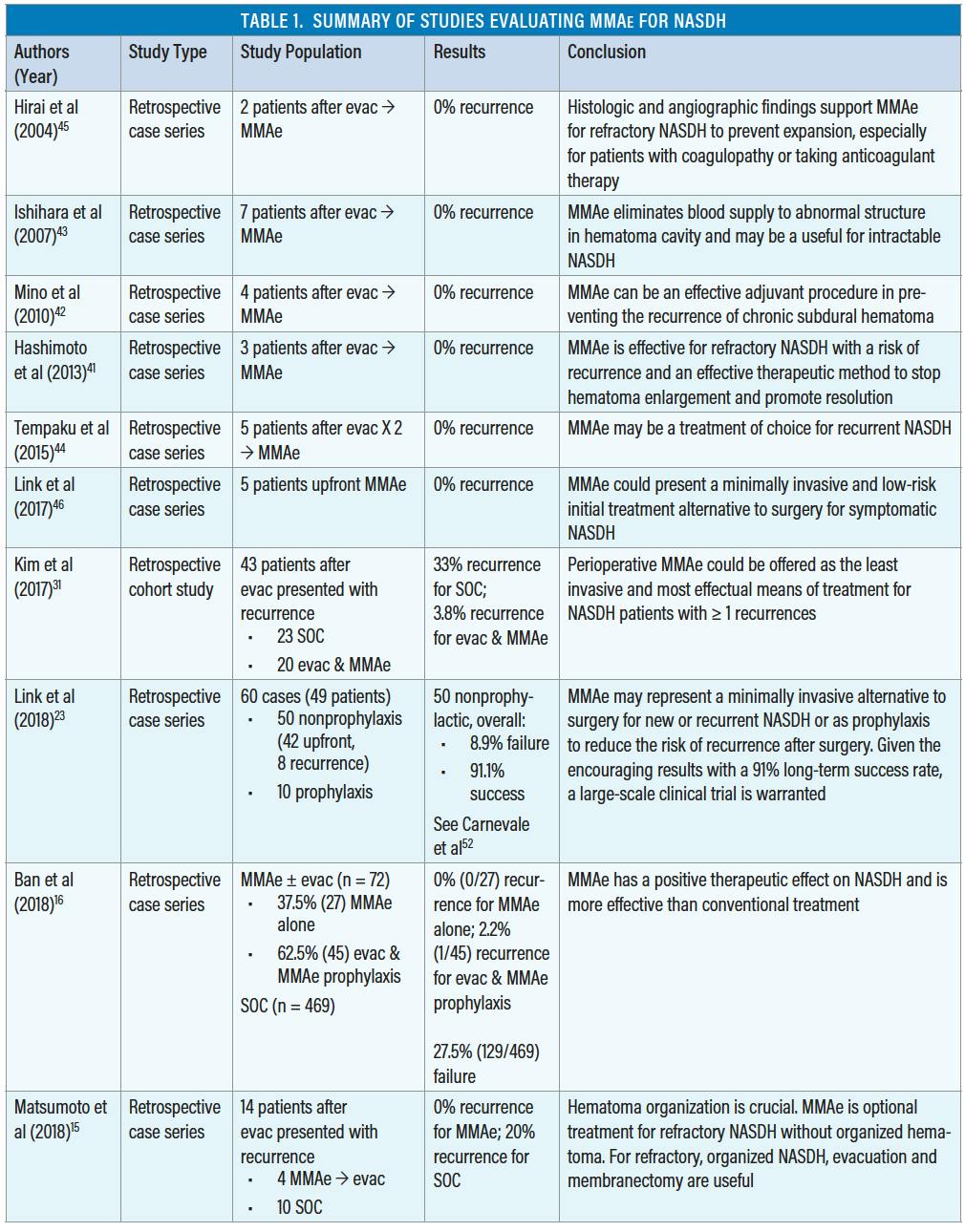
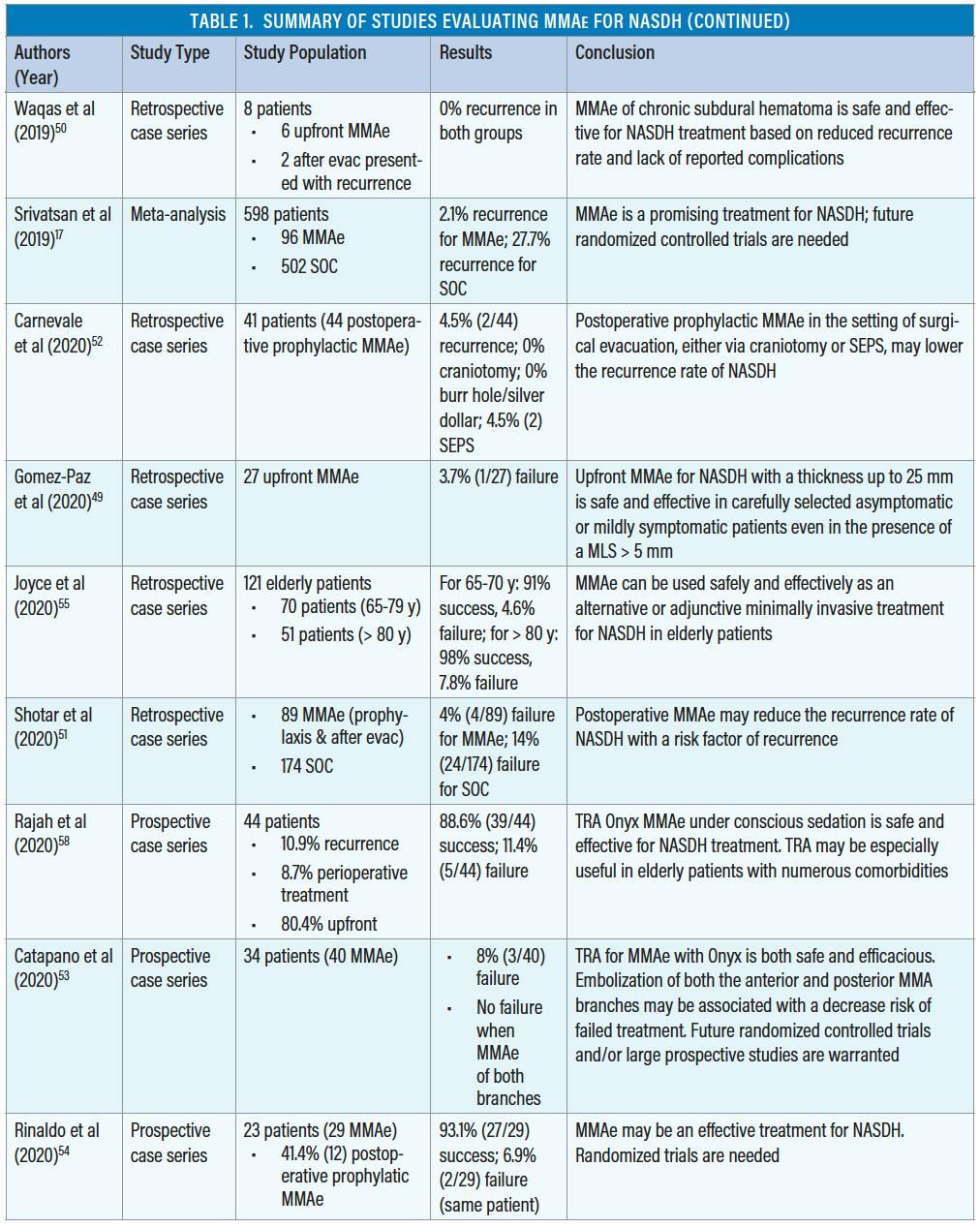
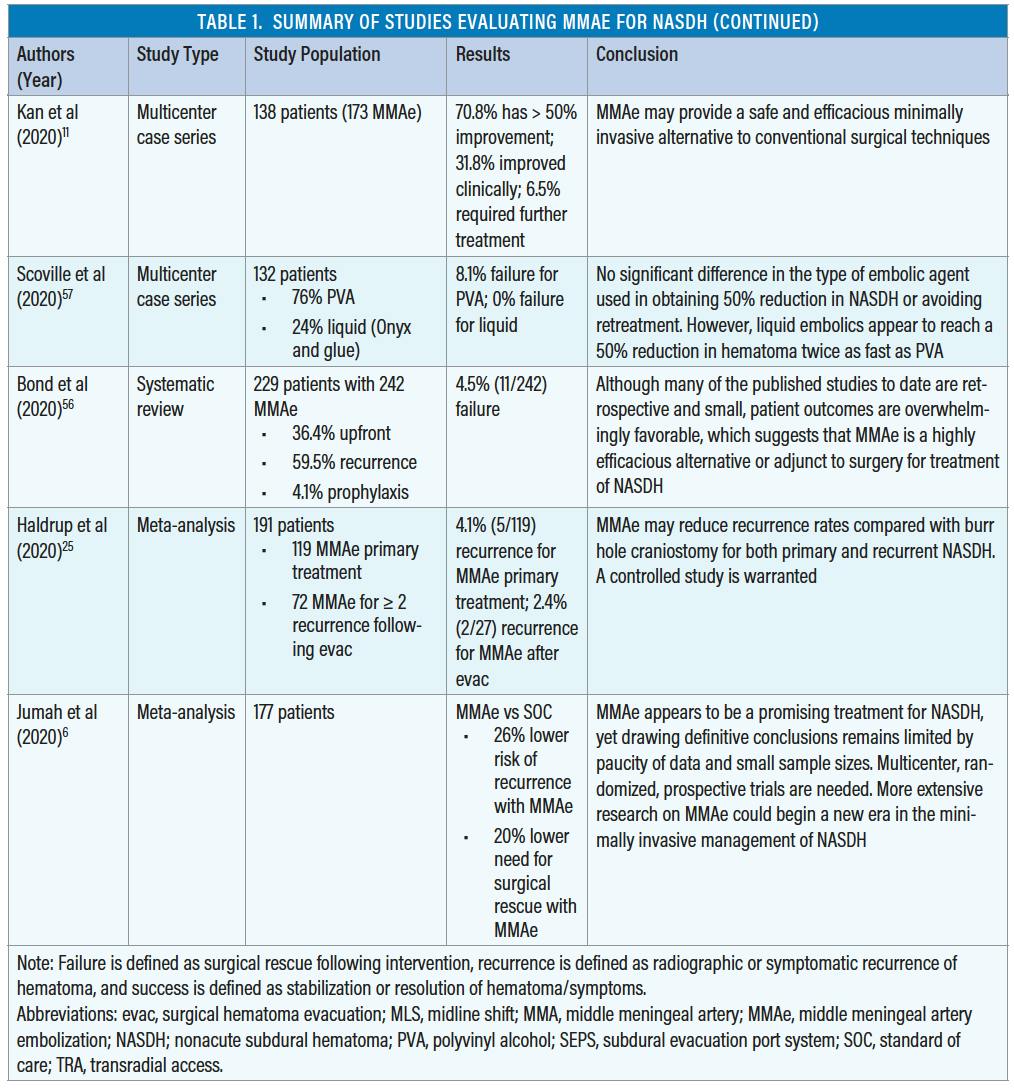
Overall, the current body of literature on MMAe has effectively narrowed the recurrence rate of NASDH from 2% to 37% after surgical evacuation to 0% to 4.1%.50,59 Nevertheless, these data from case reports, case series, retrospective studies, and meta-analyses have not shifted MMAe into standard of care. The final steps toward a more widely accepted paradigm shift in the treatment of NASDH are underway. Currently, two randomized open-label trials comparing upfront MMAe as well as an adjunctive to surgical evacuation of hematomas are underway, and two open-labeled nonrandomized trials are recruiting patients.60-62 With this necessary next step, there will be more robust evaluation of the significance of MMAe and hopefully a substantial change in the care of patients with NASDH.
REMAINING QUESTIONS FOR MMAe
One of the most important questions regarding MMAe and its role in NASDH management is whether it will prove to be effective in the gold standard of clinical trials. Although these studies are underway, there are more remaining questions regarding technical aspects and patient selection for MMAe that remain unanswered.
Radial Versus Femoral
Neuroendovascular procedures have long been conducted via femoral arterial access, which remains the primary access point for all diagnostic and interventional procedures. Recently, the endovascular community has utilized both transradial and transulnar approaches with increasing frequency, safety, and success.11,58,63-66 In one of the largest series to date, 579 neurointerventional treatments regardless of indication were reviewed and 28% were attempted via a transradial approach (TRA). Although the majority were aneurysmal embolization cases, 19% were embolizations and the researchers concluded that TRA carries a lower complication rate, equitable fluoroscopy time, and greater contrast utilization compared to the transfemoral approach.64 Although outcome by access was not directly compared, 12.3% of patient underwent TRA in the largest multicenter MMAe series consisting of 154 embolizations.11 Furthermore, Rajah et al conducted an all-TRA MMAe series of 46 patients, with 95.6% technical success due to radial spasm or vessel tortuosity and a comparable success rate of 89%.58 Given the lower complication rates and overwhelming patient satisfaction with TRA, all our embolizations are now conducted with a 5-F sheath and TRA if the patient’s vascular anatomy is favorable.
Particles Versus Liquids
The question remains of which embolic material results in the most robust and long-lasting MMAe. Various materials are utilized in neuroendovascular embolization procedures including, PVA, Onyx (Medtronic), N-butyl cyanoacrylate (NBCA), or coils, all of which come in a variety of sizes, consistencies, and viscosities. The majority of studies evaluating MMAe utilize PVA particles (> 150 µm) for embolization.11,23,67 Despite their strong literature presence and cost-effectiveness compared to liquid embolics, PVA penetrates only as distal as the vessel size and flow allow, which can be limited, especially in the elderly population. PVA is not radiopaque and requires careful administration so as to not underpenetrate distally or reflux into potentially eloquent branches. Moreover, PVA can be resorbed and therefore leaves the possibility of MMA recanalization and hematoma recurrence. On the other hand, liquid embolic agents, including Onyx and NBCA, can be radiographically monitored, infused into more distal vasculature (possibly in an uncontrolled fashion), and result in a permanent embolization.
Of the few studies comparing embolic material, there is currently no superior agent.11,63 Kan et al conducted a multicenter study of 154 consecutive MMAe and found no difference between coils, liquids embolics, liquid embolics and coils, particles, and particles and coils.11 Recently, the largest series primarily examining embolic material in MMAe was published with the same equivocal conclusion. However, this study reported that use of liquid embolics resulted in hematoma reduction twice as fast as particles (P = .008).57 Interestingly, regardless of the material used, the extent of embolization to include both the frontal and posterior branches of the MMA is shown to decrease the rate of hematoma recurrence.53
Patient Selection
As with all surgical procedures, careful patient selection can be the main determining factor in a successful outcome. For the otherwise healthy patient who presents with a symptomatic NASDH and meets operative criteria, there is little question to proceed with an evacuation. The aforementioned evidence may even push the clinician to consider prophylactic MMAe. However, for patients with NASDH but a baseline morbidity precluding surgical evacuation, the question stands as to what approach is best. Today, more patients require antithrombotic medications (antiplatelets and/or anticoagulants) for a variety of reasons, which makes discontinuing them, even briefly, very risky. At the same time, more oncologic patients are living longer and developing NASDH with surgically prohibitive platelet counts. For these populations, MMAe offers an alternative approach to the management of an otherwise operative hematoma. The effectiveness in these populations specifically is yet to be studied, and the efficacy of MMAe in these subgroups unknown. Our group is currently in collaboration with Memorial Sloan Kettering Cancer Center for the first and largest nonsurgical NASDH series of oncologic patients undergoing MMAe alone due to hematologic prohibitory factors, and the preliminary results appear promising.
CONCLUSION
Over the past 20 years, MMAe has become a well-accepted and studied intervention for the management of NASDH. Despite the remaining questions, this minimally invasive, low-complication intervention has been shown to significantly reduce the recurrence rate of a notoriously stubborn neurosurgical pathology. Soon, with the completion of ongoing randomized clinical trials, we will potentially see the paradigm shift in NASDH management to include MMAe and, hopefully, a significant improvement in the care of these patients.
1. Liu W, Bakker NA, Groen RJM. Chronic subdural hematoma: a systematic review and meta-analysis of surgical procedures. J Neurosurg. 2014;121:665-673. doi:10.3171/2014.5.JNS132715
2. Xu CS, Lu M, Liu LY, et al. Chronic subdural hematoma management: clarifying the definitions of outcome measures to better understand treatment efficacy: a systematic review and meta-analysis. Eur Rev Med. 2017;21:809-818.
3. Almenawer SA, Farrokhyar F, Hong C, et al. Chronic subdural hematoma management: a systematic review and meta-analysis of 34,829 patients. Ann Surg. 2014;259:449-457. doi:10.1097/SLA.0000000000000255
4. Ivamoto HS, Lemos HP, Atallah AN. Surgical treatments for chronic subdural hematomas: a comprehensive systematic review. World Neurosurg. 2016;86:399-418. doi:10.1016/j.wneu.2015.10.025
5. Xu C, Chen S, Yuan L, Jing Y. Burr-hole irrigation with closed-system drainage for the treatment of chronic subdural hematoma: a meta-analysis. Neurol Med Chir (Tokyo). 2016;56:62-68. doi:10.2176/nmc.ra.2015-0013
6. Jumah F, Osama M, Islim AI, et al. Efficacy and safety of middle meningeal artery embolization in the management of refractory or chronic subdural hematomas: a systematic review and meta-analysis. Acta Neurochir (Wien). 2020;162:499-507. doi:10.1007/s00701-019-04161-3
7. Feghali J, Yang W, Huang J. Updates in chronic subdural hematoma: epidemiology, etiology, pathogenesis, treatment, and outcome. World Neurosurg. 2020;141:339-345. doi:10.1016/j.wneu.2020.06.140
8. Abboud T, Dhrsen L, Gibbert C, et al. Influence of antithrombotic agents on recurrence rate and clinical outcome in patients operated for chronic subdural hematoma. Neurocirugía (Astur). 2018;29:86-92. doi:10.1016/j.neucie.2017.09.002
9. Ducruet AF, Grobelny BT, Zacharia BE, et al. The surgical management of chronic subdural hematoma. Neurosurg Rev. 2012;35:155-169. doi:10.1007/s10143-011-0349-y
10. Borger V, Vatter H, Oszvald Á, et al. Chronic subdural haematoma in elderly patients: a retrospective analysis of 322 patients between the ages of 65–94 years. Acta Neurochir (Wien). 2012;154:1549-1554. doi:10.1007/s00701-012-1434-x
11. Kan P, Maragkos GA, Srivatsan A, et al. Middle meningeal artery embolization for chronic subdural hematoma: a multi-center experience of 154 consecutive embolizations. Neurosurgery. 2021;88:268-277. doi:10.1093/neuros/nyaa379
12. Ernestus RI, Beldzinski P, Lanfermann H, Klug N. Chronic subdural hematoma: surgical treatment and outcome in 104 patients. Surg Neurol. 1997;48:220-225. doi: 10.1016/s0090-3019(97)80031-6
13. Mori K, Maeda M. Surgical treatment of chronic subdural hematoma in 500 consecutive cases: clinical characteristics, surgical outcome, complications, and recurrence rate. Neurol Med Chir (Tokyo). 2001;41:371-381. doi:10.2176/nmc.41.371
14. Yadav YR, Parihar V, Namdev H, Bajaj J. Chronic subdural hematoma. Asian J Neurosurg. 2016;11:330-342. doi:10.4103/1793-5482.145102
15. Matsumoto H, Hanayama H, Okada T, et al. Clinical investigation of chronic subdural hematoma with impending brain herniation on arrival. Neurosurg Rev. 2018;41:447-455. doi:10.1007/s10143-017-0861-9
16. Ban SP, Hwang G, Byoun HS, et al. Middle meningeal artery embolization for chronic subdural hematoma. Radiology. 2018;286:992-999. doi:10.1148/radiol.2017170053
17. Srivatsan A, Mohanty A, Nascimento FA, et al. Middle meningeal artery embolization for chronic subdural hematoma: meta-analysis and systematic review. World Neurosurg. 2019;122:613-619. doi:10.1016/j.wneu.2018.11.167
18. Berghauser Pont LME, Dirven CMF, Dippel DWJ, et al. The role of corticosteroids in the management of chronic subdural hematoma: a systematic review. Eur J Neurol. 2012;19:1397-1403. doi: 10.1111/j.1468-1331.2012.03768.x
19. Sun TF, Boet R, Poon WS. Non-surgical primary treatment of chronic subdural haematoma: preliminary results of using dexamethasone. Br J Neurosurg. 2005;19:327-333. doi:10.1080/02688690500305332
20. Qiu S, Zhuo W, Sun C, et al. Effects of atorvastatin on chronic subdural hematoma: a systematic review. Medicine. 2017;96:e7290. doi:10.1097/MD.0000000000007290
21. Poulsen FR, Munthe S, Søe M, Halle B. Perindopril and residual chronic subdural hematoma volumes six weeks after burr hole surgery: a randomized trial. Clin Neurol Neurosurg. 2014;123:4-8. doi:10.1016/j.clineuro.2014.05.003
22. Thotakura AK, Marabathina NR. Nonsurgical treatment of chronic subdural hematoma with steroids. World Neurosurg. 2015;84:1968-1972. doi:10.1016/j.wneu.2015.08.044
23. Link TW, Boddu S, Paine SM, et al. Middle meningeal artery embolization for chronic subdural hematoma: a series of 60 cases. Neurosurgery. 2019;85:801-807. doi:10.1093/neuros/nyy521
24. Gernsback J, Kolcun JPG, Jagid J. To drain or two drains: recurrences in chronic subdural hematomas. World Neurosurg. 2016;95:447-450. doi:10.1016/j.wneu.2016.08.069
25. Haldrup M, Ketharanathan B, Debrabant B, et al. Embolization of the middle meningeal artery in patients with chronic subdural hematoma-a systematic review and meta-analysis. Acta Neurochir (Wien). 2020;162:777-784. doi:10.1007/s00701-020-04266-0
26. Chon KH, Lee JM, Koh EJ, Choi HY. Independent predictors for recurrence of chronic subdural hematoma. Acta Neurochir (Wien). 2012;154:1541-1548. doi:10.1007/s00701-012-1399-9
27. Amirjamshidi A, Abouzari M, Eftekhar B, et al. Outcomes and recurrence rates in chronic subdural haematoma. Br J Neurosurg. 2007;21:272-275. doi:10.1080/02688690701272232
28. Paramasivam S, Sudan H. Middle meningeal artery embolization in the management of chronic subdural haematoma: a case report and review of literature. J Cerebrovasc Sci. 2020;8:45. doi:10.4103/jcvs.jcvs_7_20
29. Miranda LB, Braxton E, Hobbs J, Quigley MR. Chronic subdural hematoma in the elderly: not a benign disease. J Neurosurg. 2011;114:72-76. doi:10.3171/2010.8.JNS10298
30. Weigel R, Schmiedek P, Krauss JK. Outcome of contemporary surgery for chronic subdural haematoma: evidence based review. J Neurol Neurosurg Psychiatry. 2003;74:937-943. doi:10.1136/jnnp.74.7.937
31. Kim E. Embolization therapy for refractory hemorrhage in patients with chronic subdural hematomas. World Neurosurg. 2017;101:520-527. doi:10.1016/j.wneu.2017.02.070
32. Abu-Ghanem S, Yehuda M, Carmel NN, et al. Impact of preoperative embolization on the outcomes of carotid body tumor surgery: a meta-analysis and review of the literature. Head Neck. 2016;38(suppl 1):E2386-94. doi:10.1002/hed.24381
33. Killeffer JA, Killeffer FA, Schochet SS. The outer neomembrane of chronic subdural hematoma. Neurosurg Clin N Am. 2000;11:407-412.
34. Jafari N, Gesner L, Koziol JM, et al. The pathogenesis of chronic subdural hematomas: a study on the formation of chronic subdural hematomas and analysis of computed tomography findings. World Neurosurg. 2017;107:376-381. doi:10.1016/j.wneu.2017.07.108
35. Tanaka T, Kaimori M. Histological study of vascular structure between the dura mater and the outer membrane in chronic subdural hematoma in an adult [Article in Japanese]. No Shinkei Geka. 1999;27:431-436
36. Hong HJ, Kim YJ, Yi HJ, et al. Role of angiogenic growth factors and inflammatory cytokine on recurrence of chronic subdural hematoma. Surg Neurol. 2009;71:161-165. doi:10.1016/j.surneu.2008.01.023
37. Kitazono M, Yokota H, Satoh H, et al. Measurement of inflammatory cytokines and thrombomodulin in chronic subdural hematoma. Neurol Med Chir (Tokyo). 2012;52:810-815. doi:10.2176/nmc.52.810
38. Weigel R, Hohenstein A, Schilling L. Vascular endothelial growth factor concentration in chronic subdural hematoma fluid is related to computed tomography appearance and exudation rate. J Neurotrauma. 2014;31:670-673. doi:10.1089/neu.2013.2884
39. Shono T, Inamura T, Morioka T, et al. Vascular endothelial growth factor in chronic subdural haematomas. J Clin Neurosci. 2001;8:411-415. doi:10.1054/jocn.2000.0951
40. Mandai S, Sakurai M, Matsumoto Y. Middle meningeal artery embolization for refractory chronic subdural hematoma. Case report. J Neurosurg. 2000;93:686-688. doi:10.3171/jns.2000.93.4.0686
41. Hashimoto T, Ohashi T, Watanabe D, et al. Usefulness of embolization of the middle meningeal artery for refractory chronic subdural hematomas. Surg Neurol Int. 2013;4:104. doi:10.4103/2152-7806.116679
42. Mino M, Nishimura S, Hori E, et al. Efficacy of middle meningeal artery embolization in the treatment of refractory chronic subdural hematoma. Surg Neurol Int. 2010;1:78. doi:10.4103/2152-7806.73801
43. Ishihara H, Ishihara S, Kohyama S, et al. Experience in endovascular treatment of recurrent chronic subdural hematoma. Interv Neuroradiol. 2007;13 suppl 1:141-144. doi:10.1177/15910199070130S121
44. Tempaku A, Yamauchi S, Ikeda H, et al. Usefulness of interventional embolization of the middle meningeal artery for recurrent chronic subdural hematoma: five cases and a review of the literature. Interv Neuroradiol. 2015;21:366-371. doi:10.1177/1591019915583224
45. Hirai S, Ono J, Odaki M, et al. Embolization of the middle meningeal artery for refractory chronic subdural haematoma. Usefulness for patients under anticoagulant therapy. Interv Neuroradiol. 2004;10 suppl 2(supp 2):101-104. doi:10.1177/15910199040100S218
46. Link TW, Boddu S, Marcus J, et al. Middle meningeal artery embolization as treatment for chronic subdural hematoma: a case series. Oper Neurosurg (Hagerstown). 2018;14:556-562. doi:10.1093/ons/opx154
47. Matsumoto H, Hanayama H, Okada T, et al. Which surgical procedure is effective for refractory chronic subdural hematoma? Analysis of our surgical procedures and literature review. J Clin Neurosci. 2018;49:40-47. doi:10.1016/j.jocn.2017.11.009
48. Link TW, Schwarz JT, Paine SM, et al. Middle meningeal artery embolization for recurrent chronic subdural hematoma: a case series. World Neurosurg. 2018;118:e570-e574. doi:10.1016/j.wneu.2018.06.241
49. Gomez-Paz S, Akamatsu Y, Salem MM, et al. Upfront middle meningeal artery embolization for treatment of chronic subdural hematomas in patients with or without midline shift. Interv Neuroradiol. Published online December 29, 2020.doi: 10.1177/1591019920982816
50. Waqas M, Vakhari K, Weimer PV, et al. Safety and effectiveness of embolization for chronic subdural hematoma: systematic review and case series. World Neurosurg. 2019;126:228-236. doi:10.1016/j.wneu.2019.02.208
51. Shotar E, Meyblum L, Premat K, et al. Middle meningeal artery embolization reduces the post-operative recurrence rate of at-risk chronic subdural hematoma. J Neurointerv Surg. 2020;12:1209-1213. doi:10.1136/neurintsurg-2020-016048
52. Carnevale J, Schwarz J, Goldberg J, Link TW. Perioperative prophylactic middle meningeal artery embolization for chronic subdural hematoma: a series of 44 cases. Neurosurgery. 2020;67(suppl 1):nyaa447_318. doi: 10.1093/neuros/nyaa447_318
53. Catapano JS, Nguyen CL, Wakim AA, et al. Middle meningeal artery embolization for chronic subdural hematoma. Front Neurol. 2020;11:557233. doi:10.3389/fneur.2020.557233
54. Rinaldo L, Cloft H, Brinjikji W. E-113 Middle meningeal artery embolization for treatment of chronic subdural hematoma: a prospective institutional case series. J Neurointerv Surg. 2020;12:A90. doi:10.1136/neurintsurg-2020-SNIS.145
55. Joyce E, Bounajem MT, Scoville J, et al. Middle meningeal artery embolization treatment of nonacute subdural hematomas in the elderly: a multiinstitutional experience of 151 cases. Neurosurg Focus. 2020;49:E5. doi:10.3171/2020.7.FOCUS20518
56. Bond B, Bond K, Kattah J. Middle meningeal artery embolization for the treatment of chronic subdural hematoma: a systematic literature review (2552). Neurology. 2020;94(15 suppl):2552.
57. Scoville J, Joyce E, Taussky P, Grandhi R. Primary middle meningeal artery embolization for non-acute subdural hematoma: a multi-institutional retrospective review of particle versus liquid embolic agents. Neurosurgery. 2020;67(suppl 1):nyaa447_509. doi: 10.1093/neuros/nyaa447_509
58. Rajah GB, Waqas M, Dossani RH, et al. Transradial middle meningeal artery embolization for chronic subdural hematoma using Onyx: case series. J Neurointerv Surg. 2020;12:1214-1218. doi:10.1136/neurintsurg-2020-016185
59. Badger CA, Shaikh HA, Jankowitz BT. Treatment of chronic subdural hematomas utilizing middle meningeal artery embolization. J Radiol Nurs. 2020;39:298-301. doi:10.1016/j.jradnu.2020.06.005
60. Middle meningeal artery (MMA) embolization compared to traditional surgical strategies to treat chronic subdural hematomas (cSDH). Clinicaltrials.gov website. Accessed December 31, 2020. https://clinicaltrials.gov/ct2/show/NCT04095819
61. Middle meningeal artery embolization for treatment of chronic subdural hematoma. Clinicaltrials.gov website. Accessed December 31, 2020. https://clinicaltrials.gov/ct2/show/NCT03307395
62. Middle meningeal artery embolization for chronic subdural hematoma. Clinicaltrials.gov website. Accessed December 31, 2020. https://clinicaltrials.gov/ct2/show/NCT04065113
63. Catapano J, Ducruet AF, Nguyen C, et al. Middle meningeal artery embolization for chronic subdural hematomas: an institutional analysis. J Neurointerv Surg. Published online October 19, 2020. doi: 10.1136/neurintsurg-2020-016552
64. Catapano J, Nguyen C, Cole TS, et al. Propensity-adjusted cost analysis of radial versus femoral access for neuroendovascular procedures. J Neurointerv Surg. Published online October 26, 2020. doi: 10.1136/neurintsurg-2020-016728
65. Dossani RH, Waqas M, Tso MK, et al. Safety and feasibility of ulnar artery access for neuroangiography and neurointervention: a case series. J Neurointerv Surg. Published online July 20, 2020. doi:10.1136/neurintsurg-2020-016416
66. Dossani RHH, Waqas M, Tso MK, et al. Ulnar Artery Access for Neuroangiography and Neurointervention: Case Series Demonstrating Safety and Feasibility. Neurosurgery. 2020;67(suppl 1): nyaa447_258. doi: 10.1093/neuros/nyaa447_258
67. Fiorella D, Arthur AS. Middle meningeal artery embolization for the management of chronic subdural hematoma. J Neurointerv Surg. 2019;11:912-915. doi:10.1136/neurintsurg-2019-014730
Advertisement
Advertisement