Advertisement
Advertisement
February 2021
RAPID Pathways’ Approach to an Urgent Safety Signal
Discussing the challenges, opportunities, and lessons learned from paclitaxel in PAD.
By Daniel J. Bertges, MD; Mitchell W. Krucoff, MD; Aaron Lottes, PhD, MBA; Misti Malone, PhD; George Papandreou, PhD; Sara Royce, PhD; and Eleni Whatley, PhD
Two years have passed since a study-level meta-analysis of randomized controlled trials (RCTs) showed a significantly increased mortality rate in patients with peripheral artery disease (PAD) 2 to 5 years after treatment with paclitaxel-coated devices (PCDs) compared to patients treated with noncoated devices.1 This analysis, combined with a subsequent patient-level FDA meta-analysis2 and an independent patient-level data meta-analysis,3 raised concern regarding the safety of PCDs.
More recently, analyses of real-world data (RWD), such as Medicare data from the United States4 and insurance claims data from Germany,5 have shown no relationship between PCD treatment and survival. Although such analyses are limited by available follow-up, treatment bias, imperfect information about the procedure and device, and possible residual confounding due to unmeasured covariates, the discordance of results between RCTs and observational data adds further uncertainty regarding the late mortality safety signal. Additionally, the recent interim analysis from the SWEDEPAD study, an RCT using a registry platform, also showed no increase in mortality.6
These discordant analyses, and the remaining uncertainty regarding the magnitude, mechanism, and consequence of this late-term mortality signal, present a challenge for physicians as they seek to treat and advise PAD patients. To promote collaboration among stakeholders to further understand this signal, the Registry Assessment for Peripheral Interventional Devices (RAPID) initiated the Paclitaxel Pathways Program. RAPID is a demonstration program of the National Evaluation System for health Technology Coordinating Center (NESTcc).7 The RAPID Pathways Collaborative Paclitaxel Project Working Group, consisting of PAD experts from academia, industry, regulatory, and the clinical community, further evaluated the evidence surrounding PCD-related mortality. The working group’s recent publication identified strengths and limitations in study designs and data quality, which were translated to lessons learned to help guide the design, execution, and analyses of future PAD studies. These lessons learned and recommendations for future trials were summarized in a comprehensive review published in the American Heart Journal.8 A summary of these findings is described here.
LESSONS LEARNED: LIMITATIONS ENCOUNTERED FROM PAST PACLITAXEL STUDIES
A comprehensive review was conducted of the 138 clinical studies registered on clinicaltrials.gov for PAD interventions with PCDs. Studies were categorized into three groups: RCTs, single-arm studies, and RWD (including data from registries or claims databases). These studies were evaluated to identify strengths and limitations in data quality and capture.
The overview of clinical trials revealed several opportunities for improvement. For one, small sample sizes hindered interpretation of peripheral device studies, especially in terms of nonpowered endpoints. Another finding was that despite randomization, imbalances of covariates may still occur due to relatively small sample sizes and differences in disease progression, off-protocol treatment strategies, or differential lost to follow-up. Potential differences in disease progression become even more important with the longer periods needed to study late mortality signals.
Limited long-term follow-up was another major shortcoming of many studies given the unexpected finding of a late mortality signal that was not originally accounted for in trial design. Although some trials included 5-year follow-up, other data sources did not fully capture long-term vital status information for their study population. In some circumstances, endpoint data acquisition was extended or obtained retrospectively. However, ascertainment biases can be introduced through this process.
Lack of consistent adjudication of cause of death and adverse events raised challenges with further evaluating the signal and cause. Many trials use clinical events committees (CECs) to adjudicate cause of deaths for relatedness to a device or procedure. However, there was variation in adjudication processes, CEC membership, and quality and completeness of narratives in patients dying during the trial. Additionally, the inherent difficulty in the adjudication of cause of death must be acknowledged.
Data collection, data elements, event definitions, and evaluation of outcomes were not always consistent across trials. Future clinical trials would benefit from efforts to harmonize covariates and endpoints, including their definitions. Several specialty society documents exist to inform this process, but the effort requires collaboration by numerous stakeholders. RAPID has also led an effort to develop a lean consensus case report form for PAD trials but is reevaluating this effort based on the current lessons learned.9
The primary safety and effectiveness endpoints of RCTs of paclitaxel devices focused on relevant device- or procedure-related adverse events (eg, amputation, revascularization) and patency. Although important, these outcomes do not address the patient perspective. Limited patient reported outcomes were captured, and patient preference was not evaluated in these studies. As a result, valuable information needed to assess benefit/risk was not available. Evaluating patient preference and patient-reported outcomes to guide future trials is an active area of the RAPID Pathways Patient Science Working Group.
Additional limitations were identified and described in depth in the original article.7 Recommendations for future trials were identified based on these lessons learned and are summarized in Table 1.
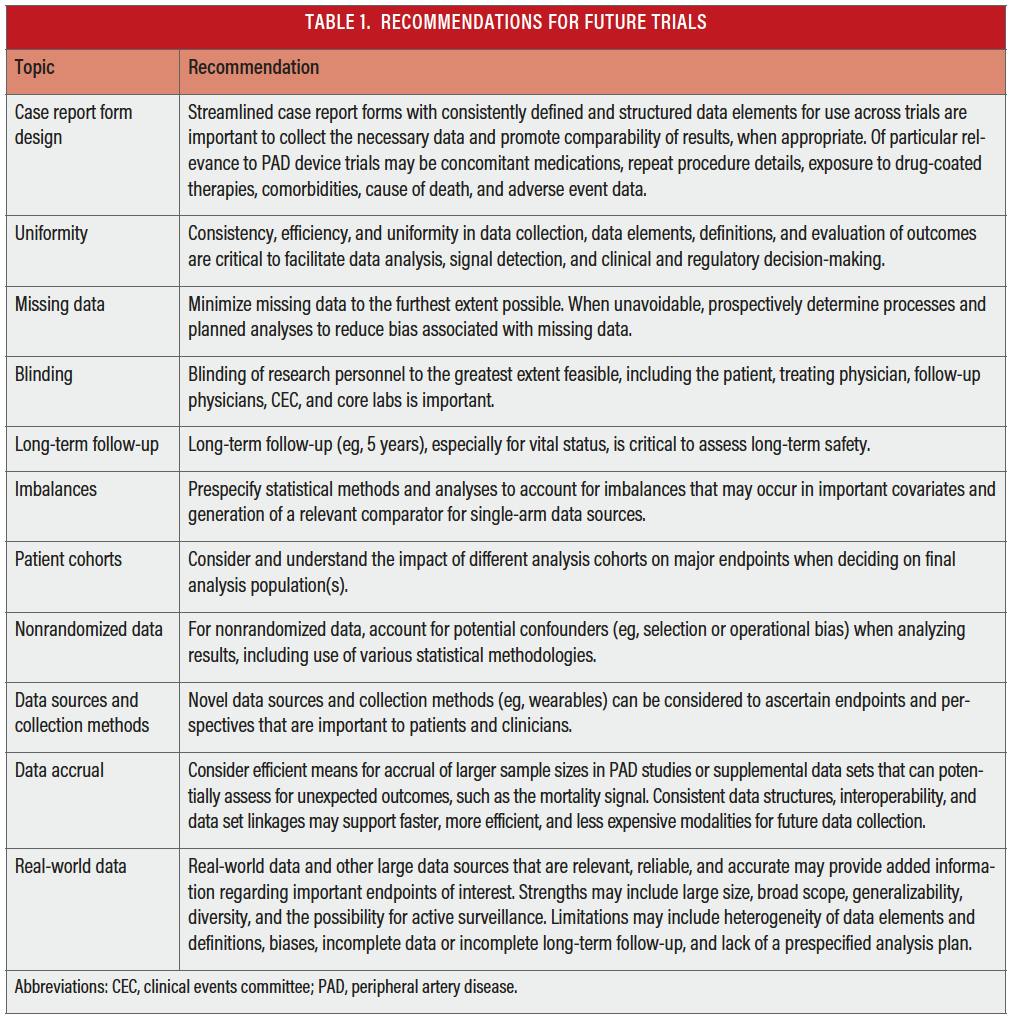
RECOMMENDATIONS FOR FUTURE TRIALS
The authors recommend that the points in Table 1 be considered when designing future PAD device trials or assessing current trials to improve trial quality and provide more robust data collection to help overcome the limitations described above.
ANSWER SAP and Pan-Industry Data Development Plan
As noted previously, numerous limitations to the study design, methodology, and evaluable data have precluded full evaluation of the paclitaxel safety signal. However, given the lessons learned regarding these data sets, the RAPID Pathways program assembled a collaborative team of stakeholders to develop a statistical analysis plan (SAP) called ANSWER (StAtistical ANalysis Protocol for the EStimation of Mortality Rates in Patients Treated for Peripheral Vascular Disease With PaclitaxEl-coated EndovasculaR Devices) to further evaluate the signal in collaboration with the Pan-Industry data development plan (DDP) SAP. The Pan-Industry DDP analysis plan uses updated data from industry-sponsored paclitaxel versus nonpaclitaxel RCTs of FDA-approved PCDs. The DDP SAP includes data from both:
- RCTs that were included in the original safety analysis but now have more complete follow-up data available
- RCTs that were not included in the original safety analysis due to lack of long-term results but now have longer-term data available
Complementary to the DDP analysis, the ANSWER SAP will estimate mortality rates over time for paclitaxel and nonpaclitaxel interventional devices in emerging data sets, focusing on real-world observational data sources and single-arm trials rather than RCTs. Use of a consistent data structure and methodology will allow comparison of results from the various data sources as well as potentially combining the data sources to further refine mortality estimates overall and in key subpopulations. By using a consistent structure, these analyses may also answer the question of why, to date, a signal has been observed in the RCTs and not in the observational data sources. Results for these important analyses are expected in Q2 2021.
CONCLUSION
Ultimately, the improved health and safety of PAD patients is the primary focus of this work. Therefore, when a signal is detected, even if there are uncertain aspects to the signal, regulators and health care providers must err on the side of caution. Even with multiple sources for detection, safety signals are difficult to identify and even more challenging to discern. This complex work requires multiple areas of expertise and collaboration. A significant milestone achieved during this work has been the collegial collaboration across stakeholders in this device area. The sharing of lessons learned has resulted in the referenced publication and recommendations to improve future trials. The collaborative efforts have also enabled the crosstalk between multiple stakeholders to streamline data sharing and analysis as demonstrated by the ANSWER SAP. As additional analysis efforts are completed, stakeholders can reevaluate the overall body of evidence to help determine the appropriate path forward for paclitaxel and other peripheral vascular technologies. Additionally, this community of stakeholders provides a framework to implement improvements to the overall PAD clinical trial landscape. Continued collaborative efforts are critical both to understanding this current safety signal as well as implementing better trials to allow for clearer, more effective, and more efficient analysis of future signals.
1. Katsanos K, Spiliopoulos S, Kitrou P, et al. Risk of death following application of paclitaxel-coated balloons and stents in the femoropopliteal artery of the leg: a systematic review and meta-analysis of randomized controlled trials. J Am Heart Assoc. 2018;7:e011245. doi: 10.1161/JAHA.118.011245
2. FDA presentation. Paclitaxel-coated drug-coated balloon (DCB) and drug-eluting stent (DES) late mortality panel, circulatory system devices panel meeting: general issues meeting. Presented at FDA Paclitaxel Advisory Meeting; June 19-20, 2019; Gaithersburg, Maryland.
3. Rocha-Singh KJ, Duval S, Jaff MR, et al. Mortality and paclitaxel-coated devices: an individual patient data meta-analysis. Circulation. 2020;141:1859-1869. doi: 10.1161/CIRCULATIONAHA.119.044697
4. Secemsky EA, Kundi H, Weinberg I, et al. Association of survival with femoropopliteal artery revascularization with drug-coated devices. JAMA Cardiol. 2019;4:332-340. doi: 10.1001/jamacardio.2019.0325
5. Behrendt CA, Sedrakyan A, Peters F, et al. Editor’s choice - long term survival after femoropopliteal artery revascularisation with paclitaxel coated devices: a propensity score matched cohort analysis. Eur J Vasc Endovasc Surg. 2020;59:587-596. doi: 10.1016/j.ejvs.2019.12.034
6. Nordanstig J, James S, Andersson M, et al. Mortality with paclitaxel-coated devices in peripheral artery disease. N Engl J Med. 2020;383:2538-2546. doi: 10.1056/NEJMoa2005206
7. NEST Coordinating Center. Demonstration projects. Accessed January 21, 2021. https://nestcc.org/demonstration-projects/
8. Lottes AE, Whatley EM, Royce SM, et al. Important considerations for trials for peripheral arterial disease: lessons learned from the paclitaxel mortality signal: a report on behalf of the registry assessment for peripheral interventional devices (RAPID) Paclitaxel Pathways Program. Am Heart J. 2020;232:71-83. doi: 10.1016/j.ahj.2020.10.070
9. Schuyler Jones W, Krucoff MW, Morales P, et al. Registry assessment of peripheral interventional devices (RAPID) - registry assessment of peripheral interventional devices core data elements. Circ J. 2018;82:316-322. doi: 10.1253/circj.CJ-17-1156
Advertisement
Advertisement