Advertisement
Advertisement
January 2021 European Supplement
Sponsored by Getinge
Case Study: Advanta V12 large diameter stent
Drs. Pond and Saeed share a case of high-grade stenosis in an ectatic common iliac artery treated with the Advanta V12 large diameter stent.
By Franklin Pond, MBBS, GDEB, FRACS, and Hani Saeed, MD, BPharm
*The Advanta V12 covered stent is CE marked for restoring the patency of iliac and renal arteries. The Advanta V12 covered stent is not available in the United States.
A 77-year-old man was admitted under the nephrology team with severe critical limb ischemia in the left leg. His medical history included diagnosed ischemic heart disease and a pacemaker inserted in 2019, and balloon aortic valvuloplasty in January 2020 followed by transcatheter aortic valve implantation in February 2020 for severe aortic stenosis. He also had long-standing type 2 diabetes mellitus, end-stage renal failure on hemodialysis via an arteriovenous fistula in the left upper arm, chronic obstructive pulmonary disease secondary to smoking, obstructive sleep apnea, and dyslipidemia.
He was referred to our vascular unit with a 2-month history of severe rest pain in his left foot that woke him from sleep multiple times throughout the night and required him to hang his foot in a dependent position to relieve the pain. Prior to this, he experienced claudication symptoms in his left leg at short distances.
On examination, he had no femoral, popliteal, or pedal pulses on the left leg. His feet were bilaterally cool with pitting edema to the midcalf. There was ischemic rubor evident in his left leg, and the Buerger test was positive. His motor movement and sensation were intact and equal bilaterally. The decision was made to obtain an aortobifemoral and bilateral lower limb CTA rather than an arterial duplex ultrasound because no femoral pulse was palpable on the left side.
The CTA showed a 14-mm left common iliac artery (CIA) with > 75% ostial stenosis and a short external iliac artery (EIA) stenosis (Figure 1). The common femoral artery (CFA), superficial femoral artery (SFA), and profunda femoris artery were found to be heavily calcified. Furthermore, the SFA was diseased in its entirety, with a short-segment occlusion in the mid-SFA and reconstitution at a diseased above-the-knee popliteal artery. The right CIA was patent, measuring 16 mm in diameter with no stenosis. Treatment options were discussed, but given the CFA disease and a TransAtlantic Inter-Society Consensus A lesion of the left CIA, a hybrid procedure was believed to be best to relieve the patient’s rest pain.
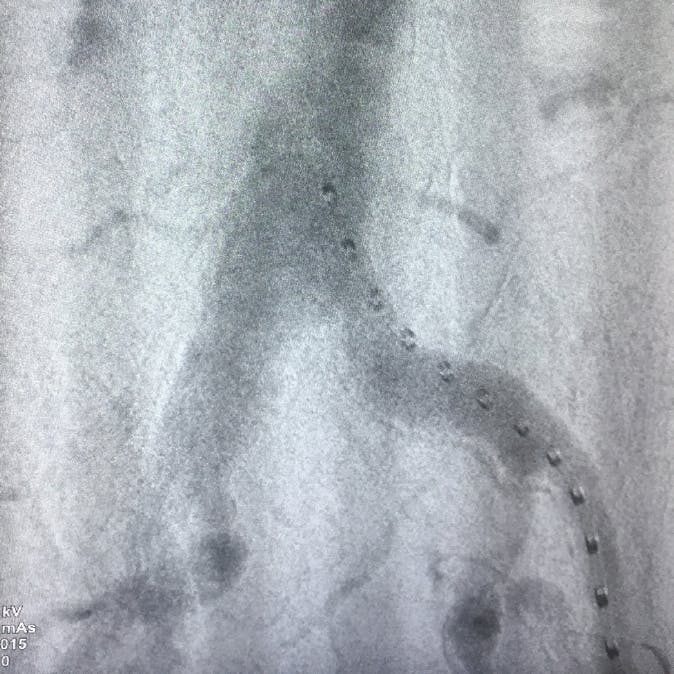
Figure 1. The initial angiogram. On the left side, the stenosis was located at the junction of the bifurcation.
After appropriate review and clearance by our anesthetics team as an inpatient, he underwent a left iliofemoral endarterectomy with profundaplasty and iliac stenting.
PROCEDURAL OVERVIEW
Under a general anesthetic, an iliofemoral endarterectomy and profundaplasty were performed, and the arteriotomy was repaired using vein patch.
Retrograde access was then achieved via the left CFA puncture under direct vision, and a 6-F Radifocus Introducer II sheath (Terumo Interventional Systems) was introduced. An angled Glidewire (Terumo Interventional Systems) was used to traverse the left CIA into the infrarenal aorta, and a pigtail catheter was then advanced and situated in the infrarenal aorta. Diagnostic runs were performed, confirming the > 75% left CIA ostial stenosis and further EIA stenosis.
The 6-F sheath in the left CFA was upgraded to a 10-F sheath that was advanced into the distal aorta. Under ultrasound guidance, the right CFA was punctured, and a 6-F sheath was introduced. A 12- X 41-mm Advanta V12 balloon expandable covered stent (Getinge)* was deployed in the left CIA just above the bifurcation and postdilated using a 14- X 40-mm Armada 35 angioplasty balloon (Abbott). A 14- X 60-mm Armada 35 angioplasty balloon was then introduced via the contralateral right side, and the Advanta V12 was postdilated and shaped using a kissing technique (Figure 2). Further angioplasty of a short EIA stenosis was performed using an 8- X 40-mm Armada 35 angioplasty balloon with good result.
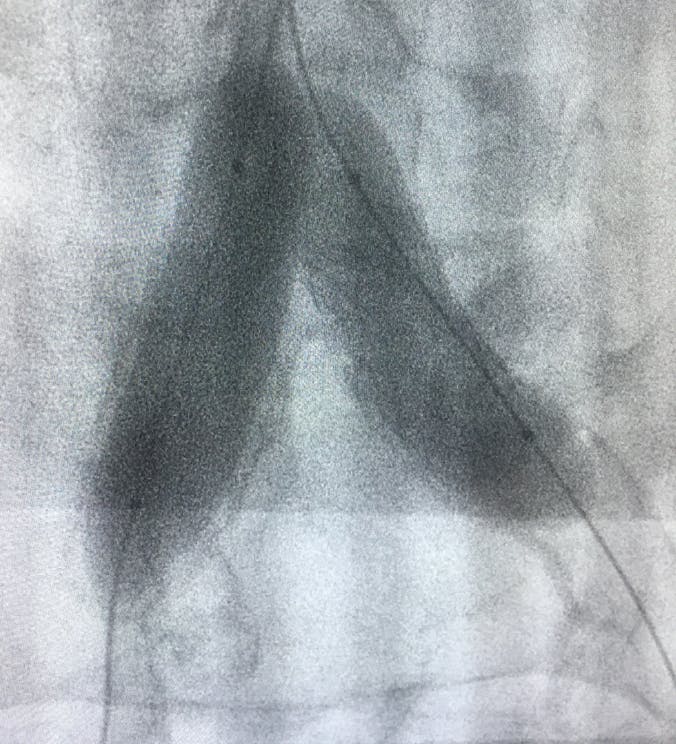
Figure 2. Postdilation with the kissing balloon technique of the Advanta V12.
Completion angiography demonstrated a widely patent Advanta V12 with no residual stenosis in the left CIA or encroachment onto the right side (Figure 3). The left CFA puncture site was then repaired using a 6/0 Prolene suture (Ethicon, a Johnson & Johnson company), and the wound was closed. The right groin sheath was removed, and manual pressure was applied.
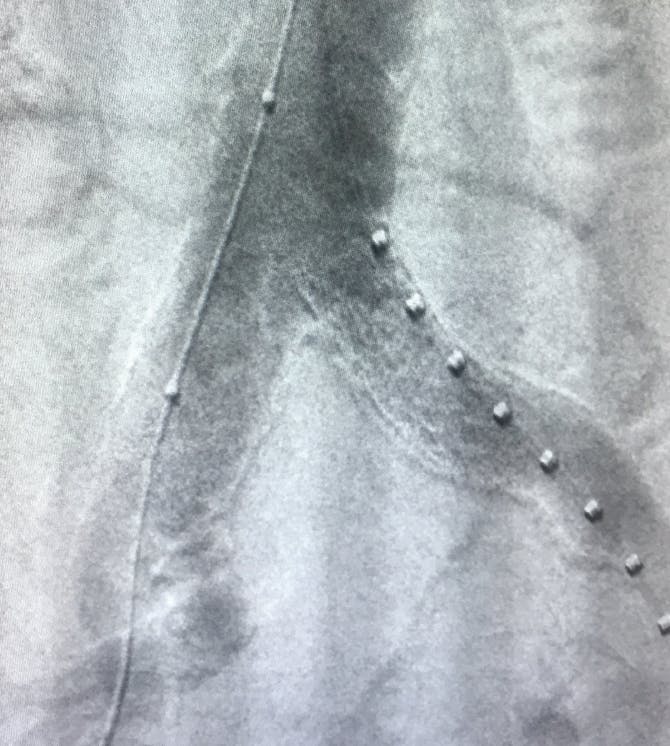
Figure 3. Completion angiography.
Postoperatively, the patient had a bounding left femoral pulse and improvement of his symptoms. He was no longer experiencing rest pain, and the ischemic rubor had resolved. He continued on dual antiplatelet and statin therapy in the perioperative period and required no additional medications or therapies. After a period of in-hospital recovery, the patient was transferred to a rehabilitation facility prior to discharge home. He was followed-up with an ultrasound 6-weeks postprocedure, which showed a patent stent.
CONCLUSION
Based on the angiographic outcome of this case, it can be established that the new Advanta V12 large diameter stent demonstrated all the expected characteristics and experience as the regular V12, including smooth trackability, predictable stent foreshortening, and solid evidence-based patency.


PN011608 REVAA
Advertisement
Advertisement