Advertisement
Advertisement
January 2021
Hemodynamic Emergencies in Oncologic and Other Interventional Procedures
A review of four key hemodynamic conditions that may be encountered in interventional practice and their management.
By Tyler Munk, BSc, MBBS, FRANZCR; Jun Wang, MD, FRCPC; Ravjot Dhatt, MD, FRCPC; Anastasia Hadjivassiliou, MBBS, FRCR, FRCPC; Peter Kim, MD; Howie Lim, MD; and David M. Liu, MD, FRCPC, FSIR
Hemodynamic emergencies related to interventional procedures are fairly rare; however, clinicians should be mindful of the early signs and symptoms and take steps toward appropriate management to reduce significant patient morbidity and mortality. This article focuses on four key hemodynamic emergencies that can occur in interventional practice—septic shock, hypertensive crisis during adrenal ablation, carcinoid crisis, and local anesthetic systemic toxicity (LAST)—and for each condition discusses risk factors, procedural management, and postprocedural care.
SEPTIC SHOCK
Sepsis is a systemic response to infection, with severe sepsis associated with organ dysfunction and septic shock associated with refractory hypotension or perfusion abnormality.1 Although drainage of an abscess is a commonly requested procedure, the incidence of periprocedural sepsis is generally rare. An exception is when highly vascularized organs are involved, and therefore interventions in the urinary and biliary system carry a higher risk of periprocedural sepsis, with a baseline incidence ranging between 1% and 3%.1
Risk Factors
In urinary interventions, the most important risk factor in periprocedural sepsis is an already infected system. The incidence of urosepsis increases threefold to 7% to 9% in pyonephrosis as compared with noninfected collecting systems.2,3 Additional risk factors include advanced age, diabetes, ureterointestinal conduits, and indwelling catheters.4 In biliary interventions, ascending infection is the key pathogenesis pathway; thus, patients with recent biliary intervention and biliary modification are at highest risk.5
Procedural factors are also important to consider. Excess pressure in the collecting or biliary system increases bacterial translocation into the vasculature; therefore, overdistension with contrast, excessive catheter or guidewire manipulation, and multiple needle passes should be avoided.3 It is often helpful to aspirate infected bile or urine before contrast injection.5
To minimize risk, preprocedural antibiotics are routinely recommended. Gram-negative organisms are the most important organisms to cover for both biliary and urinary intervention, with 1 to 2 g ceftriaxone administered intravenously (IV) as a common first-choice antibiotic.6
Management
If a patient develops sepsis despite best practice precautions, the first step in management is quickly recognizing the signs and symptoms. Early signs include chills, rigors, and fever > 100.4 °F (38 °C). Severe signs include tachycardia (> 90 bpm), hypotension (< 90 mm Hg or drop by 40 mm Hg below baseline systolic pressure), and increased respiratory rate.1 In biliary sepsis, patients classically present with fever, right upper quadrant pain, and jaundice (Charcot triad) or additionally altered mental status and hypotension (Reynold pentad).5
Often, transfer from the interventional radiology department to the critical care team is warranted, and therefore consultation should be prompt.7 Until care is transferred, the role in the interventional suite is to stabilize the patient and prevent further compromise.1 An additional dose of a broader-spectrum antibiotic can be considered, such as 3.375 g piperacillin-tazobactam IV. The severity of rigors can be addressed with 25 to 50 mg meperidine IV.5 Volume resuscitation with 500 to 1,000 mL of crystalloid solution (eg, 0.9% sodium chloride, lactated Ringer solution) is a reasonable first supportive measure, with additional fluid boluses as required.1 Because sepsis drives both a capillary leak and vasodilatory response, hypotension refractory to fluid resuscitation may occur. At this point, the addition of an arterial vasoconstrictor may be required; but typically, care will have been transferred to a higher acuity, and therefore specific vasoconstrictor regimens are not discussed in this review.
Finally, after care has been transferred to the critical care team, it should be noted that interventionalists may be called on for central venous access or arterial access if additional resuscitation efforts are required.1
HYPERTENSIVE CRISIS DURING ADRENAL ABLATION
Percutaneous adrenal ablation is a recognized alternative to operative management for both primary adrenal lesions and metastases.8 The decision to perform ablation as opposed to more traditional surgical approaches most commonly relates to comorbid medical conditions, tumors that are not surgically resectable, and patient preference.8 Either operative management or ablation predisposes these patients to large fluctuations in blood pressure, and physicians must be prepared for life-threatening hemodynamic instability.
Risk Factors
Hypertensive crisis during ablation is secondary to systemic catecholamine release.9 There is an increased relative risk of hypertensive crisis during ablation of functional adrenal tumors (eg, pheochromocytoma); however, it can occur with ablation of any lesion, including metastases.8,10,11 Other risk factors for hypertensive crisis during ablation include patient body mass index < 24 kg/m2, dominant tumor size < 4.5 cm, visualization of normal adrenal parenchyma adjacent to the lesion, and preprocedural blood pressure > 130 mm Hg.10,11
Hypertensive crisis is generally classified as blood pressure > 180/110 mm Hg, with or without associated end-organ dysfunction.8,12 Complications of uncontrolled hypertension can be neurologic (cerebral infarct, encephalopathy, intracranial hemorrhage), cardiac (ventricular failure, ischemia, arrythmias), renal (acute renal impairment), and vascular (acute dissection), among others.12
Preoperative Management
Adrenal ablation procedures should include a multidisciplinary team of interventional radiologists, surgeons, endocrinologists, and oncologists with a consensus agreement on the approach to management.13,14
The role of percutaneous biopsy prior to performing an ablation is a source of debate. When the diagnosis is confidently made on the basis of clinical history, biochemical markers, and imaging findings, an initial biopsy can be avoided.13
Consultation with endocrinology in the weeks before the ablation is recommended, with consideration given to premedication with β-blockade with or without additional β-blockade.8,11,15 Typical regimens involve premedication with phenoxybenzamine for 7 to 21 days prior with titration of β-blockers to effect.8,14,15 A preablation blood pressure of ≤ 120/80 mm Hg has been described.13,14
Intraoperative Management
Preprocedural discussion with the anesthesiologist regarding the possibility of hypertensive crisis during the procedure is required. Continuous arterial blood pressure monitoring is recommended.13-15 The need for central venous access and postprocedural monitoring or intensive care unit (ICU) admission should be discussed.
During the procedure, communication with the anesthesiologist is required before any procedural manipulation that may stimulate catecholamine release, including the initial probe insertion, probe position adjustment, and application of thermal energy.
Despite optimal premedication prior to the procedure, hypertensive crises can still develop during ablation regardless of the nature of the lesion or method of ablation.8,10,11 The management of intraprocedural hypertensive crisis is complex and dependent on patient factors and the anesthesiologist’s preference.13,14 Options for management include deepening of anesthesia, direct vasodilation with magnesium sulfate or nitrates, or further targeted arterial blood pressure management using α- or β-blockade or nicardipine.13
Postoperative Management
Postprocedural observation in either an ICU or high-dependency setting to allow for continual arterial blood pressure monitoring is recommended. Further hemodynamic instability can occur in the postoperative period, and hyper- and hypotensive crises have been observed.13-15
CARCINOID CRISIS
Carcinoid crisis is a rare but significant complication occasionally seen in patients presenting with carcinoid tumors. The mechanism behind carcinoid crisis is presumed to be due to massive release of vasoactive peptides from the tumor.16 Carcinoid crisis can manifest with profound hypo- or hypertension, flushing, diarrhea, hyperthermia, tachycardia, bronchospasm, and alterations of mental status.17 Even patients without any preoperative symptoms may develop profound carcinoid crisis intraoperatively.18
Risk Factors
Patients with neuroendocrine tumors, particularly of the carcinoid variant, have a predisposition to intraprocedural carcinoid crisis.17 Inciting events that stimulate the release of vasoactive peptides include anxiety, surgical manipulation, general anesthesia, embolization, thermal ablation, or biopsy.19 Given the lack of association between preexisting symptoms and severity of carcinoid crisis, octreotide prophylaxis is recommended for all patients with neuroendocrine tumors.
Preoperative Management
Current evidence recommends octreotide prophylaxis for 2 weeks preprocedure (100 µg daily), followed by an additional 100 µg at the time of induction.20 Optimization of hydration status and management of anxiety contributes to lower complication rates.18
Intraoperative Management
Anesthesia technique should focus on minimizing the chance of acute release of mediators through stress reduction.17 Octreotide infusion (50 µg/hour) has been suggested prophylactically to prevent carcinoid crisis in patients with advanced carcinoid tumors.19 Octreotide has been demonstrated to effectively stabilize blood pressure and is therefore considered first-line management for these patients.21
In patients presenting with uncontrollable hypertension, short-acting β-blockers are recommended if blood pressure is resistant to octreotide or if octreotide is not immediately available.22 5-HT antagonists, such as ketanserin, have also been used to control acute hypertensive crisis.23,24
Postoperative Management
The symptoms of carcinoid crisis may not resolve immediately after the procedure and may persist beyond the acute recovery phase. For this reason, close hemodynamic monitoring in a high-dependency setting is recommended. Weaning of intravenous octreotide over 2 to 3 hours has provided safe and stable outcomes.17
LOCAL ANESTHETIC SYSTEMIC TOXICITY
Although rare, LAST may be associated with significant patient morbidity and mortality. With broader interest and use of regional anesthetic techniques during endovascular procedures, the likelihood of encountering this condition is increasing.25 Clinician awareness of the early signs and symptoms along with the initiation of prompt treatment can drastically improve patient outcomes.25,26
Risk Factors
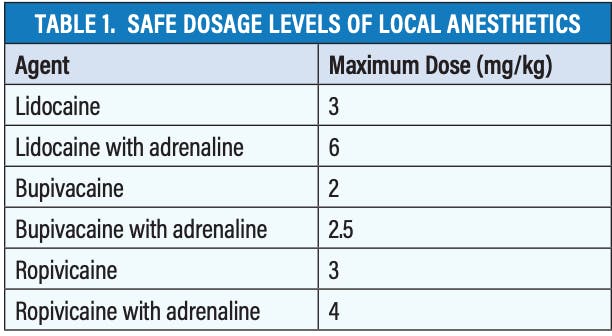
Systemic toxicity from local anesthesia can either occur by overdosage or inadvertent intravascular injection, with the latter widely recognized as the more common cause.27 Table 1 lists the safe dosage levels of local anesthetics.28 Patient factors for the development of LAST include extremes of age (young, elderly), pregnancy, renal disease, cardiac disease, and hepatic dysfunction.27
A number of strategies have been proposed to reduce the risk of LAST, including the use of ultrasound during local anesthetic infiltration, incremental local anesthesia injection and aspiration, the use of less toxic forms of local anesthesia, and the use of the lowest effective dose.25,27
Management
Systemic toxicity results in characteristic neurologic and cardiovascular signs and symptoms. The neurologic symptoms of LAST are classically sequential, beginning with perioral tingling, tinnitus, and slurred speech and progressing to confusion, agitation, and ultimately generalized convulsions and respiratory depression.25,29 These early warning signs may be masked by the use of procedural sedation or anesthesia.
The earliest cardiovascular sign of LAST is hypertension and tachycardia, which later progresses to myocardial depression and hypotension. If untreated, peripheral vasodilation, profound hypotension, conduction blocks, and potentially malignant arrhythmias can develop.26 Given the range of symptoms, any abnormal neurologic or cardiovascular signs that develop during or after the administration of local anesthetic must trigger the clinician to consider systemic toxicity.
Immediate management involves immediately stopping injection of local anesthetic (if applicable) and calling for help. The remainder of the management has three components.
1. Prompt administration of lipid emulsion. The literature describes a number of successful adult and pediatric resuscitations using intralipid 20%, which have led to widespread incorporation of intralipid into LAST resuscitation algorithms.25-27,29 Because intralipid is associated with few side effects or complication, it is recommended that intralipid be administered early. Intralipid 20% is administered intravenously with an initial bolus administration (1.5 mL/kg based on lean body mass) over 1 minute, followed by a continuous infusion of (0.25 mL/kg/min based on lean body mass) and should be continued for at least 10 minutes after the return of hemodynamic stability. If hemodynamic stability is not achieved, a further two boluses of intralipid 20% (1.5 mL/kg), followed by an increased infusion dosage (0.5 mL/kg/min) should be considered.30
2. Advanced cardiac life support. The advanced cardiac life support algorithm differs from the standard protocols, with lower doses of epinephrine and avoidance of β-blockers, calcium channel blockers, and local anesthetics to avoid the development of malignant arrhythmias.26 A focus on early oxygenation and adequate ventilation is critical, as hypoxia and acidosis worsen the cardiac toxicity of LAST.25,29 Prolonged resuscitative measures have been associated with good outcomes when high-quality cardiopulmonary resuscitation is provided throughout.29 For this reason, early discussion with ICU to consider extracorporeal membrane oxygenation treatment is advised.31,32
3. Seizure management. In the event of seizure activity, the first priority is to maintain a secure airway and then consider medications for seizure cessation. Most LAST algorithms use benzodiazepines for seizure management.
Postoperative Management
Postevent monitoring is recommended for all patients who have displayed symptoms of LAST. Patients with isolated and rapidly terminating minor central nervous system signs should be monitored for at least 2 hours, and patients with cerebrovascular system symptoms of LAST should be monitored for at least 6 hours.25,29
CONCLUSION
Each of the presented conditions is relatively rare in day-to-day practice, but the potential for hemodynamic emergency that each of these conditions pose is significant. Knowledge of each condition, careful preprocedural management, anticipation of what may occur during a procedure, prompt management, and appropriate postprocedural care will significantly reduce patient morbidity and mortality.
1. Miller MJ, Smith TP, Ryan JM. Sepsis in the interventional radiology patient. Tech Vasc Interv Radiol. 2006;9:64-68. doi: 10.1053/j.tvir.2006.12.003
2. Krohmer SJ, Pillai AK, Guevara CJ, et al. Image-guided nephrostomy interventions: how to recognize, avoid, or get out of trouble. Tech Vasc Interv Radiol. 2018;21:261-266. doi: 10.1053/j.tvir.2018.07.008
3. Lee MJ. Percutaneous genitourinary intervention. In: Vascular and Interventional Radiology: The Requisites. 2nd ed. Elsevier/Saunders; 2014;485-510.
4. Hausegger KA, Portugaller HR. Percutaneous nephrostomy and antegrade ureteral stenting: technique-indications-complications. Eur Radiol. 2006;16:2016-2030. doi: 10.1007/s00330-005-0136-7
5. O’Connell W, Shah J, Mitchell J, et al. Obstruction of the biliary and urinary system. Tech Vasc Interv Radiol. 2017;20:288-293. doi: 10.1053/j.tvir.2017.10.010
6. Chehab MA, Thakor AS, Tulin-Silver S, et al. Adult and pediatric antibiotic prophylaxis during vascular and IR procedures: a Society of Interventional Radiology practice parameter update endorsed by the Cardiovascular and Interventional Radiological Society of Europe and the Canadian Association for Interventional Radiology. J Vasc Interv Radiol. 2018;29:1483-1501.e2. doi: 10.1016/j.jvir.2018.06.007
7. Dagli M, Ramchandani P. Percutaneous nephrostomy: technical aspects and indications. Semin Intervent Radiol. 2011;28:424-437. doi: 10.1055/s-0031-1296085
8. Venkatasen A, Locklin J, Dupuy D, Wood B. Percutaneous ablation of adrenal tumors. Tech Vasc Interv Radiol. 2010;13:89-99. doi: 10.1053/j.tvir.2010.02.004
9. Yamakodo K, Takaki H, Yamada T, et al. Incidence and cause of hypertension during adrenal radiofrequency ablation. 2012;35:1422-1427. doi: 10.1007/s00270-012-0348-6
10. Zheng L, Zhou F, Yu X, et al. Hypertensive crisis during microwave ablation of adrenal neoplasms: a retrospective analysis of predictive factors. J Vasc Interv Radiol. 2019;30:1343-1350. doi: 10.1016/j.jvir.2019.01.016
11. Fintelmann FJ, Tuncali K, Puchner S, et al. Catecholamine surge during Image-guided ablation of adrenal gland metastases: predictors, consequences, and recommendations for management. J Vasc Interv Radiol. 2016;27:395-402. doi: 10.1016/j.jvir.2015.11.034
12. Katz JN, Gore JM, Amin A, et al. Practice patterns, outcomes, and end-organ dysfunction for patients with acute severe hypertension: the Studying the Treatment of Acute hyperTtension (STAT) registry. Am Heart J. 2009;158:599-606. doi: 10.1016/j.ahj.2009.07.020
13. Connor D, Boumphrey S. Preoperative care of phaemochromocytoma. BJA Educ. 2016;16;153-158. doi: 10.1093/bjaed/mkv033
14. Deljou A, Kohlenberg JD, Weingarten TN, et al. Hemodynamic instability during percutaneous ablation of extra-adrenal metastases of pheochromocytoma and paragangliomas: a case series. BMC Anesthesiol. 2018;18:158. doi: 10.1186/s12871-018-0626-1
15. Manchec B, Koethe Y, Schiro B, et al. “How we do it”—a practical approach to percutaneous adrenal ablation techniques. Tech Vasc Interv Radiol. 2020;23:100676. doi: 10.1016/j.tvir.2020.100676
16. Kvols LK. Therapy of the malignant carcinoid syndrome. Endocrinol Metab Clin North Am. 1989;18:557-568.
17. Liu DM, Kennedy A, Turner D, et al. Minimally invasive techniques in management of hepatic neuroendocrine metastatic disease. Am J Clin Oncol. 2009;32:200-215. doi: 10.1097/COC.0b013e318172b3b6
18. Vaughan DJ, Brunner MD. Anesthesia for patients with carcinoid syndrome. Int Anesthesiol Clin. 1997;35:129-142.
19. Kolbeck KJ, Farsad K. Catheter-based treatments for hepatic metastases from neuroendocrine tumors. AJR Am J Roentgenol. 2014;203:717-724. doi: 10.2214/AJR.14.12983
20. Roy RC, Carter RF, Wright PD. Somatostatin, anaesthesia, and the carcinoid syndrome. Peri-operative administration of a somatostatin analogue to suppress carcinoid tumour activity. Anaesthesia. 1987;42:627-632. doi: 10.1111/j.1365-2044.1987.tb03087.x
21. Mulvihill SJ. Perioperative use of octreotide in gastrointestinal surgery. Digestion. 1993;54(suppl 1):33-37. doi: 10.1159/000201074
22. Veall GR, Peacock JE, Bax ND, Reilly CS. Review of the anaesthetic management of 21 patients undergoing laparotomy for carcinoid syndrome. Br J Anaesth. 1994;72:335-341. doi: 10.1093/bja/72.3.335
23. Hughes EW, Hodkinson BP. Carcinoid syndrome: the combined use of ketanserin and octreotide in the management of an acute crisis during anaesthesia. Anaesth Intensive Care. 1989;17:367-370. doi: 10.1177/0310057X8901700324
24. Houghton K, Carter JA. Peri-operative management of carcinoid syndrome using ketanserin. Anaesthesia. 1986;41:596-599. doi: 10.1111/j.1365-2044.1986.tb13050.x
25. El-Boghdadly K, Pawa C, Chin KJ. Local anesthetic systemic toxicity: current perspectives. Local Reg Anesth. 2018;11:35-44. doi: 10.2147/LRA.S154512
26. Wolfe JW, Butterworth JF. Local anesthetic systemic toxicity: update on mechanisms. Curr Opin Anesthesiol. 2011;24:561-566. doi: 10.1097/ACO.0b013e32834a9394
27. Christie LE, Picard J, Weinberg GL. Local anaesthetic systemic toxicity. BJA Educ. 2015;15:136-142. doi: 10.1093/bjaceaccp/mku027
28. Williams DJ, Walker JD. A nomogram for calculating the maximum dose of local anaesthetic. Anaesthesia. 2014;69:847-853. doi: 10.1111/anae.12679
29. Odedra D, Lyons G. Local anaesthetic toxicity. Curr Anaesth Crit Care. 2010;21:52-54. doi: 10.1016/j.cacc.2009.07.016
30. Ok SH, Hong JM, Lee SH, Sohn JT. Lipid emulsion for treating local anesthetic systemic toxicity. Int J Med Sci. 2018;15:713-722. doi: 10.7150/ijms.22643
31. Froehle M, Haas NA, Kirchner, et al. ECMO for cardiac rescue after accidental intravenous mepivicaine application. Case Rep Pediatr. 2012;2012:491692. doi: 10.1155/2012/491692
32. Bacon B, Silverton N, Katz M, et al. Local anesthetic systemic toxicity induced cardiac arrest after topicalization for transesophageal echocardiography and subsequent treatment with extracorporeal cardiopulmonary resuscitation. J Cardiothorac Vasc Anesth. 2019;33:162-165. doi: 10.1053/j.jvca.2018.01.044
Advertisement
Advertisement