Advertisement
Advertisement
January 2021
Vascular Emergencies: Challenges and Solutions

What is unique about all of the fields of medicine comprising vascular health care is that a good majority of our patients often require immediate life- or limb-saving care. Time is often of the essence, and a solid foundational understanding of how best to respond to these emergencies is paramount to provide the highest level of patient care.
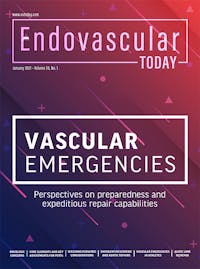
In this edition of Endovascular Today, we focus on a wide variety of emergent vascular conditions and what is currently known about their incidences, associated unique challenges, and potential treatment options. We have asked experts from leading centers to explain the essentials in a practical fashion, sharing their understanding as to best practices.
Our feature begins with a look at vascular emergencies in athletes, contributed by Drs. Bernadette Goudreau, Manasa Kanneganti, and Margaret Tracci from the University of Virginia. The authors detail some of the more common injuries sustained, their unique etiologies, and the special considerations when working with patients with highly specialized activities in the affected anatomy.
Next, Benjamin J. Pearce, MD, from the University of Alabama at Birmingham, addresses endovascular repair for aortic injuries, sharing a case study with practical tips and take-home messages applicable to others with similar presentations. Trissa Babrowski, MD, from the University of Chicago Medicine, details the incidence of mesenteric ischemia and weighs treatment options for its various presentations, with an eye toward prompt multidisciplinary management to prevent catastrophic consequences.
We then pivot to a multispecialty panel to address the compositions, communications, and capabilities of pulmonary embolism response teams, including any modifications made during the pandemic. Drs. Jay Giri, Brent Keeling, and Robert Lookstein share the experiences gained at the University of Pennsylvania, Emory University, and Mount Sinai Hospital, respectively. The interventional radiology team from the University of British Columbia then presents an overview of hemodynamic emergencies that can occur during interventional oncology procedures and other interventions, cautioning as to the warning signs and sharing prevention and management strategies.
Next, we interview Dawn Coleman, MD, from the University of Michigan, regarding the intricacies of pediatric vascular trauma management. Dr. Coleman details the most common presentations and explores the challenges in this population, including the lack of data and limitations of implant technology in children. Finally, my colleagues at the UT Southwestern Medical Center, Michael C. Siah, MD, and Michael Shih, MD, describe the etiology, clinical evaluation, and management options for acute limb ischemia, emphasizing the variability of treatment based on patient conditions and operator capabilities.
Outside of our cover feature, this edition also includes an overview of new and updated CPT reimbursement codes, authored annually by Katharine L. Krol, MD. The issue closes with an interview with Haimanot (Monnie) Wasse, MD, in which she shares her experiences as President of the American Society of Diagnostic and Interventional Nephrology, studying key outcome measures in dialysis, and the utility of social media.
We hope this edition of Endovascular Today finds you and your family in good health, and that it is informative and practical to your endeavors.
Melissa L. Kirkwood, MD
Guest Chief Medical Editor
Advertisement
Advertisement