Advertisement
Advertisement
July 2021
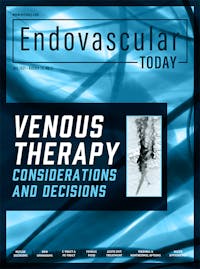
Venous Therapy Considerations and Decisions


As the ability of the vascular community to deliver therapies for a variety of venous diseases continues its rapid expansion, it is a good time to reflect and share our experiences, both positive and negative, to ensure safe and appropriate delivery of care. At a time when practice is outpacing data collection, it is important to be candid in our communications. With this in mind, this edition of Endovascular Today invites candid commentary prompted by challenging questions probing what we know, and just as importantly, what we do not. To provide a more balanced discussion, we have sought expertise from both sides of the Atlantic.
Interspersed throughout this issue are expert panel discussions on charged topics and key developments in the venous world. In the first of these panels, Suman M. Wasan, MD, asks Misaki Kiguchi, MD; Michael Lichtenberg, MD; Mahmood Razavi, MD; and Suresh Vedantham, MD, about the landscape of acute deep vein thrombosis intervention in 2021, examining the clinical ramifications of recent trial data and recent changes in the technology.
Then, moderator Gerard O’Sullivan, MD, asks Mohammad E. Barbati, MD; Dr. Desai; Dr. Jalaie; Erin H. Murphy, MD; and Emma Wilton, MD, how we each tackle various chronic deep venous occlusion challenges. Continuing on the topic of deep venous obstruction is an article by Nicos Labropoulos; Suat Doganci, MD; and Stephen A. Black, MD, who outline the primary needs for progress in chronic venous obstruction management.
Next, Suresh Vedantham, MD, and Akhilesh K. Sista, MD, share insights and updates on the C-TRACT and PE-TRACT trials, respectively, framing their potentially significant impact on venous care.
Continuing our panel format, moderator William Marston, MD, leads a discussion on venous ulcers with deep obstruction and superficial reflux through the lens of complex patient presentations. Joining him in the discussion as panelists are Irwin Toonder, RVT, and Marie Josee van Rijn, MD. Patient-centered decision-making also comes into play in Dr. med. Tobias Hirsch’s panel on thermal and nonthermal solutions for varicose vein treatment, where panelists Antonios Gasparis, MD; Ramona Gupta, MD; and Kathleen Ozsvath, MD, provide insights on the basis for their decision-making regarding the variety of therapeutic modalities, the pros and cons of each, and potential complications to be aware of.
In our last panel, Raghu Kolluri, MD, posits questions to Steve Elias, MD, and Eri Fukaya, MD, regarding their treatment of venous reflux. The conversation includes advanced disease therapy decisions, differences in perforators versus axial disease, and considerations on deep system involvement.
Closing out our venous coverage is an update from representatives for the International Pelvic Venous Disorders in Women Work Group. Kathleen Gibson, MD; Neil Khilnani, MD; and Mark H. Meissner, MD, explain how the new SVP (symptoms, varices, pathophysiology) instrument for classifying variations of pelvic venous disorders works in practice and introduce some of the group’s other projects to improve pelvic disease care.
This issue also features an interview with Tiago Bilhim, MD, on his journey in prostatic artery embolization work, tips for quality medical writing, raising awareness for interventional radiology, and more.
We hope the experiences shared by this esteemed group of global venous experts assist with the challenges you face in your practice, and we welcome your feedback and insights as well.
Kush R. Desai, MD, FSIR
Houman Jalaie, MD
Guest Chief Medical Editors
Advertisement
Advertisement