Advertisement
Advertisement
June 2021
Panel Discussion: DCBs in AV Access From Trials to the Real World
Evaluating drug-coated balloon applicability and adoptability in the dialysis access setting.
With Andrew Holden, MBChB, FRANZCR, EBIR; Narayan Karunanithy, MRCS, FRCR, FCIRSE; Scott O. Trerotola, MD; and Haimanot (Monnie) Wasse, MD, MPH, FASN, FASDIN




Based on the body of published and presented data on drug-coated balloon (DCB) use in arteriovenous (AV) access, how would you briefly summarize the landscape for people who are interested in using these devices?
Dr. Holden: Two large randomized trials evaluating DCBs in AV access circuit intervention have recently been performed. The IN.PACT AV trial is the first prospective randomized controlled trial (RCT) comparing DCB angioplasty to conventional percutaneous transluminal angioplasty (PTA) in the treatment of dialysis access circuit stenosis to meet its primary efficacy endpoint. Target lesion primary patency (TLPP) was significantly better at 6 months for patients treated with the IN.PACT AV DCB compared to standard PTA. In both arms of the trial, the target lesion underwent “vessel preparation” with high-pressure balloon angioplasty, with patients randomized if the vessel preparation resulted in a residual stenosis of < 30% diameter loss.
The benefit of treatment with the In.Pact AV DCB (Medtronic) is that it has been shown to be durable with a significant target lesion patency advantage being seen over PTA at 12 and 24 months. Not only has there been a patency advantage at the target lesion but the entire access circuit has shown significantly superior patency in patients randomized to the DCB.
The Lutonix AV trial has a very similar trial design with similar vessel preparation, including high-pressure balloon angioplasty. Unfortunately, the trial did not reach its primary efficacy endpoint of TLPP at 6 months. Although the patency advantage in the DCB did reach significance at other time points, the absolute patency and the patency difference between the two treatment arms was considerably lower in the Lutonix AV trial compared to the IN.PACT AV trial.
Dr. Wasse: The most recent IN.PACT AV DCB data demonstrate short-term safety, prolonged time to restenosis when used to treat lesions within mature arteriovenous fistulas (AVFs), and an association with fewer interventions and longer access circuit patency.
Dr. Trerotola: I would say that these devices have a great deal of potential but also conflicting data as to how effective they are, and we don’t yet know exactly how to apply them in the dialysis access world.
Dr. Karunanithy: There is emerging high-quality evidence evaluating DCBs in AV access. However, the patients and access cohorts that benefit the most from their use has not been clearly established. Therefore, the use of DCBs needs to be determined on an individual patient basis, taking into account the overall patient access journey.
Are there specific AV access stenosis types and locations in which you particularly favor using a DCB?
Dr. Trerotola: There are no data supporting specific benefits for DCBs in any one location versus another. If you look at the IN.PACT AV trial, in every subset they looked at, the DCB is better than angioplasty alone, but this was because the DCB performed better overall in this trial. The subset analysis from the Lutonix AV trial did not show that the DCB performed better in any particular location. So, although this is not an evidence-based response, there are some “common sense” examples of where DCBs would offer better patency versus angioplasty alone, such as when angioplasty fails, and areas in which you don’t want to put a stent graft—either because it’s the cannulation zone where there is risk of infection and stent fracture or in areas like the terminal arch of the cephalic vein, where it’s very difficult to accurately place a stent graft without risking the axillary vein due to the stent landing in the wrong place.
Dr. Karunanithy: The trials done to date have not indicated that specific lesion locations do better with DCB than others. Nevertheless, in routine clinical practice, recurrent “juxta-anastomotic” and “swing point” (in brachiobasilic AVFs) are specific lesion locations where I would contemplate use of a DCB. The assessment for treatment is more holistic, as it is important to take into consideration the “quality” of the access circuit prior to dysfunction, such as adequacy of dialysis, duration of dialysis, and clinical symptoms, as well as what the alternative access and renal transplant options are for the individual patient.
Dr. Wasse: As previously mentioned, DCB use in investigational device exemption (IDE) trials has excluded lesions located within the central vein or in-stent stenosis. As always, it is important to consider the circuit longevity when treating an isolated lesion, and at times, although off-label, I have used a DCB in areas that are not optimal for covered stent placement. This includes the thoracic outlet or stenosis associated with cardiovascular implantable electronic device leads in the subclavian or brachiocephalic vein. It may be that future studies examine these locations to determine the benefit of DCB application to these sites as compared to plain old balloon angioplasty.
Dr. Holden: In the IN.PACT AV trial, a patency advantage was seen for DCB versus standard PTA for both types of stenosis (de novo and restenosis), all types of fistulas (forearm and upper arm), and all locations within the access circuit. However, the most impressive patency advantages were seen for restenotic lesions involving the anastomosis, venous outflow, and cephalic arch. When we first used DCBs in AV access circuit intervention, we confined our use to restenotic lesions at these three locations. Now it has become standard practice for all lesion types and locations.
It is important to remind readers that the access circuit was defined in both trials as extending from the AV anastomosis to the cephalic arch. Central venous stenoses were not evaluated in this study.
How comparable are the IDE trials in this space? What are the biggest differences in their designs?
Dr. Wasse: There are several differences between the two recent IDE RCTs in this space, which are shown in Table 1.1,2 Key differences include study populations and study device paclitaxel dosage.
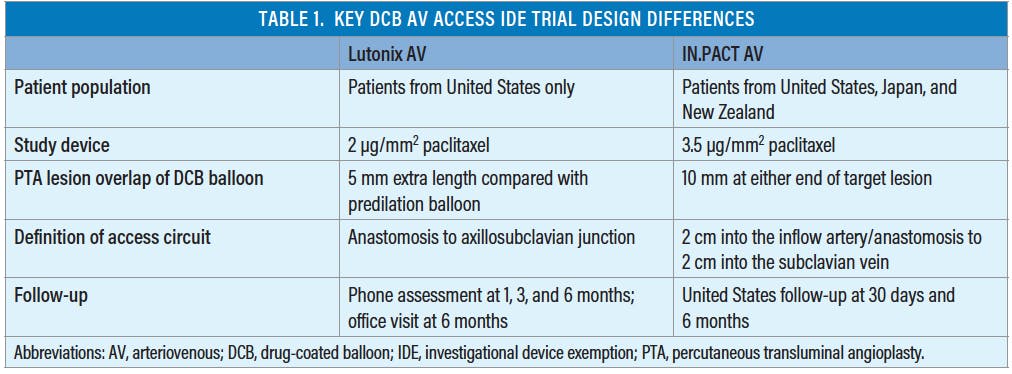
Dr. Karunanithy: The studies by Lookstein et al,1 Trerotola et al,2,3 and Karunanithy et al4 are similar in design and measured outcomes. Lookstein et al evaluated the In.Pact DCB in the industry-supported study that recruited 330 patients in 29 international sites. The primary endpoint was TLPP at 6 months, and this was superior in the DCB arm (82.2%) compared to placebo (59.5%). Trerotola et al evaluated the Lutonix DCB (BD Interventional) in an industry-supported study that recruited 285 patients in 23 United States sites.
The primary endpoint was TLPP at 6 months, and no statistically significant difference was shown (71.4% DCB vs 63% placebo). Results have now been reported to 2 years. Although there remains no difference in TLPP, fewer interventions were required to maintain target lesion patency in the DCB group.
My colleagues and I also evaluated the Lutonix DCB in PAVE, an investigator-initiated study funded by the National Institute for Health Research that recruited 212 patients in 20 United Kingdom sites. The primary endpoint was time to end of TLPP with variable follow-up (minimum 1 year) and Cox proportional hazards analysis. No statistically significant difference between DCB and placebo was shown. TLPP was defined as patency with no clinically driven reintervention to the index treatment segment. The study included dysfunctional AV access with a single treatment segment and 46 fistulas (21.7%) that had not been used for dialysis.
Finally, there is a difference in the paclitaxel dose between the devices used; the In.Pact DCB dose is 3.5 µg/mm2 compared to the Lutonix DCB with a dose of 2 µg/mm2, and the devices also use different excipients.
Dr. Holden: As mentioned, the two IDE trials (IN.PACT AV and Lutonix AV) have a very similar design, randomizing patients to either DCB or standard PTA after high-pressure balloon angioplasty vessel preparation. However, there were some important differences. The Lutonix AV trial was only performed in the United States, and upper arm AVFs (brachiocephalic and brachiobasilic) were most common. The IN.PACT AV trial was performed in the United States, Japan, and New Zealand, and 50% of the AVFs were forearm (radiocephalic) and 50% were upper arm. Although the target lesion length (100 mm) and stenosis severity (< 50% diameter loss) were the same for both trials, the inclusion and exclusion criteria in the IN.PACT AV trial were a little more restrictive. Patients with a stent in the access circuit or previous thrombosis of the current access circuit were excluded. It should also be noted that 6-month patency was measured at exactly 180 days in the Lutonix AV trial while a 30-day window was used in the IN.PACT AV trial, meaning patency was measured to 210 days.
Dr. Trerotola: The most notable difference in the two IDE trials is in their demographics, with one-third of the patients in the IN.PACT AV trial from Japan and New Zealand, and the Lutonix AV trial comprising only patients in the United States. Interestingly, the absolute patency difference in the Lutonix AV trial was 11%, and if you look at the United States cohort of the IN.PACT AV trial, it’s only 18%, which almost certainly wouldn’t be statistically significant. Finally, in addition to the paclitaxel dosage and excipient differences, there are also differences in the duration of inflation of the DCB.
With the PAVE study, there are additional demographic, execution, and follow-up differences, so it’s not exactly the same as the two IDE studies, which, other than the technical differences I’ve mentioned, were conducted in an almost identical fashion. Based on the PAVE findings, many may jump to the conclusion that the Lutonix DCB is the issue because both the PAVE study and the Lutonix AV studies were negative. However, there are studies conducted exactly the same way as the IN.PACT AV trial that are also negative. For example, the Maleux et al study had exactly the same device as the IN.PACT AV trial and similar design but no difference in patency.5
The IDE trials mandated specific techniques for DCB use such as treatment beyond the prep PTA site, DCB inflation of ≥ 2 minutes, and not using a DCB more than once. Are IDE clinical trial techniques being adopted in a real-world setting?
Dr. Holden: This is a great question! Obviously trial inclusion and exclusion criteria limit some applicability to “real-world” cases. For example, in both trials, lesion length was limited to 100 mm, and although that could include up to two lesions, they had to be within the 100-mm overall lesion length. In reality, we often see multiple lesions separated by a greater distance or occasionally longer lesions. It is reasonable to assume that the same antirestenotic benefit will be seen with a DCB in these lesions, but that has not been proven. Postmarket registries can often provide important additional information in that regard.
Another real-world challenge is to make sure the vessel preparation step with high-pressure balloon angioplasty that was used in the trials is replicated. This step may often be overlooked in the desire to quickly complete a case, but it is a vital component if clinical trial outcomes are to be replicated in the real-world setting.
Dr. Karunanithy: In an ideal world, the use of any medical device strictly in line with the manufacturer’s instructions for use will optimize outcomes for the patients we treat. For DCBs, this involves careful handling of the device on the table, minimized transit time to the target lesion, ensuring there is no geographic mismatch, and adequate balloon inflation time. In the PAVE trial that involved 20 high-volume United Kingdom centers, adherence to the trial protocol was impressive to observe.
Dr. Trerotola: One of the contributing factors in the negative studies, including PAVE, is that they performed such a high-quality angioplasty in both groups that the differences between the groups were made very small. There are studies in which the study design did not require such a high-quality angioplasty, such as in some of the stent graft trials, and the patency in the angioplasty (control) group is much lower than that seen in the DCB study control groups in spite of comparable patient populations. I think a lot of doctors in the real world are probably not maximizing the benefit they can get from a plain old angioplasty balloon; if they use a DCB, it’s possible they may get better results than they otherwise would, but they could also maximize the benefits of using angioplasty balloons.
Dr. Wasse: Vessel prep, inflation time, and predilation are all elements that have the potential to slow down the procedure and increase cost. However, when considering that the main purpose of a DCB is drug delivery, rather than vessel dilatation, I believe that interventionalists using DCBs won't find that these steps significantly hamper a procedure.
Although there are data that support a cost-effective role for AV access use of DCBs, how does the lack of specific reimbursement in some regions/settings influence real-world adoption?
Dr. Trerotola: There are many dialysis access angioplasties being performed in office-based practices, most of which cannot afford to use a DCB. So, to the extent that there is a benefit from DCBs that would be applicable to at least some subset of the dialysis access population, these patients in particular are not being allowed that benefit, because there’s no reimbursement for DCBs.
Dr. Wasse: Cost has an enormous impact on the use of DCBs outside of a hospital setting, where margins are often tight and cost-saving practices are top of mind. Unfortunately, this is an impediment to DCB use in office-based practices, where the majority of vascular access procedures are currently performed.
Dr. Karunanithy: Most health care organizations grapple with the difficult task of managing cost while providing high-quality care. There remains a clear need for more robust effectiveness data for DCBs in AV access and a clear narrative about how it translates to better care for this patient group.
Dr. Holden: Although the specifics of reimbursement vary from country to country, it is true that a specific reimbursement for a DCB provides an impediment to widespread adoption. To remind readers of what we know from cost-effectiveness studies presented using the IN.PACT AV trial data, it is clear in multiple geographies—such as the United States, Japan, and Europe—that the up-front cost of the DCB in AV access intervention is offset by the cost savings due to lower reintervention rates over a period of time. The time to reach a cost-neutral position varies but is generally within 1 to 2 years postintervention, after which there are clear cost savings. Of course, this does not include the quality-of-life improvements these patients experience by avoiding reinterventions to maintain access circuit patency.
Aside from cost, are there other barriers to wider adoption and use?
Dr. Wasse: Although evidence does not demonstrate a significant difference in patient survival between a DCB and plain balloon at 1 year, there are still those who have the impression that DCBs may pose a mortality risk and are cautious about their use. I also believe that unless an interventionalist truly appreciates the ever-present and unpredictable stress that dialysis access dysfunction places on a hemodialysis patient, many think that it’s no big deal for the patient to undergo a procedure every 3 to 4 months versus 6 to 7 months, so they may not reach for a more effective balloon.
Dr. Holden: The biggest barrier to adoption outside of cost is probably some hesitancy to accept a new treatment paradigm, particularly in clinical situations that were not included in the trials. Some may also have a safety concern regarding paclitaxel-coated devices, although recent evidence suggests the previously raised concerns were highly likely to be a result of trial design and inadvertent bias. It was very pleasing to see the 2-year all-cause mortality was exactly the same in both treatment arms of the IN.PACT AV trial.
Dr. Trerotola: I don’t think concerns regarding mortality should be a barrier, as the data that we have from the dialysis trials do not support any difference in this regard. Beyond that issue, wider adoption takes time and effort. Operators who are trying to maximize their efficiency in a case may not necessarily take the time to perform another angioplasty and do it for 3 minutes. That takes a conscious effort.
Dr. Karunanithy: Given the divergent results from the trials discussed previously, definitive evidence confirming the effectiveness of DCBs would overcome the barrier to routine clinical use. Although there was a safety indicator raised about potential risk of mortality, more up-to-date evidence appears to refute this. Nevertheless, definitive evidence to confirm safety endorsed by organizations like the United Kingdom Medicines & Healthcare Products Regulatory Agency and the FDA would help provide assurance to the clinicians on the front line using these devices.
Are you aware of any DCB studies that are planned or underway to further explore the role of drug delivery in AV access?
Dr. Holden: I’m aware of several trials evaluating DCBs in AV access as well as several small trials looking at other forms of vessel preparation, such as cutting balloons, in association with DCBs. These will be very interesting.
Dr. Karunanithy: There is early interest and proof of concept studies underway in evaluating sirolimus-eluting balloons in hemodialysis access. This would appear to be a natural progression as we have seen in the coronary vascular space where the trend from paclitaxel- to limus-coated devices has happened.
Dr. Trerotola: Looking at clinicaltrials.gov, it appears there are a few. However, to the best of my knowledge, the studies we really need, such as head-to-head comparisons of Lutonix and In.Pact, are not planned, let alone underway.
What are the critical lessons to learn from past trials and recent experiences for the next generation of DCB development and/or study?
Dr. Wasse: There are still several elements that would benefit from further clarity, such as DCB use at specific lesion locations (eg, cannulation zone, in-stent) and within the central veins. I would hope that future studies would help elucidate DCB use in these areas, as well as include patient-focused clinical outcomes.
Dr. Holden: Large, multicenter, core laboratory–adjudicated, prospective randomized trials remain the most valuable tool to objectively assess the role of DCBs and their subsequent development. The research teams, industry partners, and patients involved in the two large trials addressing DCB use in AV access intervention should be congratulated. However, it is important to recognize that there is still room for improvement in dialysis access management, and we should continue to strive to improve outcomes for hemodialysis patients who have such a challenging quality of life.
Dr. Karunanithy: Patient selection is key. It appears that certain patients and lesion types do well with good standard treatment, but a large cohort do not. Defining the group at risk of high event rate is important for future trial design. Conducting regular interim analysis is useful to ensure the event rate is as expected.
Dr. Trerotola: I am worried that industry may be becoming wary of exploring these new technologies because of the fear of failure. The next big thing is out there somewhere, but unless there is the wherewithal to conduct the studies, we may not get to see it. I think that’s happened in catheter research already. There are many different catheter coatings, but earlier studies of catheter coatings seemed to put the kibosh on doing additional trials, and that is really a concern.
One thing is for sure: We have to make certain we’re comparing apples to apples when we do these studies, and that we’re doing them in a way that they can be compared readily, one to the other. We need to match demographics, duration, and definitions, and obey the lessons of the Kidney Health Initiative (KHI). The KHI roadmap is published,6,7 it is consensus, and the FDA is onboard. With future studies, we must carefully control variables better than we have in the past. It’s important to acknowledge the work of the KHI, a truly multidisciplinary effort along with Doug Silverstein and other contributors from the FDA. Acknowledging that work and making sure that the existence of the KHI stays at the forefront is key.
1. Lookstein RA, Haruguchi H, Ouriel K, et al; IN.PACT AV Access investigators. Drug-coated balloons for dysfunctional dialysis arteriovenous fistulas. N Engl J Med. 2020;383:733-742. doi: 10.1056/NEJMoa1914617
2. Trerotola SO, Lawson J, Roy-Chaudhury P, et al; Lutonix AV clinical trial investigators. Drug coated balloon angioplasty in failing AV fistulas: a randomized controlled trial. Clin J Am Soc Nephrol. 2018;13:1215-1224. doi: 10.2215/CJN.14231217
3. Trerotola SO, Saad TF, Roy-Chaudhury P; Lutonix AV clinical trial investigators. The Lutonix AV randomized trial of paclitaxel-coated balloons in arteriovenous fistula stenosis: 2-year results and subgroup analysis. J Vasc Interv Radiol. 2020;31:1-14.e5. doi: 10.1016/j.jvir.2019.08.035
4. Karunanithy N, Robinson EJ, Ahmad F, et al. A multicenter randomized controlled trial indicates that paclitaxel-coated balloons provide no benefit for arteriovenous fistulas. Kidney Int. Published online March 27, 2021. doi: 10.1016/j.kint.2021.02.040
5. Maleux G, Vander Mijnsbrugge W, Henroteaux D, et al. Multicenter, randomized trial of conventional balloon angioplasty versus paclitaxel-coated balloon angioplasty for the treatment of dysfunctioning autologous dialysis fistulae. J Vasc Interv Radiol. 2018;29:470-475. doi: 10.1016/j.jvir.2017.10.023
6. Beathard GA, Lok CE, Glickman MH, et al. Definitions and end points for interventional studies for arteriovenous dialysis access. Clin J Am Soc Nephrol. 2018;13:501-512. doi: 10.2215/CJN.11531116
7. Hurst FP, Lee RE, Thompson AM, et al. FDA regulatory perspectives for studies on hemodialysis vascular access. Clin J Am Soc Nephrol. 2018;13:513-518. doi: 10.2215/CJN.02900317
Advertisement
Advertisement