Advertisement
Advertisement
June 2021
The Utility of IVUS in Dialysis Access
A brief review of available literature, applications in practice, and technical considerations.
Despite the increased use of intravascular ultrasound (IVUS) for central venous interventions, abdominal and thoracic aortic aneurysms, and aortic dissections, the adoption of IVUS has been slow for dialysis access. Barriers to adoption include cost, education, and lack of available literature. This article briefly reviews where we are with IVUS in dialysis access in 2021.
IVUS IN DIALYSIS ACCESS
Early reports of the use of IVUS for dialysis access date to the early 1990s. Davidson et al aimed to characterize the mechanism of angioplasty in dialysis access and compared IVUS with angiography, noting that IVUS was more sensitive in detecting dissection and thrombus compared with angiography.1 Interestingly, in their conclusion, the authors noted that it is unknown whether the additional information provided by IVUS would result in better short- and long-term outcomes. In 2016, Ross and colleagues attempted to answer this question and performed a single-center randomized study in patients with failing dialysis accesses.2 The control group underwent the standard procedure with angiography and the test group had angiography followed by IVUS. Their study showed that IVUS changed the treatment plan in 76% of patients, which had initially been based on digital subtraction angiography alone. Although their study did not reach statistical significance, it suggested that IVUS may extend the time to further intervention in patients with arteriovenous grafts.
Use of IVUS in the central venous system has also received significant attention, and the use of IVUS in this area has carried over to reports in dialysis access as well. de Graaf et al studied 12 patients with suspected central venous occlusion and evaluated them with standard plain angiography and then with IVUS.3 IVUS identified three additional lesions not seen with conventional imaging. The limitations of conventional imaging of the central venous system, including external ultrasound, were outlined, specifically the inability to obtain multiple projections and problems with bony obstructions. They also noted that IVUS allows for evaluation of the success of percutaneous transluminal angioplasty alone. Routine use of IVUS should also be considered in patients requiring limited contrast exposure, those with advanced chronic kidney disease not yet on dialysis, and those with allergic reactions to contrast. However, de Graaf et al concluded that in order for IVUS to become more widely used, its cost must be justified.
In a recently published review of IVUS in dialysis access, the arguments made in favor of IVUS included three-dimensional visualization instead of standard two-dimensional visualization provided with angiography as an aid in diagnosis, accurate angioplasty and/or stenting, and evaluation of efficacy of intervention.4 As in previous publications, Patel also noted the benefits of IVUS in patients with severe contrast allergy or those requiring limited contrast exposure, in addition to the often-overlooked value of limiting radiation exposure. The benefits of decreased radiation and contrast exposure have been outlined for other pathologies such as aortic interventions.5 Patel noted that there are few significant disadvantages but conceded that IVUS is not reimbursed in office-based setting by Medicare.
APPLICATIONS IN PRACTICE AND TECHNICAL CONSIDERATIONS
My personal approach to IVUS is the same as with any other specialty tool—I do not use it all the time, but I never forget about it. In my experience, IVUS is particularly useful for any central venous issue for accurate angioplasty balloon and stent sizing and location as well as in patients with severe contrast allergy. It can also be invaluable in cases of recurrent intervention without a clear etiology of the issue.
The usable catheters are made by a variety of different vendors and come in different lengths, guidewire specifications, and imaging diameter size. In general, over-the-wire catheters are easy to use, and one key consideration is wire compatibility. I prefer to use 0.035-inch guidewires in my dialysis access procedures. Also, the 0.035-inch catheter tends to have a large imaging diameter, which is a consideration in the central venous system to allow accurate imaging of the great venous vessels. The larger sheath size that is often required (8 F for certain catheters) is not a significant issue because usually one sheath is in the access itself or vein rather than an arterial access. I am fortunate that IVUS is used frequently in my lab and operating room and the staff are familiar with the setup and machine. Because of this, little time is added to the actual intervention. If you are just getting started using IVUS, I would recommend having a thorough in-service with all the staff to avoid the challenges of any new technology.
My preference is to use IVUS prior to intervention if possible to have a better understanding of the procedural outcome. IVUS is an excellent tool for measuring the vessel diameter, can help guide sizing, and helps determine the efficacy of an intervention. Case 1 and Case 2 sidebars describe two cases in which IVUS was used to better identify dialysis access–related stenosis.
CASE 1: CENTRAL VENOUS STENOSIS
A man in his late 70s who had been on dialysis for a number of years was currently dialyzed with a right thigh graft and presented with increased venous pressures and significant leg swelling. He was taken to the interventional suite and angiography was performed, which showed a high-grade stenosis in the right common iliac vein with collateral flow (Figure 1A). In my experience, it can be difficult to correctly size venous stents in the iliac with conventional angiography, and thus we used IVUS with a 0.035-inch guidewire (Figure 1B). Just distal to the stenosis, the vein measured 16 mm (Figure 1C). Angioplasty was performed using a 12-mm X 4-cm balloon; however, there was significant residual stenosis and we therefore placed an 18- X 100-mm bare-metal self-expanding stent. There was no residual stenosis on follow-up IVUS (Figure 2). This case is a good example of the utility of IVUS in central venous stenosis to allow proper sizing and identification of stenosis, as three-dimensional image of the vein can be obtained. The patient did well and the leg swelling resolved.
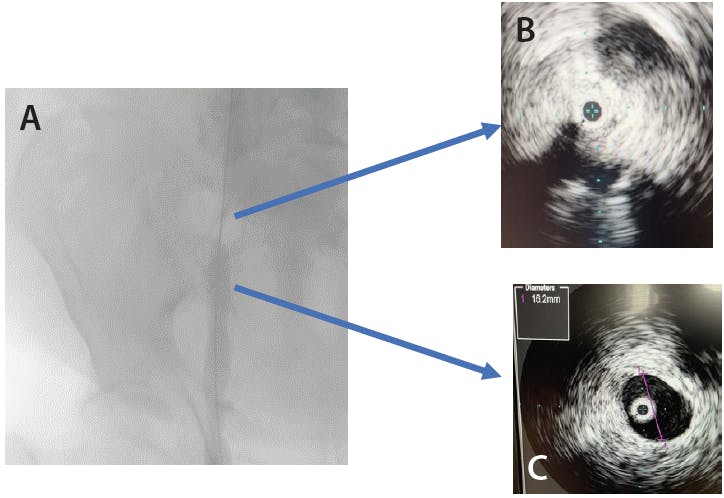
Figure 1. Angiogram showing high-grade stenosis in the right common illiac vein with collateral flow (A). IVUS showing the stenosis; the vein distal to the stenosis measured 16 mm (B, C).
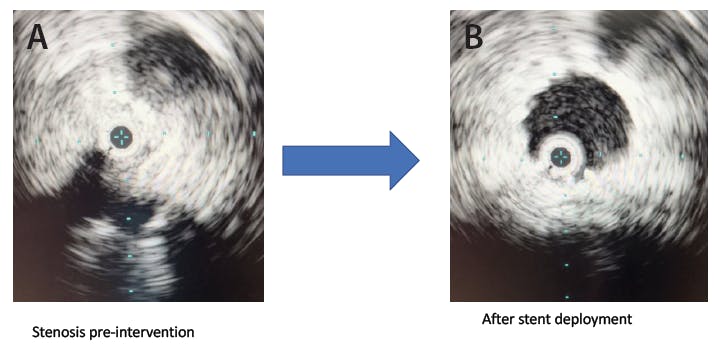
Figure 2. IVUS before angioplasty (A) and after stent placement (B).
CASE 2: CEPHALIC ARCH STENOSIS
A man in his mid-60s on dialysis for the past 6 months (following a failed transplant, which functioned for a number of years) with a left brachiocephalic arteriovenous fistula presented with increased bleeding times and hand pain during dialysis. He previously had a forearm graft, and therefore the upper arm cephalic vein was large. Ultrasound in the office revealed a high-grade stenosis at the cephalic arch (peak systolic velocity [PSV], 498 cm/second; PSV ratio, 4.4). Finger pressures with and without compression were significantly different (index, 80 mm Hg to 160 mm Hg). Secondary to access malfunction and hand pain, he was taken for intervention. Angiography was performed and identified the area of stenosis (Figure 3A). Angioplasty was performed using 8-mm X 4-cm and 10-mm X 4-cm balloons; however, there was significant residual stenosis, and therefore it was decided to place a covered stent. Due to the significant size difference, IVUS was used to aid in stent selection to avoid a significantly undersized stent in the distal vein (Figure 3B and 3C). An 11-mm X 10-cm covered stent was chosen and deployed. Postdilation was performed with resolution of significant stenosis (Figure 3D and 3E). The inflow was then banded, and the patient had a nice thrill and improved flow to the hand.
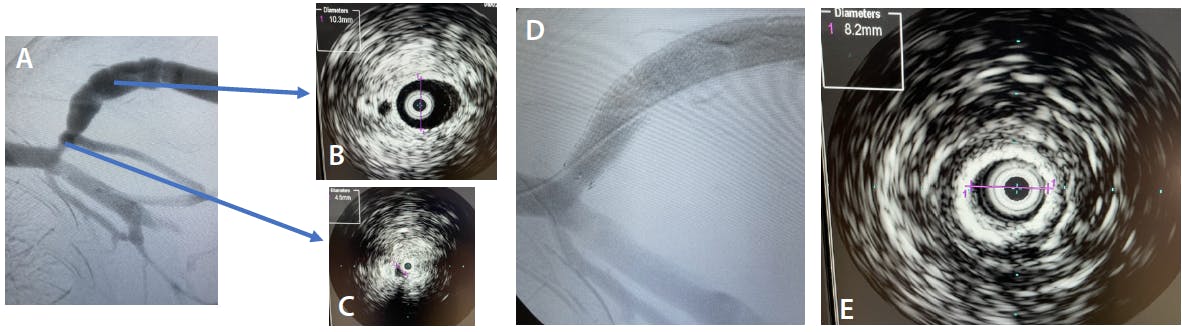
Figure 3. Initial angiogram showing the area of stenosis (A). IVUS was performed to assess vessel diameter before intervention (B, C). Postintervention angiogram (D) and IVUS (E) showing resolution of significant stenosis.
SUMMARY
IVUS is an excellent tool with a number of uses in the vascular system. Dialysis access interventionalists should consider using IVUS in the central venous system, in patients in whom contrast exposure needs to be limited, patients with recurrent issues where conventional angiography does not reveal a lesion, and as an aid in sizing balloons and stents. The barriers remain cost and reimbursement as well as expertise in its use. There is definitely more to come for this imaging modality in dialysis access.
1. Davidson CJ, Newman GE, Shiekh KH, et al. Mechanisms of angioplasty in hemodialysis fistula stenoses evaluated by intravascular ultrasound. Kidney Int. 1991;40:91-95. doi: 10.1038/ki.1991.185
2. Ross JR, Franga DL, Gallichio M, et al. Role of intravascular ultrasound imaging during endovascular interventions of failing hemodialysis access grafts. J Vasc Surg. 2017;65:1383-1389. doi: 10.1016/j.jvs.2016.10.115
3. de Graaf R, van Laanen J, Peppelenbosch N, et al. The value of intravascular ultrasound in the treatment of central venous obstructions in hemodialysis patients. J Vasc Access. 2016;17 suppl 1:S12-S15. doi: 10.5301/jva.5000536
4. Patel D. Intravascular ultrasound imaging for the optimization of dialysis access interventions. J Vasc Access. Published online January 28, 2020. doi: 10.1177/1129729820901617
5. Pearce BJ, Jordan WD Jr. Using IVUS during EVAR and TEVAR: improving patient outcomes. Semin Vasc Surg. 2009;22:172-180. doi: 10.1053/j.semvascsurg.2009.07.009
Advertisement
Advertisement