Advertisement
Advertisement
March 2021
Panel Discussion: What Attributes Are Necessary for the Ideal Branch Stent?
Characteristics of and challenges to designing an ideal branch stent and how it could be achieved.
With Matthew J. Eagleton, MD; Sanghyun Ahn, MD; Javairiah Fatima, MD, FACS, DFSVS; Stephen W.K. Cheng, MS, FRCS, FRCS(Ed), FACS; Martin J. Austermann, MD, PhD; Nuno V. Dias, MD, PhD; and Björn Sonesson, MD
Overview of Branch Stents
By Matthew J. Eagleton, MD, and Sanghyun Ahn, MD
A key component of fenestrated and branched endovascular aortic repair (F/BEVAR) is the bridging stent that connects the aortic component to the target vessel. The durability of this stent is the keystone to the success of the technique. The durability is termed “branch stability” and is composed of freedom from endoleak, occlusion/stenosis, component separation/migration, device integrity issues, and the need for any reintervention. Several factors affect branch stability, including aortic stent graft design, bridging stent graft properties, target vessel morphology (ie, cranial/caudal direction, stenosis, curvature/tortuosity), and postprocedural pharmacology. It is likely that long-term durability is not dependent on just one of these items but is instead multifactorial.
Early fenestrated endografts had fenestrations in the aortic stent graft in which that portion of the aortic component was within the sealing zone of the aneurysm neck. There was no gap between the fenestration and the aortic wall, with the fabric material around the fenestration in direct apposition with the aortic wall. In this scenario, the original bridging stents, which were bare-metal stents, were predominantly designed to maintain alignment of the fenestration and played little role in achieving aneurysm seal and exclusion. However, long-term patency was improved with the use of a balloon-expandable stent graft (BESG).1 With the evolution of the technology to treat more extensive aneurysms, the construction of these fenestrations changed to reinforced fenestrations, in addition to the introduction of directional branches. This placed additional responsibility on the bridging stent to work in concert with the aortic component to not only achieve long-term patency of the target vessels but also contribute toward achieving and maintaining aneurysm exclusion. Currently, these connections rely on two modes of connection within the aortic component. The first is a reinforced fenestration that interacts predominantly with a BESG (Figure 1). The second is a directional branch (a short cuff of graft material), which typically can interact with either a BESG or self-expanding stent graft (SESG). There are pros and cons to both, and many times a combination of branch anchoring points is used.
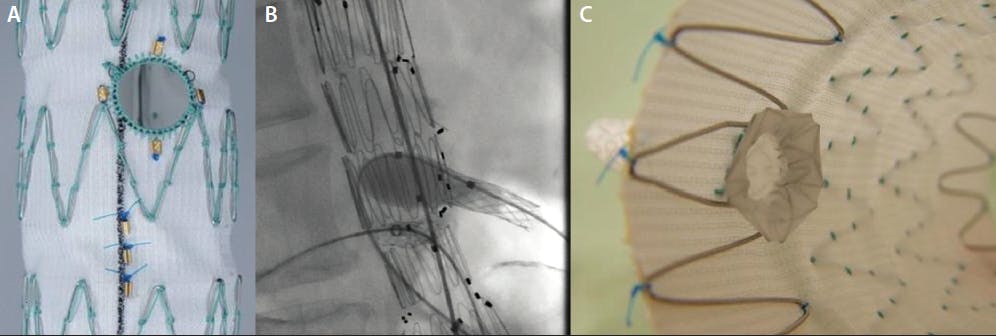
Figure 1. Images of reinforced fenestrations (A). The bridging stent graft obtains a seal with flaring of the proximal stent with an oversized balloon (B), which creates a seal with the aortic component (C).
The bridging stents that have been used were not specifically designed to mate with aortic components. Despite this, our ability to achieve branch stability is excellent. Initial results reported by Mastracci et al demonstrated visceral branch occlusion of < 2% and renal branch occlusion of < 4%.2 Reinterventions were similarly low, and indications were predominantly divided evenly between target vessel stenosis and branch-related endoleak. When evaluating outcomes in only complex thoracoabdominal aortic aneurysms, 5-year patency rates for the target vessels approached 98%.3 Reinterventions in this cohort were most commonly performed for target vessel stenosis (7%) or endoleak (15%). Similar outcomes have been demonstrated from multiple series both in Europe and the United States.4-8 To improve on these outcomes, we have to look at the modes of failure and what properties of the bridging stent can be altered to address these failures.
One factor that contributes to branch instability is the connection design between the bridging stent and the aortic stent graft. From the perspective of the visceral vessel (celiac and superior mesenteric arteries) patency, the use of reinforced fenestrations or directional branches is equivalent. Although reinforced fenestrations mandate the use of a BESG, directional branches do not. In the latter, patency is not dependent on the use of BESG versus SESG, although BESG use may be associated with lower endoleak rates.6,8 In addition, the use of reinforced fenestrations when the graft material does not abut the aortic wall does have a higher endoleak rate than a directional branch. The use of one versus the other is typically chosen based on an aortic design that will provide the most secure aneurysm seal while covering the least amount of aortic wall—thus potentially reducing the risk of complications such as spinal cord ischemia.
The limitations of current stent designs are most characteristically observed when renal arteries are incorporated into the repair. As with visceral vessels, reinforced fenestrations are associated with higher rates of type IIIb endoleaks. This could be overcome with a different bridging stent graft design that allows for more secure interaction between the bridging stent and the fenestration. However, directional branches for the renal arteries have patency issues. Although visceral occlusion occurs in < 2% of cases based on directional branches, it is 8% to 10% for renal arteries.6,9 Similarly, freedom from renal artery occlusion is significantly lower for designs using reinforced fenestrations as opposed to directional branches (97.1% vs 90.4%; P = .0015).5 These results are likely not secondary to the actual presence of a directional branch. Unless the renal arteries are caudally directed, the bridging stent may have to sustain patency despite traversing a significant angle (Figure 2). This would suggest that flexibility is a key property of bridging stent graft design.
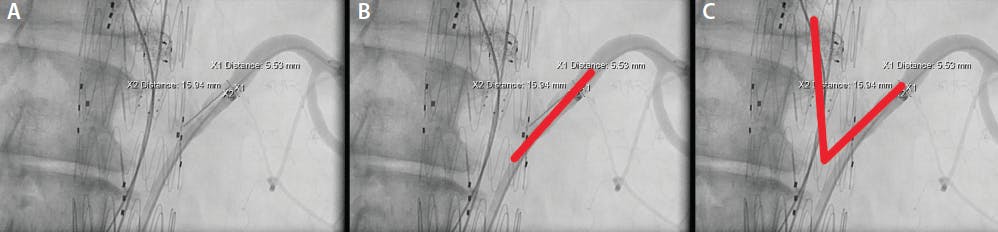
Figure 2. Example of an aneurysm being treated with a F/BEVAR that has a cranially directed renal artery (A). In this scenario, the target artery is incorporated with a reinforced fenestration, which allows for a straight trajectory for the intended bridging stent (B, red line). Alternately, a directional branch could be used (C). In that scenario, the bridging stent would need to take a significant angulation to traverse from a caudally directed branch to a cranially directed artery. This could alternately be overcome with a cranially directed branch.
Although tortuosity and angulation can be introduced by stent graft design, curvature and tortuosity in the target vessel may be problematic, and this may be overcome with an alternate branch stent design. Currently, surgeons attempt to overcome target vessel curvature and tortuosity with the adjunct use of a self-expanding stent (SES), either at the distal landing zone of the bridging stent (Figure 3) or within the bridging stents themselves. This most commonly occurs when a BESG is placed in a curved or tortuous vessel. The addition of a SES can help reduce kinking at the distal end of the stent. Frequently, the decision to place an additional SES is made based on preoperative interpretation of the target vessel trajectory on cross-sectional imaging, which may be difficult to assess intraoperatively. Sylvan et al attempted to demonstrate that target vessel curvature was associated with higher rates of branch instability.10 Interestingly, most branch-related adverse events occurred in low- and medium-curved vessels. However, most high-curved vessels had preemptive placement of a SES. The use of adjunctive SES is not associated with unfavorable outcomes, but it is not known whether outcomes would have been worse had they been omitted.11 It is also not known whether the placement of SESs in low- and medium-curved vessels could lower the observed (but low) rates of branch instability.
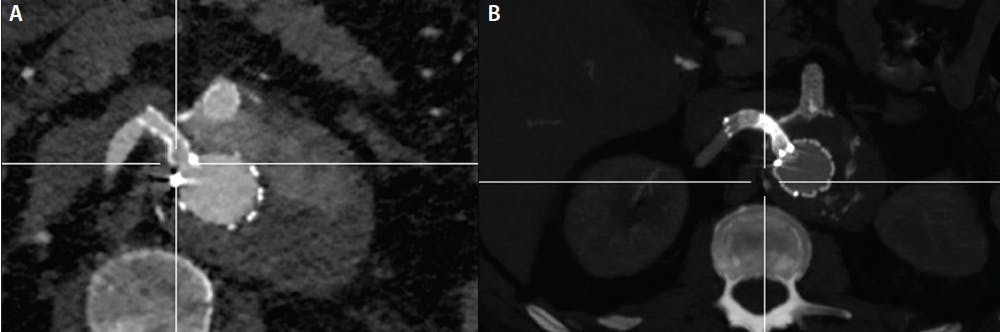
Figure 3. CT from a patient in which a BESG was used in a curved vessel (A). A SES is placed to ease this transition (B).
1. Mohabbat W, Greenberg RK, Mastracci TM, et al. Revised duplex criteria and outcomes for renal stents and stent grafts following endovascular repair of juxtarenal and thoracoabdominal aneurysms. J Vasc Surg. 2009;49:827-837; discussion 837. doi: 10.1016/j.jvs.2008.11.024
2. Mastracci TM, Greenberg RK, Eagleton MJ, Hernandez AV. Durability of branches in branched and fenestrated endografts. J Vasc Surg. 2013;57:926-933; discussion 933. doi: 10.1016/j.jvs.2012.09.071
3. Eagleton MJ, Follansbee M, Wolski K, et al. Fenestrated and branched endovascular aneurysm repair outcomes for type II and III thoracoabdominal aortic aneurysms. J Vasc Surg. 2016;63:930-942. doi: 10.1016/j.jvs.2015.10.095
4. Panuccio G, Bisdas T, Berekoven B, et al. Performance of bridging stent grafts in fenestrated and branched aortic endografting. Eur J Vasc Endovasc Surg. 2015;50:60-70. doi: 10.1016/j.ejvs.2015.03.023
5. Martin-Gonzalez T, Mastracci T, Carrell T, et al. Mid-term outcomes of renal branches versus renal fenestrations for thoraco-abdominal aneurysm repair. Eur J Vasc Endovasc Surg. 2016;52:141-148. doi: 10.1016/j.ejvs.2016.03.018
6. Mastracci TM, Carrell T, Constantinou J, et al. Editor’s choice - effect of branch stent choice on branch-related outcomes in complex aortic repair. Eur J Vasc Endovasc Surg. 2016;51:536-542. doi: 10.1016/j.ejvs.2015.12.046
7. Spear R, Sobocinski J, Hertault A, et al. One year outcomes of 101 BeGraft stent grafts used as bridging stents in fenestrated endovascular repairs. Eur J Vasc Endovasc Surg. 2018;55:504-510. doi: 10.1016/j.ejvs.2018.01.023
8. Tenorio ER, Kärkkäinen JM, Mendes BC, et al. Outcomes of directional branches using self-expandable or balloon-expandable stent grafts during endovascular repair of thoracoabdominal aortic aneurysms. J Vasc Surg. 2020;71:1489-1502 e1486. doi: 10.1016/j.jvs.2019.07.079
9. Premprabha D, Sobel J, Pua C, et al. Visceral branch occlusion following aneurysm repair using multibranched thoracoabdominal stent-grafts. J Endovasc Ther. 2014;21:783-790. doi: 10.1583/14-4807R.1
10. Sylvan J, Brier C, Wolski K, et al. Impact of alterations in target vessel curvature on branch durability after endovascular repair of thoracoabdominal aortic aneurysms. J Vasc Surg. 2016;63:634-641. doi: 10.1016/j.jvs.2015.09.053
11. Farivar BS, Brier C, Kuramochi Y, Eagleton MJ. Impact of bridging stent design and configuration on branch vessel durability after fenestrated endovascular repair of complex aortic aneurysms. J Vasc Surg. 2021;73:819-825. doi: 10.1016/j.jvs.2020.06.122
Panel Question: What Are the Characteristics of an Ideal Branch Stent?

As endovascular technology has continued to evolve, repair of complex aortic aneurysms (juxta-/pararenal or thoracoabdominal) using an endovascular approach has seen an upstroke. The durability of such repair is largely dependent on the inherent characteristics of the branch stents that bridge the main aortic device to the visceral target vessels in fenestrations and directional side branches.
An ideal bridging stent graft should offer a low-profile delivery system, incorporating flexibility to conform to a wide range of target vessels and angulations. It should accommodate various diameters and lengths with minimal foreshortening, allowing predictable and precise stent deployment. Additionally, high radial strength with resistance to kinking is critical to achieve long-term patency and resist migration, minimizing endoleaks.
iCast (Getinge) has been a long-standing stent of choice as a mating stent for fenestrations. Its balloon-expandable, stainless-steel stent encapsulated in two layers of polytetrafluoroethylene (PTFE) with an interlinked cell design provides excellent radial force and features postdilatation to larger diameters but at the expense of decreased flexibility, therefore rendering itself susceptible to kinks in tortuosity or angulation.
The Viabahn endoprosthesis (Gore & Associates) is known for its high flexibility and kink resistance secondary to its design with a single spiraling nitinol wire construction draped over PTFE; however, this feature makes it less favorable when higher radial strength is needed. Its bidirectional deployment mechanism makes it suboptimal in short landing zones, such as an early target vessel branching where precise deployment is necessary. Viabahn is limited in available lengths and in its ability to allow for customization to a larger diameter with postdilatation given its self-expanding nature.
The Viabahn VBX balloon-expandable endoprosthesis (Gore & Associates), the newest available option in the United States, comprises a unique geometry with each independent stainless-steel ring connected via a fluoropolymer (expanded PTFE) graft material, maximizing flexibility and kink resistance in tortuous or sharply angulated vessels. This provides high radial strength that is optimal in tight orifical stenosis. This balloon-expandable stent allows secondary postdilatation while maintaining the lower delivery profile, but it is predisposed to foreshortening due to the significant dilatation beyond the nominal diameter. Overall, the Viabahn VBX stent comes close to being an ideal branch stent graft with promising early results; data are eagerly awaited to evaluate its long-term durability.
The BeGraft peripheral stent graft (Bentley) is a cobalt-chromium stent covered with PTFE and is used extensively for the indication in Europe. Users believe it to be a near-perfect low-profile graft with very high radial strength combined with flexibility and immense customizability via postdilatation with minimal foreshortening.
Although each branch stent has certain key characteristics that make them the preferred stent in certain anatomy, the same features may render it suboptimal in others, making it challenging to incorporate all the ideal features without their respective disadvantages. This is likely the reason why use as a branch stent is an off-label indication for all these grafts. Nonetheless, many technologies once considered impossible are already today’s reality and, therefore, despite all its challenges, the ideal branch stent graft is only a matter of time.

Surgeons are always looking for an “ideal” branch stent for fenestrated and branched repair. Much has been discussed regarding the essential attributes, with research done on materials and hemodynamics. However, stent properties are often closely related, and improving one may compromise another. A perfect stent may never need to exist, yet we should learn to choose a stent according to challenges presented by three key issues: delivery, morphology, and durability.
First, we have to get the stent into position with relative ease and then deploy it accurately. The arch branches require only a short and direct route. A brachial approach for a thoracoabdominal aneurysm needs a longer but straight path, although a transfemoral fenestrated graft often demands a more tortuous route. For the latter, particularly in ethnic or gender groups of small stature, a 6-F delivery system is always preferred at the expense of sacrificing some of the stent’s strength. To low profile, we can add flexibility, visibility, and accuracy as desirable properties, and simple, balloon-expandable stents have an advantage despite their availability in shorter lengths.
Next, the stent should possess the strength to maintain its position, resist deformity from forces of respiration and blood flow, and accommodate deformation in case deployment was less than exact. In the long run, bridging stent failures come from fractures, dislocations, and separation, which occur in areas of stress. Ideally, we prefer a stent that has a robust proximal section against separation, has flaring capability, and is strong at its junction with fenestrations. The mid-part could be more flexible and adaptable yet maintain a radial force to turn angles. The target vessel landing zone should have a good transition in terms of rigidity without relining and be kink resistant. This is the area where much of the improvement in stent design made progress, with freedom from reintervention rates now exceeding 90% at 3 years.1,2 To improve these rates, we should examine technical success more closely than the absence of type I/III endoleaks, perhaps to the point of analyzing these potential areas of stress to allow a stent to adapt, as well as design a stent with different sectional properties in mind.
Last is the issue of long-term patency. We know that smaller-diameter, longer stents (renal arteries) are the Achilles heel of branched repairs. Reported patency rates of 85% in 3 years are still suboptimal.3 Studies on flow, take-off angles, and bending have also addressed some of the unknown areas. We may need a different stent for the renal arteries, where the kidneys present higher resistance to flow. Perhaps a heparin-bonded, tapered stent to sustain streamline flow with minimal recirculation will take priority in these targets.
Ultimately, there is more to durability than the stent itself. Careful planning and execution of the repair and proper adjuncts will ensure good results. Perhaps the ideal stents should be chosen by their properties considering a balance of delivery, strength, and patency. The ideal stent could be route- and organ-specific rather than one design fits all.
1. Katsargyris A, Oikonomou K, Kouvelos G, et al. Comparison of outcomes for double fenestrated endovascular aneurysm repair versus triple or quadruple fenestrated endovascular aneurysm repair in the treatment of complex abdominal aortic aneurysms. J Vasc Surg. 2017;66:29-36. doi: 10.1016/j.jvs.2016.11.043
2. Mastracci TM, Greenberg RK, Eagleton MJ, Hernandez AV. Durability of branches in branched and fenestrated endografts. J Vasc Surg. 2013;57:926-933. doi: 10.1016/j.jvs.2012.09.071
3. Eagleton MJ, Follansbee M, Wolski K, et al. Fenestrated and branched endovascular aneurysm repair outcomes for type II and III thoracoabdominal aortic aneurysms. J Vasc Surg. 2016;63:930-942. doi: 10.1016/j.jvs.2015.10.095

For about 20 years, we have treated thoracoabdominal and complex abdominal aneurysms using fenestrated and branched endografts. Several specialized centers have developed different workflows to implant these endografts with high success and low complication rates. However, there is still no consensus on which kind of bridging stent graft (self-expanding or balloon-expandable) should be used in the different morphologies.
Regarding the fenestrated technology, the most important attribute is durability, and we should think about the forces in the body that the bridging stent graft should withstand over time. The branch stent should resist forces like pulsatile blood pressure and breathing movements of the target vessels. The bridging stent graft should have a high radial force and shear stability at the proximal portion to withstand migration or misplacement of the aortic endograft in relation to the target vessel.
Regarding the branched endografts, we have cuffs instead of fenestrations with a better overlapping zone. The middle section is some distance in between the cuff and the target vessel ostium, and then the last section is the distal sealing zone within the target vessel. Again, in this situation, the most important attribute is durability. Another important feature is flexibility to manage the curve or angle between the cuff and the target vessel. Kink resistance should avoid early occlusions.
The ideal bridging stent graft for this indication should have high radial force at the proximal part, the middle portion should be flexible and kink resistant, and the distal portion should also be flexible and have some active fixation in the target vessel to avoid dislocation of the bridging stent graft out of the target vessel and to create a smooth transition to the target vessel.
The introducer system should facilitate precise placement of the covered stent, and delivery through an 8-F sheath has to be possible.
Developing and manufacturing the previously described ideal bridging stent graft with different features at the proximal, middle, and distal parts should be possible and may help us in the future.

I would define the characteristics of the ideal bridging stent as follows:
The proximal aspect of the bridging stent should be constructed specifically to interact with the fenestration or branch design of the aortic component. For directional branches, this may be as simple as creating a balloon-expandable component. When the stent interacts with a reinforced fenestration, a more complex sealing component may be better suited to reduce the rate of type IIIb endoleaks.
The distal component of the stent graft (ie, just beyond the mating portion) should be flexible. The exact amount of flexibility is unclear. The amount of flexibility necessary to overcome the innate curvature and tortuosity in the target vessel may be very different than the amount necessary to provide a durable repair when cephalad-directed target vessels are bridged from caudally directed branches.
Other characteristics of the stent itself that are important are not unique to bridging stents. It needs to be easy to see under fluoroscopy and discernible from the markers on other components.
The delivery sheath size should be relatively small (≤ 6 F) for a wide variety of length and diameter options for the bridging stent. In addition, the delivery system should allow for precise deployment of the stent graft despite having traversed potentially tortuous pathways.
Once the stent grafts are designed and made available for use, proving superior outcomes will take time. With the current low rate of branch instability, showing significant improvement will require a substantially powered study and several years of follow-up. This will require multi-institutional efforts to accrue a significant volume of patients. Other contributing factors may affect long-term branch stability and still warrant assessment. We do not know whether specific antiplatelet therapy is beneficial. In addition, we have only just begun to evaluate the effect of vessel movement on our endograft designs and durability.1 There is a lot more to learn and a lot more progress to make, but we will get there.
1. Suh GY, Choi G, Herfkens RJ, et al. Three-dimensional modeling analysis of visceral arteries and kidneys during respiration. Ann Vasc Surg. 2016;34:250-260. doi: 10.1016/j.avsg.2016.04.004


Obtaining the ideal branch stent for complex EVAR needs to address the stent design and the delivery system in relation to the type of repair. In branched grafts, the stent needs to have a high radial force in the proximal part. This will provide an appropriate seal in the branch cuff and the proximal part of the target vessel. Moreover, it also avoids compression between the aortic wall and the endograft, as well as at the target vessel ostium when this is stenosed. The distal portion of the stent needs to be flexible to provide conformability to tortuosity and the breathing-induced movements of the target vessel. The stent needs also to have a smooth transition to the distal target vessel and adapt to any diameter changes that can occur in the target vessel. The characteristics of the proximal part of the stent will generally compromise flexibility, which may be tempting, but at times, especially in the acute setting, devices with downward-facing branches need to be bridged into upward-going target vessels. As such, some degree of flexibility will be important even in the proximal part. Stents should have the metal struts on the outside with the luminal part covered with graft to facilitate recatheterization, especially if compression or kinks occur during follow-up.
In fenestrated endografts, the stents should have similar properties as in branched grafts, but the proximal segment should be shorter because fenestrations are generally located closer to the target vessel ostium. The seal is obtained in a nitinol ring, which would ideally have the stent completely flared (ie, flattened, against the inner surface of the endograft). This would not only improve the seal but also avoid compressions when crossing with other aortic devices and facilitate future catheterizations. Unfortunately, this type of flaring has only been achieved with bare-metal stents and not with covered stents, which are usually needed.
Flexibility and softness are needed to manage tortuous accesses, but a degree of pushability is also required to track forward, especially through tight bends. This balance should be uniform throughout the shaft to avoid longitudinal compression when dealing with resistance.
Minimizing the profile of the delivery system is essential, independently of the access and endograft type used, because it limits limb ischemia and cerebrovascular events and allows the use of preloaded delivery systems and steerable introducers. The delivery system should protect the stent or have the stent very well attached without grooves to avoid dislodgments upon advancement.
In summary, the ideal stent needs to combine characteristics of balloon-expandable stents and others of SESs. Some progress has been made, but dedicated stents should be possible and are eagerly awaited.
Advertisement
Advertisement