Advertisement
Advertisement
March 2021
Teaching Radiation Safety: Instructing Juniors About Dangers and Protections
Strategies for encouraging an ongoing, career-long effort toward learning and maintaining appropriate radiation protection practices in endovascular trainees.
By Adrien Hertault, MD, PhD; Gilles Soenens, MD; and Isabelle Van Herzeele, MD, PhD
The endovascular specialist community treats an increasing number of patients (who are often obese) using minimally invasive, complex endovascular techniques. This results in an exceptional level of radiation exposure for those who use radiation in their daily workplace. Radiation can’t be seen, smelled, heard, or felt. Most effects have a long latency period and may cause harm, including cataracts, accelerated aging, and cancer. Individuals vary in their body’s ability to repair this radiation damage. The International Commission on Radiological Protection (ICRP), the main regulatory body overseeing radiation protection (RP), has set the annual occupational dose limit to 20 mSv per year averaged over 5 years, with a maximum dose of 50 mSv per year.1 Considerable variation in occupational exposures has been observed for the same type of procedure, suggesting that RP should be improved.2
Education and training in RP are imperative to protect the next generation of endovascular specialists. In Europe, this is regulated at the national level under the wings of the European Directive on Basic Safety Standards.3 Significant differences have been noted in RP training regulations for vascular surgeons across Europe. A survey among 21 representatives from the European Vascular Surgeons in Training council noted that in one-third of the 21 surveyed countries, there is no mandatory course or certification in RP to become a vascular surgeon. In most countries where a mandatory course existed, it only needed to be completed before board certification in vascular surgery, with no recertification requirement. The course consists of theoretical training, and additional hands-on training or e-learning is provided in only four of 14 countries.4 Although the Euratom is rather vague,3 the ICRP makes specific recommendations, suggesting RP education at the start of medical school and continued through residency. It should be adjusted to the role of the physician and updated at least every 36 months postgraduation.1
A STEPWISE APPROACH TO TEACHING RADIATION SAFETY
How do we effectively teach trainees to protect themselves and the team when everyone in the room is being x-rayed every time someone steps on the pedal to x-ray the patient? This article explores some efficient training modalities.
Knowledge and Technical Skills
Appropriate RP knowledge, technical skills, and attitudes should be acquired before using radiation. Unfortunately, RP courses often focus on broad knowledge topics that may not always be relevant in daily practice. This was confirmed by a multispecialty European Delphi consensus about the key competencies in RP.5 They rated theoretical topics and basic physics, suggesting that these may be valuable but that RP courses should mostly focus on knowledge about topics such as the cause and consequences of scatter radiation, specific risks for health care workers, and the management of pregnant staff. Likewise, the preferred key technical skills should focus on the following practical strategies and actions to reduce radiation exposure: avoid putting hands within the fluoroscopy field, increase distance from the radiation source during digital subtraction angiography (DSA) runs, and maximize distance from the radiation source whenever possible. The correct use of personal protective equipment (PPE) and mobile shielding as well as communication about adequate protection before using x-rays were considered the key radiation safety attitudes.5
Web-Based Applications and Simulation Training
As with training technical skills, trainees should demonstrate that they have captured these key radiation safety principles during the voluntary/mandatory RP courses and can apply them in a safe environment before stepping on the x-ray pedal in real life. There are web-based technologies that can be used as training and assessment tools, such as “Radiation Safety in the Hybrid Angiography Suite: the Dos and Don’ts,” a massive open online course that combines online e-learning modules, multiple-choice questions, practical institutional videos, and an educational game to enhance the RP knowledge and skills of every team member.6 Other web-based applications allow trainees to alter angulation, magnification, and pulse rate and immediately test the influence of each factor on the radiation dose and scatter.7
After successfully completing a validated web-based application, trainees should apply and practice the RP principles during hands-on, virtual reality, simulation-based sessions without being exposed to radiation (eg, endovascular treatment of a symptomatic superficial femoral artery occlusion or endovascular aortic aneurysm exclusion). Trainees should participate in these sessions until RP skills become automated while respecting and applying the “as low as reasonably achievable” (ALARA) principle (Figure 1). Some examples of these practices include:
- Perform imaging only when necessary and with no more radiation than needed to provide adequate image quality.
- Consider the crucial positioning of the patient with respect to the x-ray tube and the detector and ensure the image receptor is as close to the patient as possible, not only to optimally visualize anatomy but also to minimize radiation exposure.
- Always start the procedure in low-dose fluoroscopy mode, and only switch to the high-dose rate if the image quality is inadequate.
- Avoid steep angulations of the C-arm if possible.
- Use additional tools including pulsed fluoroscopy, collimation, and lower DSA frame rate settings; avoid optical magnification; and use last-image-hold and fluoroscopy loops.8
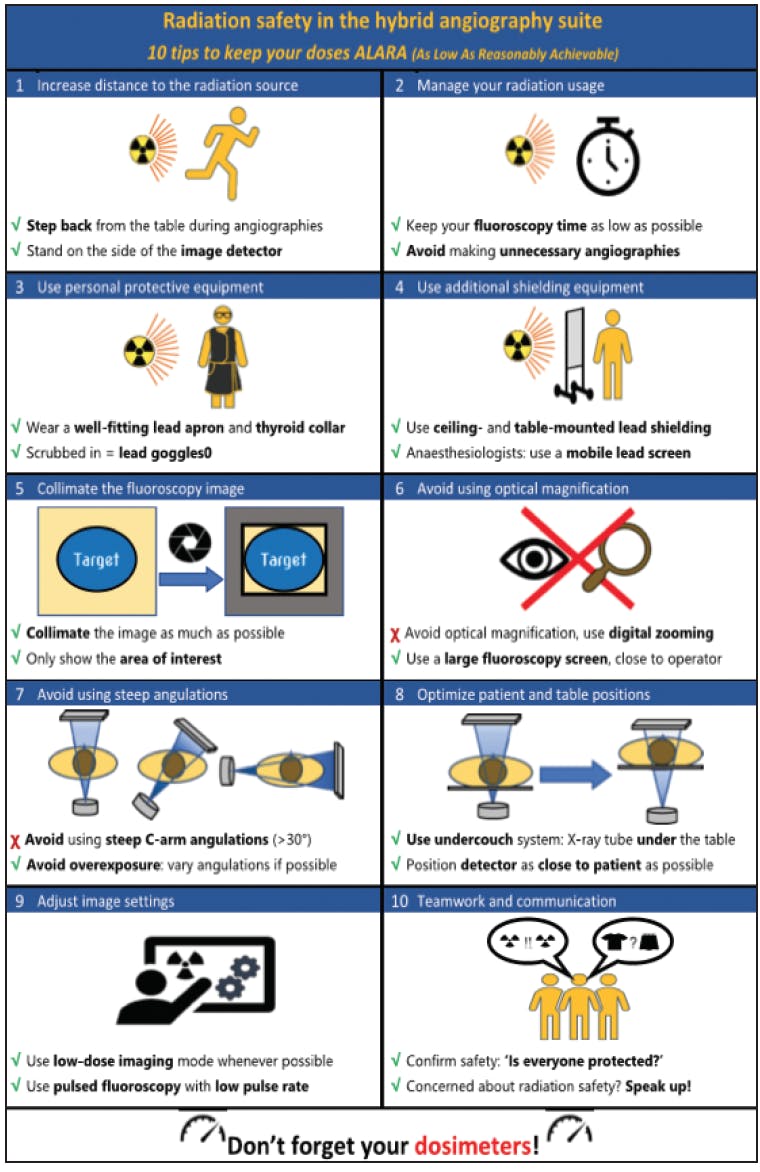
Figure 1. Ten tips to keep your doses ALARA. Reprinted from International Journal of Surgery, 77, Bart Doyen, Peter Vlerick, Gilles Soenens, et al, Team perception of the radiation safety climate in the hybrid angiography suite: a cross-sectional study, 48-56, 2020, with permission from Elsevier.
During and after the simulated sessions, feedback must be provided about the trainee’s radiation safety behavior by reviewing the automatically recorded simulator assessment parameters (eg, dose area product, changes in frame rate, table height, image intensifier position); and a scoring report summarizing how each radiation safety principle was followed. Additionally, a reliable radiation safety scale may be used by proctors to provide high-quality formative feedback and facilitate supervised debriefings about preprocedural planning, setup of the (hybrid) operating room (OR), PPE and shielding equipment, position of team members relative to the radiation source, awareness of radiation usage, handling of the C-arm, image quality versus radiation dose, use of additional dose-reducing functions, communication/leadership, and overall radiation performance (including the ALARA principle).9
Augmented reality (AR) can make x-rays visible and display scattered radiation during simulated sessions. This has the potential to be a great proctoring tool to raise awareness of exposure to harmful ionizing radiation generated during x-ray–guided procedures.10,11 AR can also allow trainees to learn how to optimally set up the hybrid OR to safely perform an endovascular procedure, ensuring that the entire team will be protected against radiation.12
Simulated training sessions are mostly offered during short workshops but should ideally be repeated to allow trainees the opportunity to gradually enhance their endovascular technique, procedural efficiency, and RP skills. Ideally, this would be done until a benchmark level is reached, prior to using these skills in real-life practice.
Supervised, Real-Life Practice
Next, stepwise training and further RP practice should be done under close supervision in the endovascular OR using the x-ray pedal similar to the teaching/learning of a surgical technique, such as endarterectomy or angioplasty. The responsibilities of the trainee (positioning protective equipment and managing collimation, patient-sensor distance, and C-arm angulations) should be gradually increased. Ideally, learning an endovascular procedure and managing RP should be taught separately, and step-by-step support can be decreased until the trainees can simultaneously manage x-rays and the technical aspects of the endovascular procedure.
A radiation safety rating scale can also play an important role in daily practice to provide formative feedback about trainees’ RP skills—if the scale is used by endovascular specialists, technicians, or medical physics experts who possess the knowledge and expertise from a clinical and medical physical perspective. These radiation safety behavior assessments should be performed regularly and routinely during endovascular training and be integrated into board certification exams.
The quality of feedback may be enriched by real-time dosimeters, dose archiving and communication system (DACS), and structured dose reports. Real-time dosimeters are positioned above the lead apron and provide real-time information on the amount of radiation the wearer has been exposed to. This information is displayed in the OR on a screen with a basic color code: green means radiation levels are acceptable, orange means changes are needed to reduce exposure, and red is a warning that RP habits must be altered. The DACS was developed to identify high-risk exposures in diagnostic radiology. It continuously records radiation information across various imaging modalities and has evolved to (1) provide a longitudinal assessment of practices by type of procedure and physician and (2) offer structured reports that may identify behaviors responsible for high exposures and allow correction of RP practices.13 An important part of continuous RP training is to understand where you stand and constantly try to improve. Therefore, the amount of radiation being administered during endovascular procedures should be monitored and compared yearly with national or local diagnostic reference levels.14
CONCLUSION
RP training programs need to be regularly updated, and retraining should be planned at least every 36 months or when there is a significant change in radiology technique or radiation risk. When trainees move to a different vascular department that uses different fluoroscopy equipment, a refresher course may be required.
Thorough knowledge and use of PPE and shielding equipment, fluoroscopic equipment (including the use of fusion guidance), and awareness of potential radiation harm are needed to ensure optimal benefit and safety for the patient and for health care workers. RP is and must be a continuous process for every endovascular specialist, trainee, or team member, not an occasional event.
1. The 2007 recommendations of the International Commission on Radiological Protection. ICRP publication 103. Ann ICRP. 2007;37:1-332. doi: 10.1016/j.icrp.2007.10.003
2. Hertault A, Bianchini A, Amiot S, et al. Editor’s choice–comprehensive literature review of radiation levels during endovascular aortic repair in cathlabs and operating theatres. Eur J Vasc Endovasc Surg. 2020;60:374-385. doi: 10.1016/j.ejvs.2020.05.036
3. EUR-Lex. Council Directive 2013/59/EURATOM of 5 December 2013 laying down basic safety standards for protection against the dangers arising from exposure to ionising radiation, and repealing Directives 89/618/Euratom, 90/641/Euratom, 96/29/Euratom, 97/43/Euratom and 2003/122/Euratom. Accessed January 21, 2021. https://eur-lex.europa.eu/eli/dir/2013/59/oj
4. Weiss S, Van Herzeele I; European Vascular Surgeons in Training (EVST) and the ESVS academy. Radiation protection training for vascular surgeons in twenty-one European countries. Eur J Vasc Endovasc Surg. 2020;59:512-513. doi: 10.1016/j.ejvs.2020.01.014
5. Doyen B, Maurel B, Cole J, et al. Defining the key competencies in radiation protection for endovascular procedures: a multispecialty Delphi consensus study. Eur J Vasc Endovasc Surg. 2018;55:281-287. doi: 10.1016/j.ejvs.2017.11.020
6. Doyen B. Safety in the hybrid angiography suite: opening Pandora’s box [Phd thesis]. Ghent, Belgium: Ghent University; 2020.
7. Katz A, Shtub A, Solomonica A, et al. Simulator training to minimize ionizing radiation exposure in the catheterization laboratory. Int J Cardiovasc Imaging. 2017;33:303-310. doi: 10.1007/s10554-016-1009-7
8. Rehani MM, Miller DL, Baliyan V. High-dose fluoroscopically guided procedures in patients: radiation management recommendations for interventionalists. Cardiovasc Intervent Radiol. Published online November 11, 2020. doi: 10.1007/s00270-020-02703-2
9. Doyen B, Maurel B, Hertault A, et al. Radiation safety performance is more than simply measuring doses! Development of a radiation safety rating scale. Cardiovasc Intervent Radiol. 2020;43:1331-1341. doi: 10.1007/s00270-020-02590-7
10. Loy Rodas N, Padoy N. Seeing is believing: increasing intraoperative awareness to scattered radiation in interventional procedures by combining augmented reality, Monte Carlo simulations and wireless dosimeters. Int J Comput Assist Radiol Surg. 2015;10:1181-1191. doi: 10.1007/s11548-015-1161-x
11. 3D Systems 2020. Radiation Safety Module. Accessed January 21, 2020. https://www.3dsystems.com/medical-simulators/simbionix-angio-mentor/modules/radiation-safety
12. GE Healthcare. Top 3 considerations to make your hybrid OR investment successful! Accessed January 21, 2020. https://landing1.gehealthcare.com/USC-AD-19-07-DGS-INT-Discovery_Details.html
13. Hertault A, Rhee R, Antoniou GA, et al. Radiation dose reduction during EVAR: results from a prospective multicentre study (the REVAR study). Eur J Vasc Endovasc Surg. 2018;56:426-433. doi: 10.1016/j.ejvs.2018.05.001
14. Rial R, Vañó E, Del Río-Solá ML, et al. National diagnostic reference levels for endovascular aneurysm repair and optimisation strategies. Eur J Vasc Endovasc Surg. 2020;60:837-842. doi: 10.1016/j.ejvs.2020.08.006
Advertisement
Advertisement