Advertisement
Advertisement
March 2021
Sponsored by Inari Medical
The VTE Paradigm Shift Continues: Nonthrombolytic Treatment of the Upper Extremities
An expert discussion and case experiences demonstrating the utility of single-session FlowTriever and ClotTriever thrombectomy for upper extremity thromboses, particularly in patients undergoing dialysis.
With Angelo G. Marino, DO; Jeffrey Forris Beecham Chick, MD, MPH, FCIRSE, FSVM; Joseph A. Paulisin, DO; Clark W. Schumacher, MD; Holland Korbitz, DO; and Craig Biebel, DO



Deep vein thrombosis (DVT) of the upper extremities (UEDVT) affects approximately 500,000 patients in the United States per year.1 The most common form, known as secondary UEDVT, occurs when an indwelling device irritates the surrounding endothelium and promotes the development of thromboses. With increasing use of these devices, secondary UEDVT has become a more frequent concern. Symptom severity in UEDVT, which can range from none to excessive limb swelling and even limb ischemia, often warrants clinical intervention.
If untreated, complications of UEDVT can include pulmonary embolism (PE) and postthrombotic syndrome (PTS). PE occurs in up to 6% of cases, most often in secondary UEDVT. PTS, which can result in persistent limb swelling, pain, and heaviness, occurs in up to 45% of cases.2 In the context of tunneled catheters for hemodialysis access, UEDVT can cause severe arm swelling, threaten the ability to perform dialysis, and render the affected access site useless.
In the following interview, Drs. Jeffrey Forris Beecham Chick, Angelo G. Marino, and Joseph A. Paulisin discuss their approach to treat UEDVT and share their experiences using the FlowTriever and ClotTriever Systems (Inari Medical) for rapid single-session thrombus removal without the need for thrombolytic drugs.
UEDVT can be primary or secondary in nature, across a wide range of etiologies. Which UEDVT scenarios do you treat most often?
Dr. Chick: Upper extremity and thoracic central venous occlusive diseases that require evaluation and treatment at our center are often caused by indwelling venous access devices (such as central venous catheters [CVCs], chest ports, and transvenous cardiac leads), dialysis access points (arteriovenous [AV] fistulas and grafts), and intrathoracic malignancies (lung cancers, lymphomas, and metastases).
Dr. Marino: Similar to Dr. Chick, most patients we see have secondary UEDVT related to an indwelling device, usually a peripherally inserted central catheter (PICC) or CVC. A smaller number of patients present with UEDVT related to venous thoracic outlet syndrome (TOS) and some who present with catheter-associated UEDVT may have underlying TOS. Most are treated with anticoagulation alone; however, if symptoms fail to improve, then we consider intervention with catheter-directed therapies.
Dr. Paulisin: The most common UEDVT disease presentations I see are related to dialysis access. I use ClotTriever frequently in this setting for acute and chronic occlusions of the central veins. I also treat TOS and UEDVT related to ports and central access sites for chemotherapy, albeit less frequently.
What are the main challenges you face when treating UEDVT?
Dr. Chick: I encounter five principal challenges when treating these diseases: (1) proper assessment of thrombus chronicity, (2) successful thrombus traversal, (3) adequate thrombus clearance, (4) optimal scaffold placement, and (5) appropriate long-term anticoagulation and antiplatelet therapy with close follow-up evaluation.
Presentation, history, duplex ultrasound findings, CT venography, and MR venography are valuable in understanding thrombus chronicity, although I often encounter discrepant findings on catheter-based venography. In acute venous occlusive diseases, a variety of standard “blunt” recanalization techniques may be employed to traverse thrombus. However, acute-on-chronic and chronic venous occlusive diseases may require advanced “sharp” recanalization techniques, including use of transeptal needles, Rösch-Uchida transjugular liver access sets (Cook Medical), or PowerWire radiofrequency guidewires (Baylis Medical Company, Inc.). There are many devices available for thrombus clearance. Identifying the appropriate device for adequate clearance can prove challenging.
Postthrombectomy scaffold selection and placement considerations include the type (bare-metal stents vs stent grafts, closed- vs open-cell designs) as well as proper sizes and locations for deployment. The optimal postintervention anticoagulation and antiplatelet regimen after various endovenous interventions has yet to be adequately evaluated.
Dr. Marino: To me, the challenges are similar with UEDVT and lower extremity DVT. In both cases, proper preprocedural imaging and planning are imperative for a successful outcome. The chronicity of the clot, clot burden, vessel size, and need for immediate clinical benefit in severe cases can pose difficulties in treatment.
What considerations guide your interventional decision-making? How have ClotTriever and FlowTriever impacted your treatment approach in UEDVT?
Dr. Paulisin: When strategizing UEDVT treatment, the use of intravascular ultrasound (IVUS) has become critical. It informs me of the size of access vessels, type of occlusion, and overall location during the procedure. IVUS guidance allows us to see if a guidewire has entered a collateral vessel, in which case we would refrain from thrombectomy or stenting, which could be catastrophic in this setting.
Before FlowTriever and ClotTriever were options, I often defaulted to thrombolytic approaches and, occasionally, to small-bore aspiration. In my experience, the clot burden was often only minimally affected, especially if thrombus appeared chronic on IVUS, leaving me with unsatisfactory results. Using a thrombectomy device like ClotTriever or FlowTriever—which are designed for the venous system to address multiple clot morphologies—I can remove acute thrombus and effectively treat subacute and chronic occlusions.
Dr. Marino: There are many things to consider when approaching a UEDVT case. With lytic therapy, you must weigh the benefit of treatment against the potential bleeding risk. Intensive care unit (ICU) or stepdown bed availability is always a consideration, and follow-up procedures need to be arranged. Additionally, the complexity of the underlying disease and potential need for venoplasty and stenting need to be thought through.
The Inari Medical devices have significantly impacted my treatment approach. If the access vessel size is large enough to accommodate the ClotTriever sheath, I will proceed with thrombectomy rather than catheter-directed lysis. ClotTriever thrombectomy allows a single-session approach without the need for an ICU bed and minimal to no bleeding risk. Thus far, our results have been remarkable. The devices allow removal of the full spectrum of clot, including acute, subacute, and chronic. Procedure times are relatively low, and thrombectomy can provide patients with immediate symptom relief.
Dr. Chick: In choosing access sites, I am guided by chronicity and location (ie, the respective upper extremity and thoracic central venous segments involved) of the target occlusion. Location and chronicity are also essential to strategize whether thrombectomy, thrombolysis, or stent placement is warranted. ClotTriever and FlowTriever are single-session thrombectomy devices that allow for rapid thrombus removal without thrombolytic therapy. These devices facilitate more complete thrombus removal in various stages of chronicity, allowing for better preparation of diseased veins for stent or stent graft placement. In some cases, treatment with these devices removes the need for stent placement altogether.
What are your immediate and long-term treatment goals for your UEDVT patients?
Dr. Paulisin: My immediate consideration is to debulk a lesion that is causing issues and remove as much thrombus as possible. If I cannot relieve enough of the burden, I sometimes use percutaneous transluminal angioplasty (PTA) to further loosen thrombus before redeploying ClotTriever to extract more. In my experience, veins tend to respond better to PTA after ClotTriever use.
The extent and type of treatment I choose is primarily related to a patient’s unique issues and symptoms. We have patients with central occlusions, where collateral veins develop to work around an obstruction. Other patients have recirculation issues or prolonged bleeding, and we are ready to use the full interventional toolbox at our disposal for these patients. When treating patients with AV fistulas, I consider adjunctive central ballooning and stenting to prolong the life of the access when feasible. If patients are running out of options, I may use ClotTriever and PTA exclusively to debulk as much thrombus as possible to avoid stenting and preserve future access sites for a patient undergoing dialysis.
Dr. Marino: I have a similar approach with a primary goal to restore patency and provide symptom relief. Saving venous access sites can be equally important for certain patients. Avoiding rethrombosis is crucial in the short and long term. Because thrombectomy with ClotTriever allows for removal of more chronic clot and scarring, it will be interesting to see if surgical decompression could be performed in patients with TOS, without the need for venous reconstruction (patch angioplasty or bypass).
Dr. Chick: In the immediate setting, ClotTriever and FlowTriever thrombectomy devices allow for rapid thrombus removal and swift symptomatic recovery for UEDVT and superior vena cava (SVC) syndromes without the hemorrhagic risks associated with thrombolytic infusion. In the longer term, these thrombectomy devices will allow us to restore compromised or abandoned venous access sites.
Do you have any advice or tips for new users contemplating the use of ClotTriever or FlowTriever in this clinical setting?
Dr. Paulisin: Let me start by saying endovascular treatment with ClotTriever and FlowTriever is not as challenging as one might think. Most UEDVTs we see are caused by the presence of central lines, cannulations, and PICC lines. If patients require debulking of thrombus for symptom relief, I recommend a multidirectional “flossing” technique. With this approach, we prepare and drape both a groin and an upper extremity/internal jugular (IJ) site to give us options for deploying the FlowTriever or ClotTriever device. Employing a stiff wire and using a flossing approach can prevent unwanted wire misadventures involving buckling or loss of purchase during thrombectomy passes.
Also, consider using what is already in place. If a patient’s DVT stems from the presence of an implanted port, PICC line, dialysis catheter, or pacemaker, then working with devices that are present can aid in crossing and treating a lesion.
Whenever possible, use IVUS to guide adjunctive stenting and ballooning and confirm the location when crossing occlusions. I would not recommend stenting in TOS, but it can be an option in occlusions of the central venous system, for instance in dialysis access–related UEDVT. In this case, IVUS can guide stent sizing and placement to avoid covering a potential future access site. IVUS can furthermore be useful when crossing occlusions, which can be nerve-wracking in the chest, particularly in the AV access realm due to arterialization.
One last tip relates to sedation. Be aware that minimal anesthesia is not ideal in all cases, and central anesthesia might be required.
Dr. Marino: My first tip is to remember that preprocedural planning is key to success, and this includes checking to see if access veins (basilic or brachial) are adequate caliber for the device. The inner diameter of the ClotTriever sheath is 13 F, and therefore the minimum vessel diameter is 6 mm. Next, ensure adequate anticoagulation before, during, and after the procedure. I agree with Dr. Paulisin that the use of IVUS, if available, provides a great deal of relevant information and helps assess chronicity of clot as well as vessel caliber and residual thrombus. If there is difficulty in removing more chronic clot, use a balloon to dilate the area, then attempt additional passes with the ClotTriever device. If TOS is suspected, perform thrombectomy with the patient’s arm in the neutral position to allow easier passage of the ClotTriever device. Once patency is restored, perform venograms with the arm in a neutral position and abduction to access for TOS.
Dr. Chick: I agree—planning makes perfect. Although management of upper extremity and thoracic central venous occlusive diseases may be rewarding for patients, operators, and referrers, they may be fraught with challenges, frustrations, and potential pitfalls. Careful access site planning is paramount to success. Understanding proper scaffold selection and deployment, including the use of appropriately sized self-expanding stents and avoiding regions of extrinsic compression or repetitive stress (eg, costoclavicular junction), is critical. Respecting the delicate SVC and the pericardial recesses during thrombectomy, venoplasty, and stent placement is vital, coupled with the readiness to perform emergent thoracostomy and pericardial drainage if needed.
As interventional techniques and tools continue to evolve, what role do you see mechanical thrombectomy playing in the future of UEDVT treatment?
Dr. Chick: Mechanical thrombectomy, including the use of both the ClotTriever and FlowTriever devices, will likely become the standard of care for the treatment of acute, acute-on-chronic, and chronic venous occlusive diseases within the upper extremities from both benign and malignant causes. These methods allow for venous preservation, salvation, and restoration. With time, they will be expanded for the treatment of dialysis access–induced thromboses and catheter-associated fibrin sheaths. The future is exciting for both patients and practitioners.
Dr. Marino: I agree with Dr. Chick. We are beginning to see a paradigm shift in the treatment of venous thromboembolism, including UEDVT, and mechanical thrombectomy is poised to become the standard of care. As previously highlighted, the advantages of mechanical thrombectomy compared to lytic therapy are numerous. As tools continue to evolve, I anticipate applications for the treatment of thrombosed upper extremity dialysis access AV fistulas and grafts. The ClotTriever and FlowTriever devices add new tools to our armamentarium, and their unparalleled performances vastly improve our ability to treat patients with DVT/PE.
Dr. Paulisin: I believe that percutaneous mechanical thrombectomy will replace the role of catheter-directed thrombolysis in UEDVTs because it is simply more effective. The primary reason is that most clot is older than we previously thought and therefore does not respond well to thrombolysis. Thrombectomy can work on both acute and chronic thrombus. We had become accustomed to the risks of thrombolysis and ICU stays that our patients had to experience, but now we can avoid those risks. Cost to the hospital, risk to the patient, and length of stay are all dramatically affected for the better when using mechanical thrombectomy. Ultimately, mechanical thrombectomy appears to be better for patients, and that is why I believe it should be the gold standard treatment for DVT in the upper and lower extremities.
1. Tamizifar B, Beigi A, Rismankarzadeh M. Venous thrombosis in subclavian, axillary, brachial veins with extension to internal jugular vein, right sigmoid sinus and simultaneous pulmonary embolism. J Res Med Sci. 2013;18:77-79.
2. Grigorian A, Nahmias JT. Upper extremity deep venous thrombosis. StatPearls Publishing; 2020.
Preserving AV Fistula Hemodialysis Access Using the ClotTriever in a Patient With SVC Thrombosis and a Contraindication to Thrombolysis

A dialysis-dependent woman in her early 40s with a complex medical history including end-stage renal disease was admitted to the hospital for right arm swelling. A right brachiocephalic AV fistula had been created for permanent dialysis access 30 days before. While waiting for the fistula to mature, the patient was dialyzing through a tunneled hemodialysis catheter placed through the right IJ vein. At the time of admission, the catheter that had been placed 23 days before was no longer working. A right arm AV fistulagram on the second day in the hospital demonstrated thrombus along the AV anastomosis, as well as pericatheter thrombosis within the SVC and at the cavoatrial junction. Chest CT confirmed these findings (Figure 1A and 1B). Because of a recent fall with left wrist fracture, thrombolysis was contraindicated. To provide symptomatic relief, preserve patency of the SVC, and aid in maturation of the right arm AV fistula, it was decided to perform endovascular thrombectomy using the ClotTriever System.
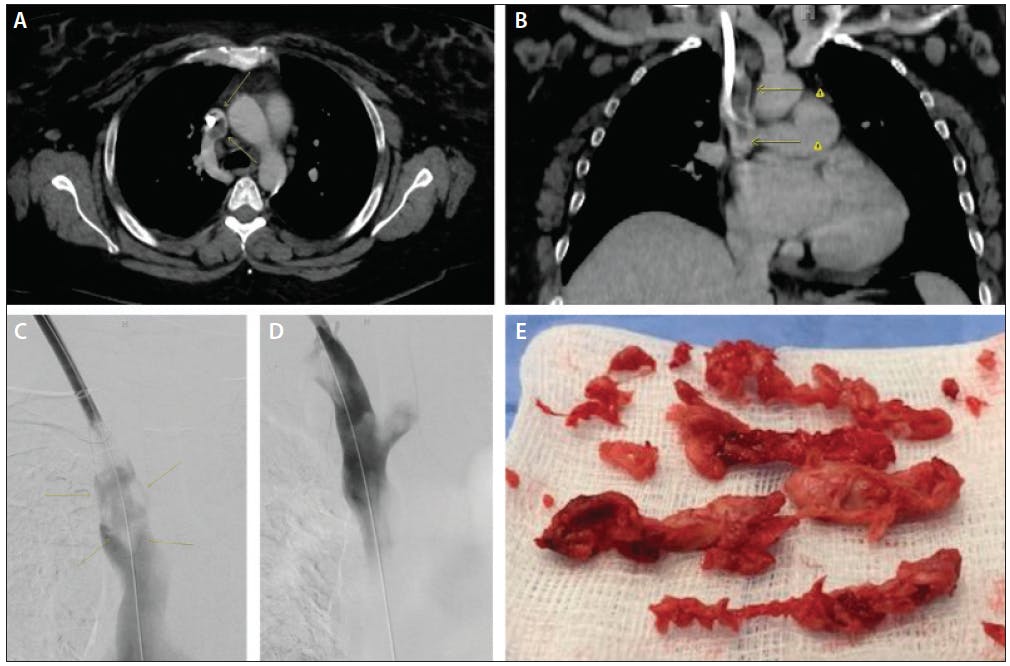
Figure 1. Axial contrast-enhanced chest CT images demonstrated nearly occlusive thrombus within the SVC around a 15.5-F dialysis catheter (A). Coronal contrast-enhanced chest CT images demonstrated nearly occlusive thrombus within the SVC around the dialysis catheter (B). Digital subtraction angiography performed before and during endovascular thrombectomy demonstrated thrombus within the SVC and at the cavoatrial junction; thrombus extended into the central left brachiocephalic vein as well (C). Digital subtraction angiography performed after endovascular thrombectomy demonstrated an approximately 75% decrease in clot burden within the SVC (D). Organized thrombus extracted with eight ClotTriever passes (E).
PROCEDURAL OVERVIEW
The ClotTriever System has two components: (1) a sheath (13 or 16 F) to facilitate vascular access with an expandable funnel and (2) a catheter with a coring element and attached nitinol bag for thrombus capture and distal protection. When it is inserted through the sheath over an 0.035-inch guidewire, the catheter is advanced beyond the thrombus, deployed, and then slowly pulled back toward the sheath, removing thrombus from the patient. The device can be cleaned and reinserted after each pass.
Before performing mechanical thrombectomy, we removed the nonfunctioning catheter over two Glidewires (Terumo Interventional Systems) and achieved new right IJ venous access. A venogram confirmed the presence of nearly occlusive thrombus within the SVC and at the cavoatrial junction (Figure 1C). We then placed a 16-F ClotTriever sheath using the standard technique. Next, we advanced a Bentson guidewire through the inferior vena cava (IVC) and into the right external iliac vein. We exchanged the guidewire for a 1-cm Amplatz Super Stiff guidewire (Boston Scientific Corporation) and advanced the ClotTriever catheter into the IVC, starting at approximately the level of the intrahepatic IVC. We performed eight passes with the ClotTriever device—coring, collecting, and removing large amounts of organized thrombus with each pass. Approximately 75% of the initial thrombus burden was removed (Figure 1D). On inspection, the thrombus appeared chronic because it was white and pale red in color and had a rubbery texture (Figure 1E).
Immediately after SVC thrombectomy, a tunneled dialysis catheter was placed through the left IJ vein to allow dialysis while the right arm AV fistula matured. The patient tolerated the procedure well, experienced rapid symptom relief, and was discharged to home several days later on warfarin. Nine months after the procedure, the patient was doing well and was dialyzing through a mature right arm AV fistula. The tunneled dialysis catheter had been removed.
DISCUSSION
Using the ClotTriever, we were able to treat nearly occlusive SVC thrombosis when thrombolysis was contraindicated. The extracted thrombus appeared chronic—dense with collagen, rather than fibrin—and therefore was unlikely to have responded to thrombolytic approaches, as thrombolytics depend on the presence of fibrin to be effective.1-5 As thrombus ages, it becomes increasingly collagen rich. Within 7 days, approximately 20% of thrombus remodels into collagen, and by 21 days, as much as 80% of thrombus is collagen.2 Given that thrombolysis mediates the conversion of plasminogen to plasmin, which acts by breaking up fibrin, thrombolytic agents do not affect chronic, collagen-rich thrombus. ClotTriever thrombectomy allowed for nearly complete extraction of a majority of the chronic-appearing thrombus in this patient.
Endovascular thrombectomy using the ClotTriever provided symptomatic relief from right arm swelling and likely prevented further chronic caval thrombosis. The patient was treated in a single session, including introduction of a new tunneled dialysis catheter. This treatment helped to preserve a long-term, catheter-based dialysis access as the patient’s right arm AV fistula matured.
1. Beythien C, Terres W, Gutensohn K, Meinertz T. [Thrombus age as a determinant of lysis efficacy of in vitro produced platelet-fibrin thrombi]. Z Kardiol. 1996;85:661-667.
2. Czaplicki C, Albadawi H, Partovi S, et al. Can thrombus age guide thrombolytic therapy? Cardiovasc Diagn Ther. 2017;7(suppl 3):S186-S196. doi: 10.21037/cdt.2017.11.05
3. Fernandes T, Planquette B, Sanchez O, Morris T. From acute to chronic thromboembolic disease. Ann Am Thorac Soc. 2016;(13 suppl 3):S207-S214. doi: 10.1513/AnnalsATS.201509-619AS
4. Phillippe HM. Overview of venous thromboembolism. Am J Manag Care. 2017;23(20 suppl):S376-S382.
5. Vedantham S, Piazza G, Sista AK, Goldenberg NA. Guidance for the use of thrombolytic therapy for the treatment of venous thromboembolism. J Thromb Thrombolysis. 2016;41:68-80.
Treating Central Venous Thrombosis From a Failed Dialysis Catheter With FlowTriever and ClotTriever


A dialysis-dependent woman in her early 50s presented to our interventional radiology department due to a nonfunctioning dialysis catheter. Her complex history included end-stage renal disease and severe peripheral artery disease that necessitated below-the-knee amputations on both sides.
The patient had ongoing issues with thromboses and failing tunneled catheters and required multiple catheter exchanges to allow the continuation of her hemodialysis treatment. During one dialysis session, she experienced a change in mental status and hypotension, prompting admittance to the ICU. Throughout the next 2 days, her mental status worsened, and a blood culture tested positive for gram-positive Staphylococcus aureus. It was suspected that her current permacath was infected. The permacath was removed at the bedside, and treatment was initiated with cefazolin; however, subsequent blood cultures still came back positive.
The next day, a transesophageal echocardiogram provided evidence of a mobile mass in the SVC that extended into the right atrium (RA; Figure 1A). Due to her bacteremia, endocarditis was a concern. Another repeat blood culture came back negative, and a temporary groin catheter was finally able to be placed on her right side to resume dialysis. A chest CT confirmed the presence of a foreign body in the SVC and RA.
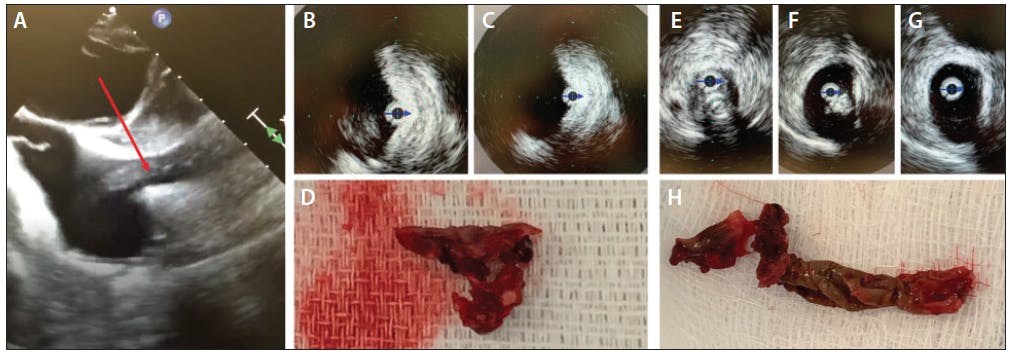
Figure 1. Transesophageal echocardiography showed a floating mass extending into the RA (A). IVUS of the RA confirmed the presence of thrombotic material (B). IVUS performed after FlowTriever thrombectomy showed a cleared RA (C). Aspiration with FlowTriever extracted organized material with visual signs of inflammation/infection (D). IVUS of the SVC showed persistent occlusion (E, F). IVUS performed after ClotTriever thrombectomy showed clearance of the SVC occlusion (G). ClotTriever extracted very organized thrombotic material, including remnants of the fibrin sheath (H).
Cardiology, cardiothoracic and vascular surgery, and the resident infectious disease team were brought into the discussion. At that point, the main diagnostic debate centered around the root cause of her bacteremia: endocarditis or infected remnants of the thrombosed catheter. Because her initial bacteremia had cleared up, it was assumed that rather than endocarditis, her issues were likely due to a remnant of an infected fibrin sheath that had formed around her failing dialysis catheter and traveled to the SVC and RA. Consequently, the decision was made to intervene with FlowTriever thrombectomy to extract the thrombotic material.
In addition to thrombectomy to remove the foreign body from the RA and clear out the SVC for improved future dialysis catheter functionality, reinsertion of a new tunnel catheter to address the patient’s ongoing need for dialysis was also recommended.
PROCEDURAL OVERVIEW
The procedure was performed the next day with the patient under general anesthesia in the catheterization laboratory. A multidirectional approach was planned, and access was achieved to both IJ veins, as well as the right common femoral vein (the site of the patient’s recently placed dialysis catheter). The catheter was exchanged for a 14-F sheath. At the right IJ, an 8-F sheath was used for access and IVUS. The left IJ vein access was also upgraded to 8 F to perform further IVUS guidance from the other side.
Cannulation was possible through the right IJ into a healthy IVC, where the wire coming from the femoral position was snared and a flossing technique was performed over a Supra Core wire (Abbott). This wire was used as a stable rail for the remainder of the procedure.
Using IVUS guidance, a large remnant of a fibrin sheath was found free-floating in the RA (Figure 1B), as well as a chronically thrombosed IJ and right innominate vein. Then, the FlowTriever System’s Triever24 (T24; Inari Medical) catheter was chosen to address the RA, coming from the groin access. Multiple aspirations were performed using T24, and very dense thrombus was removed by continually employing IVUS to guide FlowTriever aspirations for targeted thrombus extraction (Figure 1C and 1D).
A repeat IVUS run showed further foreign masses and wall-adherent thrombus still present in the SVC (Figure 1E and 1F). It was decided to employ further treatment with the ClotTriever System. To prepare for ClotTriever thrombectomy, the 8-F sheath in the right IJ was exchanged for the 13-F ClotTriever sheath. Two pulls of the ClotTriever catheter were performed, extracting two large thrombus loads and obvious remnants of a fibrin sheath, which appeared infected (Figure 1H). A final repeat IVUS showed complete resolution of thrombus, with no remaining free-floating masses (Figure 1G). After the thrombectomy procedure, all sheaths were removed and the right IJ sheath was exchanged for a new tunneled catheter.
The patient was discharged to home the next day on long-term antibiotics to prevent further infection and apixaban for thrombosis prevention. She was able to use the new catheter for several months postprocedure until a fistula created during a subsequent outpatient procedure had matured.
DISCUSSION
We successfully treated a septic patient with central venous thrombosis and free-floating fibrin sheath remnants using a combination of FlowTriever and ClotTriever. Our treatment decisions were driven by an immediate need to eliminate the underlying cause of the patient’s infection and clear up central venous thrombus that impacted her dialysis treatment. Having both FlowTriever and ClotTriever available to rapidly remove thrombus from various venous anatomies allowed us to achieve an optimal treatment result with no residual thrombus. FlowTriever aspiration made it possible to evacuate large parts of the free-floating masses from the RA, which showed visual signs of infection when removed. With the controlled, vacuum-based approach using a custom large-bore syringe, blood loss is limited to a maximum of 60 mL per FlowTriever aspiration. In addition, the large-bore design allowed removal of large, organized thrombus. ClotTriever allowed further targeted thrombectomy of chronic masses and venous occlusions and ultimately cleared out any remaining thrombus in the SVC. We believe that the optimal thrombectomy result we achieved not only ensured that no infectious material remained in her circulation but also provided the patient with the best chance for continued hemodialysis treatment.
Advertisement
Advertisement