Advertisement
Advertisement
March 2021
Sponsored by JOTEC GmbH, a fully owned subsidiary of CryoLife, Inc.
INNER-B Study: Evaluating the JOTEC E-nside TAAA Multibranch Stent Graft System
Details on the INNER-B study and its first patient treated for a TAAA with the E-nside stent graft.
By Antonio Giménez-Gaibar, MD, PhD; Elena González Cañas, MD, PhD; Marta S. Santos Espí, MD; and Nilo J. Mosquera, MD
The E-nside TAAA Multibranch Stent Graft System is available under CE Mark only and is not approved for use in the United States.
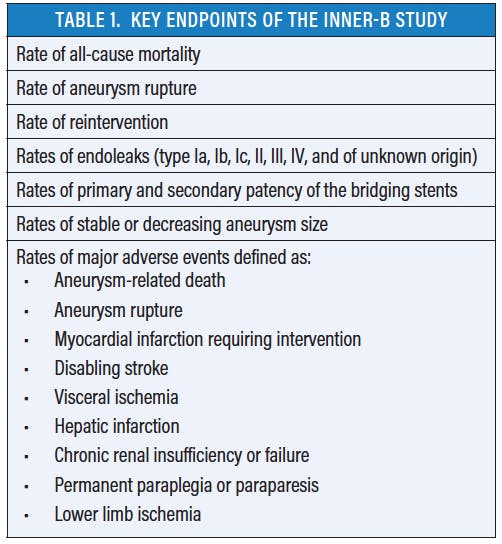
On October 29, 2020, the first patient in the INNER-B study on the endovascular treatment of thoracoabdominal aortic aneurysm (TAAA) with the E-nside TAAA Multibranch Stent Graft System (JOTEC, a fully owned subsidiary of CryoLife, Inc.) was treated at the Hospital Universitari Parc Tauli in Sabadell (Barcelona), Spain. The INNER-B is an observational, prospective, European multicenter postmarket clinical follow-up study sponsored by the German medical device manufacturer JOTEC GmbH. The primary study objective is to evaluate the prevention of death related to TAAA when treated with the E-nside stent graft. Furthermore, safety and clinical performance of the device will be evaluated as secondary objectives. Key endpoints are listed in Table 1.
INDICATIONS AND SPECIFICATIONS
The E-nside stent graft is indicated for the endovascular treatment of patients with TAAAs (Figure 1). It is the first and only off-the-shelf precannulated thoracoabdominal stent graft with inner branches. Technically, the device is a self-expanding stent graft with individual nitinol springs permanently sewn into a textile tube that is preloaded in a delivery system with an 8.5-mm outer diameter. Several radiopaque markers facilitate trackability during the deployment procedure. Additionally, two E-shaped markers simplify the correct positioning of the implant. The E-nside stent graft can be supplied in four different sizes by varying the proximal and distal diameters, thereby providing an optimized adaptation to the vascular segment to shield the lesion from blood pressure. Peripheral covered stents are used to connect the inner branches with the corresponding visceral vessels. Once connected, the four inner branches allow blood flow through the lumen of the E-nside stent graft to the celiac trunk, the superior mesenteric artery, and the two renal arteries. The E-nside stent graft offers the possibility to treat approximately 70% of patients who would have otherwise required a custom-made stent graft. Therefore, the E-nside stent graft eliminates the waiting period and allows for a fast aneurysm exclusion.
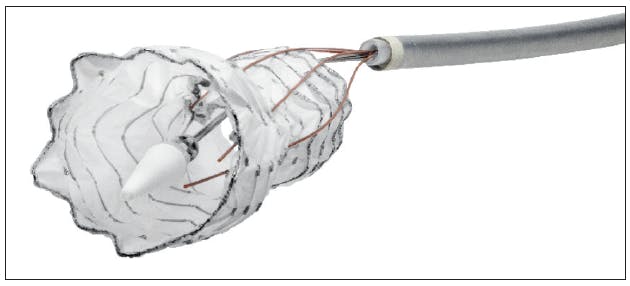
Figure 1. E-nside stent graft.
THE INNER-B STUDY
Prior to data collection, all patients participating in the INNER-B study are required to express their written informed consent to the use of their clinical records for study purposes. Patient follow-up occurs at discharge and at 30 days as well as between 3 and 6 months, and 12, 24, 36, and 60 months after the intervention. CT imaging files are sent to a core lab for an independent second evaluation. Source data verification is performed on 100% of the patients to ensure a high degree of data quality as well as compliance with pertinent regulatory requirements. The study is conducted in accordance with national regulatory guidelines and ISO 14155. The investigator protocol has been approved by all applicable ethical committees. Further information on the study is available at clinicaltrials.gov/ct2/show/NCT04383145.
“The INNER-B study has been designed to evaluate the clinical performance of the JOTEC E-nside stent graft under real-life circumstances. This is a milestone for the advancement of endovascular thoracoabdominal treatment, as no other clinical study with a similar structure has been conducted before,” commented Dr. Nilo J. Mosquera the Principal Coordinating Investigator of the study. “With its multicentric prospective design, core lab assessment, and 5-year follow-up period, the study pursues very ambitious and challenging goals, which will certainly provide robust data to thoroughly analyze not only the performance of the E-nside stent graft but also the benefits of thoracoabdominal endovascular repair itself. All principal investigators and I are excited about participating; this was clear since the first investigator meeting. We are delighted to see that the inclusion period has effectively begun with the very first study patient thanks to Dr. Antonio Giménez-Gaibar and his group and are looking forward to making this novel device accessible to our patients.”
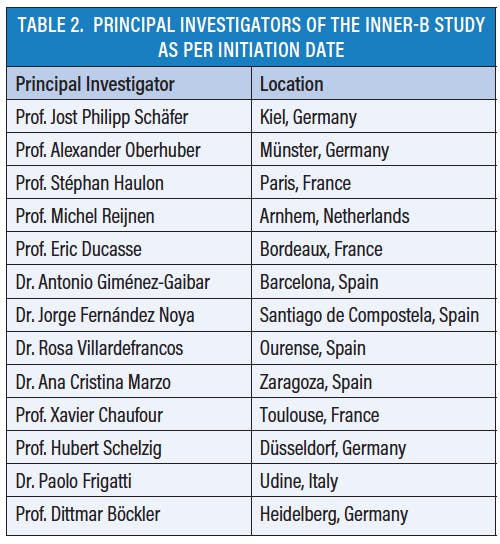
Since July 2020, 13 clinical centers in five European countries have been initiated in the INNER-B study. The principal investigators participate in the trial at their respective locations (Table 2). During the study course, 200 patients with TAAAs will be enrolled in approximately 20 centers within the next 3.5 years.
The First Patient
The first E-nside stent graft implantation in the INNER-B study was recently performed by Dr. Antonio Giménez-Gaibar and his team (Figure 2) on a 69-year-old woman. The patient was diagnosed with a Crawford type I TAAA that had previously been treated by partial supra-aortic trunk debranching with carotid-carotid-subclavian bypass and additional thoracic endovascular aortic repair (TEVAR). Two years later, CT imaging showed an enlargement of the descending thoracic aortic aneurysm with a type Ib endoleak caused by insufficient sealing between the distal landing zone of the thoracic stent graft and the aortic wall.
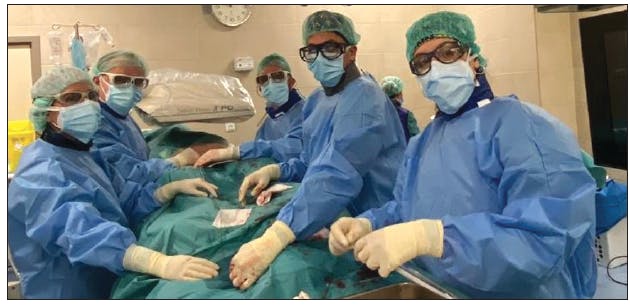
Figure 2. Implantation team from Hospital Universitari Parc Tauli in Sabadell (Barcelona), Spain.
In October 2020, she underwent revision surgery to receive the E-nside stent graft that was proximally fixated in the existing thoracic stent graft and distally in the abdominal aorta. The implantation procedure was free of incidents and primary technical success was achieved (Figure 3A and 3B). The precannulated inner branches enabled the procedure despite very tortuous anatomy. A month later, CT confirmed that the aneurysm was excluded from blood flow and no complications had arisen (Figure 3C).
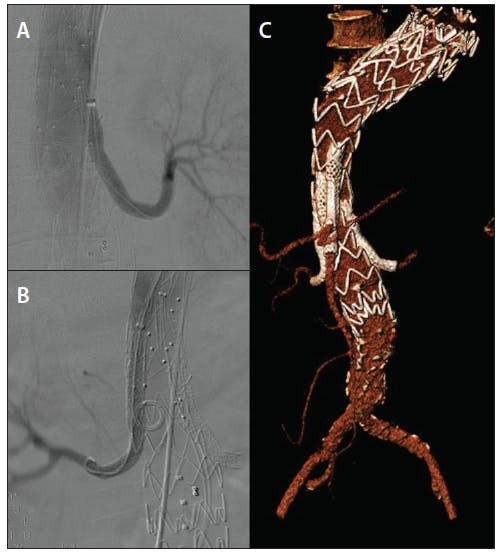
Figure 3. Perioperative angiogram (A, B) and CT scan at 1 month (C).
“The performance of the first implantation of the E-nside stent graft was very challenging,” said Dr. Giménez-Gaibar. “Indeed, the device fulfilled our expectations. The procedure went swiftly as the precannulation of the side branches saved us a lot of time. Additionally, the through-and-through technique enhanced the stability, navigability, and pushability of all devices. The off-the-shelf availability of the E-nside TAAA Multibranch Stent Graft System allowed for quick surgery scheduling and early treatment to minimize the risk of complications such as aneurysm rupture. The results obtained with this first patient are very encouraging, and we look forward to offering the benefits of the E-nside stent graft to more patients in the INNER-B study.”
CONCLUSION
The INNER-B study is estimated to be completed after 5 years of follow-up at the beginning of 2030. The first results will be published as soon as 200 patients will have reached 12-month follow-up.
Advertisement
Advertisement